Showing posts with label roundtables. Show all posts

Thursday, May 2, 2013

Two Pretty Ones on Their Film

The Pretty One at Tribeca Film Festival

Two Pretty Ones on Their Film

from brinkzine.com (5/2/13)


Zoe Kazan as Laurel (L) and Audrey
No actress gives more feeling to underdog young women as Zoe Kazan, which is why we always fall in love with her characters. This was true two years ago when she won the Best Actress award at the Tribeca Film Festival starring in The Exploding Girl. And it was true at this year's festival when one of the greatest indie actors brought tremendous sensitivity (and a lot of humor) to two characters in Jenee LaMarque's debut feature, The Pretty One, a quirky comedy with a touch of sadness. The two young women are identical twins: Laurel, a wallflower who remains home to look after her widower father (John Carroll Lynch), and the dynamic Audrey, who is a successful realtor and has men chasing after her. When Audrey is killed in a car accident, Laurel assumes her identity, moving into her apartment, working at her job, and dealing with all of Audrey's acquaintances--including Basel, the quirky neighbor Audrey detested (a bearded Jake Johnson from TV's New Girl) but she is attracted to; and her boss's husband Charles (Ron Livingston), who pursues her although Audrey broke off their affair. She tries to become Audrey so she can experience being "the pretty one" finally, but also as her way to deal with a terrible loss. Naturally she will have to face the dire consequences for her deception. I took part in the following roundtable with the personable Kazan and LaMarque at the festival, before any of us journalists had seen the movie. I note my questions.
Danny Peary: Jenee, I haven't seen your short Spoonful, which is also about sisters and a death in the family. So did this evolve from that?
Jenee LaMarque: It does share the sister aspect, and it's sort of darkly comedic in a similar way. It didn't come from it but it has a similar tone.
Jenee LaMarque
Q: Can you tell us a little about the writing process for this?
JL: There was a long writing process. This was actually the first screenplay that I ever wrote. I wrote the first draft when I was pregnant with my daughter who's now five, so it's been quite a journey. During the process, I went to AFI and studied screenwriting. I wrote most of the draft of the script when I was in film school, and then continued revising and writing afterwards. One of the wonderful boons for the movie was Zoe, who is not only a great actress and very funny but also an incredibly talented screenwriter. She contributed a lot as a writer and storyteller.
Q: Zoe, can you talk about your part in the collaboration?
Zoe Kazan: Sure. I asked Jenee for something that was above and beyond. I asked her to sit down and talk through the entire script with me. We had the luxury of having the time to do that. I came out to L.A. multiple times before we shot the movie and we would sit down and I would say, "Where did this line come from? " Or: "How funny is this supposed to be?" Or: "Is this moment supposed to be sad?" And we really talked through every moment of the script before we ever shot it, so I had a good idea of what Jenee wanted. And also, during that process, if I got to something that I felt was not going to sound right coming out of my mouth, I would ask to talk about it. Jenee was great about making revisions and also sticking by her guns when she thought we could make something work or if I didnt understand what her intention was. We did a good job of balancing that.
JL: I think Zoe and Jake Johnson also had great chemistry and could improvise off one another. There are some scenes where the way that they're communicating is very playful.
ZK: She really encouraged us to do that.
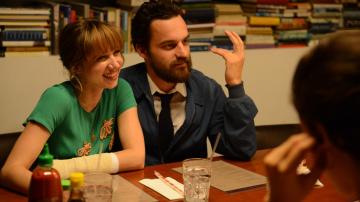
Zoe Kazan and Jake Johnson
JL: Yes, I really wanted them to follow the structure of the script, but along the way to improvise and make it their own. The moments that I find the most fun are those that I didn't plan to happen. The improvised moments are funny and real.
ZK: Having that freedom was really cool, because often first-time writers are really cautious about every word in their scripts. I know that I was with my first script for Ruby Sparks. We always tried to do justice to her script, so it was never about trying to make the script better. It was just about letting organic things happen.
Q: Zoe, because you were the screenwriter on Ruby Sparks, were you particularly attached to that movie?
ZK: Yeah, that was a very special experience because that was the first time I had written a script and I'd never been involved in something from start to finish like that before, and I was making it with my boyfriend [Paul Dano] and [the directors] Jonathan [Dayton] and Valerie [Faris], who have known him since he was a teenager. It really felt like a labor of love in a different way. But every time I do a movie, I think it has to be worth investing completely in and loving it like it's coming out of me. I didn't start writing because I felt I always needed to be in charge but because I felt I had stories to tell. I do that through acting, too. When I read Jenee's script, there were parts of myself that I felt I could address through her words better than I had been able to through anybody else's words before. That was a really cool thing. I think Jenee and I both connect on a personal level to the loss experienced in the film. I felt like that was a part of me that I wanted to be able to express. I also connected to the idea that these twins are sort of two sides of one coin. There's kind of a duality to both characters that was intriguing to me. Audrey is very forward and very confident but also feels some self-hatred. Laurel is buried inside of herself but also has creativity and joy underneath that. I hadn't been asked to do a lot of really sexy stuff on film before, and that's a big part of my life--I've always been a really sexual person. I went through a period of time when I was "sleeping around," and I honor that part of myself, rather than calling it immoral. And I was able to show the part of me that still feels like a gawky 13-year-old.' There's a part of me that's never going to feel pretty, and a part that's never going to feel like a grown-up, and I was able to give life to those parts of me and say they're beautiful too and worth looking at.
 Q: Playing the twin sisters, did you look to any other actresses who have done the same?
ZK: Well, Lindsay Lohan in The Parent Trap. She's so good in that movie it's crazy! I'm not saying that the movie is for adults, because it is not, but she's amazing in it! And after doing what we did in our film, I can't believe an 11-year-old could do what she did. Itas so insane. Also, I grew up on the Hayley Mills' The Parent Trap because that was one of my mom's favorites from being kid. I loved that. For me it was more about connecting to Jenees' world. Jene had a very specific vision. She knew what she wanted to do with the camera; she knew what she wanted in terms of tone. That's something that is really rare with a first-time director. So I was just thrilled that she wanted these things, and I was really trying to connect to that. I watch a lot of movies for inspiration, and I watched a a couple Jane Campion films and movies like that. Jenee turned me on to some videos this woman named Candice [Brieitz} made of identical twins who are posed in the same clothes. Jenee also gave me a reading on twins, explaining what it's like to lose an identical twin--that was probably more helpful than the movies.
Q: Since you play both twins, did you find it hard to perform opposite yourself? How did you get the timing right?
ZK: It was really hard, we had to work on that together.
JL: It's difficult. It took three times as long to shoot the scenes where she was playing both characters. She acted off of a body double, and it was trying to create a connection between the two of them. There's a lot of math and calculating. It's challenging because you create a performance for one twin and then you have to do a second performance.
ZK: And if my body double did something with her hands that was accidentally in the shot, I'd have to match that in my performance. That was hard because it limited me, and I probably became a little Napoleon on set. Do not do that with your hands! Because youre trained as an actor to be really generous with your scene partner and vibe off of what theyre doing, but I would be watching her with half my brain going, and thinking Is that going to be in there? It was a challenge--I got so much better at the technical aspects of building scenes after doing that.
 

DP: In The Exploding Girl and this film, you play young women who underestimate themselves. [Jenee nods] Did that appeal to you on a personal level and did you identify with them?
ZK: Yeah. I have to put on makeup for a living. It's part of what I have to do. I grew up essentially an enormous book nerd and I never felt I was the pretty one. I always felt like an odd duck. I think there are parts of yourself that you put away to become a grown-up. You protect yourself. But it's really wonderful in your acting to be able to bring those things out. I'm not a very shy person but there's a shy part of me and being able to let that part be is a relief. For instance, on The Exploding Girl, I didn't wear makeup throughout that whole movie, I did my own hair, and her clothes were mine. There's a release in feeling you're not the girl and don't have an obligation to be pretty. I really felt that on this film. We all go home and throw on sweatpants and take off our makeup and put up our hair up and we look like opossums. There's a part of all of us that doesn't feel good about ourselves and this movie deals with that. Audrey went out and convinced the world that she was beautiful and sexy and an adult. But there's a conundrum because all those insecurities also exist in her too, so how do we reconcile that?
JL: [I also see the two characters as two sides of the same coin. There's the part of us that feels insecure and scared and doesn't want to take chances--and doesn't deserve anything. And there's a part of us that's brave and goes out there and takes risks and maybe puts on makeup [to look prettier]. There's value in both sides. I'm not saying that if you're brave all your problems are going to be solved. That's not what this movie is saying. I think women deal with that sort of duality and ask, Where do I fit on the spectrum of being a woman?; and Am I going to choose to wear makeup or am I going to not choose to wear makeup? I hope that people honor both the sides. twins' father
Q: Zoe, what's next for you?
ZK: I shot four films last year, including this one, so I am seeking a tiny bit of a regrouping break. I didn't have any time to write last year because of that, so I'm just writing a bunch right now, I just finished doing a play here in New York. And then I have The F Word that I shot last year with Daniel Radcliffe coming out later. And, oh yeah, I wrote a new play. I'm going to workshop it at South Coast Rep in Los Angeles next week.
Q: Whats it about?
ZK: An affair.
Q: And what about you, Jenee?
JL: I have a baby due in August, so that is coming up next for me. I'm also working on a couple of screenplays, just the beginnings of them right now. I really focused on this movie for the last five years. It's such an honor to be here at this festival, finally putting it out in the world.
ZK: I'm going to brag about Jenee for a second. Jenee is just two years out of film school and this is her first festival. After it came out of Sundance, her script got put on the Black List and was a big deal. I think, Jenee, you've had a lot of pressure on you, and now it's really cool that you're going to go away and be creative again.
JL: Thank you, I'm really excited about that.
John Carroll Lynch plays the twins' father
 

Monday, July 9, 2012

The Girl Who Finally Said No

Trishna Is Playing in Theaters

The Girl Who Finally Said No

(from brinkzine.com 7/10/12)
TrishnaFPphoto.jpg Freida Pinto photo by DP
Michael Winterbottom's sumptuous Trishna, in which he transports Thomas Hardy's Tess of the D'Urbervilles from 19th Century England to modern-day India, was one of my favorite films at this year's Tribeca Film Festival. The scenery is gorgeous, the lovely Freida Pinto delivers a daring, assured, and exquisite performance in the title role, director Winterbottom breaks rules and takes interesting liberties with the novel, and the jolting ending is sure to be controversial. The result is that there should be lot of discussion on your way home. The film opens this Friday and I highly recommend it. The story of the ill-fated heroine will stay with you, as it does me. I took part in the following roundtables with Pinto and Winterbottom during the festival. I note my questions.
Roundtable with Freida Pinto
Q: When you go back to India, as you did on Trishna, does it shock you how little or how much has changed?
FP: It doesn't shock me because I grew up in an environment in Bombay where not everyone had the same opportunities that I had. I feel that Trishna is a perfect way to bring Tess of the D'Urbervilles from 19th Century England to 21st Century India, because you see so much urbanization and the onset of these educational systems because children want to be educated. Things are changing and it is happening at a fast pace, although it will take time until it trickles down to rural communities. It was actually shocking to see the changes that are already happening in rural areas. I would expect them to not happen because they're so far away from city life, but it has changed so much. You know, 21st Century India is so different from what it was in rural England even when Hardy wrote about it. It's happening much faster than it happened back then.
Q: You grew up in Bombay and in a very different class than Trishna. She is far removed from your own experience, so how did you connect to her?
FP: It was really difficult because of what you say. I never grew up in a situation where I had to be submissive, not just to men but females in my life. I had the independence and liberty to always make my own choices. I didn't know what the other world would feel like. So I started my research a month prior to the film starting. I went down to Rajasthan and spent time with a few families. Some of the families we actually used in the film. I met a lot of girls, all kinds of girls. There were girls like Chanchal, the really talkative one at the start of the film. They were kind of traditional but a little more outspoken than Trishna. And then there were girls like Trishna. I remember meeting a 16-year-old girl who was married and staying with his family. I asked her, "Have you finished school? Do you want to be educated?" She was like, "Yeah, I'd like to but now I've got to cook." She was not openly resentful of it. She had almost accepted that this was going to be her life from then on. Those are the kind of influences I brought to my character. Because that's when it struck me that there is a reality that exists outside of my own.
Q: Under what circumstances did you see this movie for the first time and what went through your mind afterward?
FP: Michael wanted me to see the film before I watched it with the audience at the Toronto Film Festival. Unfortunately, they burned a copy of the movie but the quality wasnt really good. I didnt want to ruin the experience so I stopped watching it. And I remember telling him, "Everything was too dark and I couldn't see anything." And he's like, "What? That was the feel of the film and you didnt like it?" And I was like, "I didn't mean that. But let's watch it at the premiere." When I actually watched it I looked at the way it was pieced together. Obviously, when you're shooting a semi-improvisational film you really don't know which direction the director is going to take it using the footage. It was really up to him on the editing table to decide what direction he wanted to go in, because we gave him all kinds of things to choose from. And what actually went through my mind after the screening was how everything he had said completely made sense. This was especially true when I wanted to have more of a say in what was happening with Trishna's situation, and he said, "Don't talk. Just be quiet and absorb what's happening around you. And we'll see how it goes." That now made the most sense because Trishna's passiveness as she absorbs pain, and her internalizing of it of it justifies Trishna's final act for me.
trishnatwointimate.jpg Riz Ahmed and Freida Pinto
Q: How would you describe Michael Winterbottom's directing style?
FP: He's very quiet but he's to the point. What I found amazing about his style of working was how unconventional it is. There are no Actions or Cuts. The camera didn't stop rolling as soon as the scene was over. It would go on to capture even mistakes because sometimes a mistake makes for a beautiful take. He was always encouraging his actors to improv on set, which is a leap of faith. A director has to really believe that they'll be able to do it and carry out his story. He was trusting and very welcoming to suggestions and very democratic on set. I can still hear him.
Danny Peary: Does Trishna ever say NO to a man in the film?
FP: Toward the end actually she says to Jay that she doesn't feel like dancing for him any more. And he kind of persuades her to do it anyway.
DP: Her passivity is really interesting.
FP: I needed Michael's help with that because it was really, really hard for me to keep quiet in a lot of situations. It was improv and Michael helped me quite a bit by saying this is probably where Trishna would say something or wouldn't say anything. That's the difference between letting the actor just play out the character and letting her own thoughts and own upbringing interfere with her character, especially when she's that passive. It was almost to the point that it gets disturbing
Q: Is the submission of a daughter to a father still true in India in every class?
FP: Not in every class. Definitely not in my family. Actually, down south in Kerala there is a matriarchal system. So, it's completely the opposite of what we would see otherwise. I think it really depends on the family, the extent of education in the family, and how much of the world they've seen. You'll find this kind of submissive situation in Trishna's lower-class society and also in the Rajput society, which is the rich and the royal family of Rajasthan. One of the girls I met was going off to get married. An arranged marriage. She used to ride a bike and have a completely urban lifestyle, and I was interviewing her and she said, "Oh yeah, this is going to be my last month at the hotel. I'm not going to be working here after that." I'm like, "Oh, a new job?" "Oh, no. I'm going to get married so I'm going to enjoy this bike riding for the last few months." I asked, "What do your parents have to say about it?" "Oh, my father wants me to get married." So, it doesnt really hold the same for all.
DP: Because you're a female from India playing a female from India, would you contribute anything to Englishman Michael Winterbottom's knowledge of the subject?
FP: Yeah. You know, I'm very happy that he went there before all of us. Even eight years before when he was shooting Code 46 and that's when he found Osian. He loves Thomas Hardy and his books anyway. I thought this would be the perfect place to shoot Trishna because he found the similar Tess. And he was very welcoming to suggestions that came from Riz Ahmed and me, especially from me because I am from India about my character, her passiveness and how she would probably possibly respond. Most importantly, how she would be with her father? There's a difference in how she would interact with her father and her mother. You know, she's never that open with her father. She never really has an open conversation with him. Not so much with her mother either. You know, the only person that she loves talking to are her siblings. That's the only level that she can actually relate to. Yeah, so Michael was very open to suggestions. And he already knew how he wanted Trishna to play out. So, it did help that I wasn't there telling him, "Oh no, she wouldnt wear that because thats completely not believable." He would just let me do it because he knew that I would not mess up.
SPOILER ALERTDP: Heres a question that you dont want to answer. Would Trishna kill herself even if she didnt kill Jay first?
FP: I thought about this so much and it's a really good question. I was very conflicted about whether she actually had to kill him. I was thinking that maybe she should just go back to her family and find another job on the farm. Maybe she should just do that. But then it struck me, this girl just had an abortion. You know how it is in villages. Everyone knows what everyone's doing. The word spreads like fire. She lives in a social situation where she's already looked down upon for what she's done in the past. She's brought shame upon the family. So, going back and living there is as painful as being looked down upon as someone dirty. It would be almost as difficult for her to do that as it is to stay with him. There is emotional torture, which rips her apart. But neither with him nor with her family can she really live again. I felt like she has so much strength in her, which she has used to kind of plow through all the situations she's been through. Maybe she can go that one extra mile and just live with this pain. But you never know actually with human beings, when they just flip and they just dont want to do it anymore. I would want her to be a survivor in this situation. But unfortunately--also because we were going according to the book--she does end her life. In the book she gets hanged, so it's a different thing. But her death is inevitable. I also feel like it's the death of her pain and suffering when she physically leaves the world. It's sad that she is always one inch closer to what she wants but she never gets it--whether it's the fact that she wants to complete her education or to be in love with this man or help a family.
DP: Or dance.
FP: Or dance. And that's the most important thing because the only time she comes alive is when she's dancing, even when she was in Osian with her family. So I almost feel like some kind of a death is almost inevitable for this character. Trishna is an unfortunate character. However, if I were playing her as Freida, I would do it so differently. I would go back to Bombay and find a career as a dancer or I would kill him right at the start of the film! I dont know. It's a tricky situation. I was rooting for her, I really was.
Q: She has the responsibility of earning the money for her family;her siblings depend on her, as do her father and mother. So when she kills herself, she essentially cuts them off of any financial aid.
FP: That is true. That's horrible. When she says goodbye to her siblings she pretty much knows that it's going to be very difficult for them to even complete their education. She's prompting them to just keep going, keep going, something that she couldn't do. And I felt that would be so damaging for a family because she was bringing in the income. But I was like, "Okay, this girl has gone through so much." Maybe this is the answer too. Maybe it is. I'm not promoting it, but maybe it is for her.
END SPOILER ALERT
Q: Tell me one thing you learned from Trishna?
FP: Just to say no when the time is right. Don't wait for time to fly by. Saying no,
even in situations in the film industry,
trishnapintohood.jpg Freida Pinto as Trishna
maybe with publicity, here you're asked to do certain things that you don't think are right for you or you can't relate to. Instead of beating around the bush, I think the best thing to say is: "I'm just not going to do it."
Q: How did your parents feel about you getting into acting?
FP: They were fine with it. They would be surprised if I did anything else because they knew I was dramatic enough when I was a kid. They had no idea what I was going to do when I grew up. I knew that acting was a passion but I never knew that a profession could be made out of it. I did not have a godfather in the industry or someone to guide me. I had none of it. So, I kept saying, Oh, I'm going to join the army, and then it was something else and then something else and then a wedding planner. So, they knew these dramatics would stop somewhere when I finally found my calling.
Q: I'm wondering if you think that beauty is something that helps you in your career or has it also been something where people have looked at you and said that she's really beautiful and we're going to use her only as a beautiful girl.
FP: It's funny because when my second film happened, none of the beauty questions even came up. I played a Palestinian-Italian journalist in Miral. So, I was just playing her as a 17-year-old girl and that question never really arose even though she is so beautiful.. In the Woody Allen film, yes, in playing a next door neighbor who is a seductress, that did come into the picture. But I feel it really depends on me, how I want to pitch myself when I go into meetings and how I want to play a character. I hate saying this, but sometimes they look for this "exotic" girl in the film. Then they'll send a script for an "exotic girl, " and I'd have two lines, which you can take
out without affecting the film at all. It's for me to say that the part is not for me.
Q: What's coming up next for you?
FP: I have two independent films that I'm working on at the moment. They're not really financed. I feel so passionate about doing independent projects and promoting them at Tribeca and other festivals that welcome independent films. I've been prepping for one of them since December. I really do hope it takes off. I wont say much because I know they want to make an official announcement before I open my big, fat mouth. It's contemporary, almost based on true life.
Q: What kind of prepping?
FP: Oh, physical prepping. It's not an action film even though I do physical prepping. But another film of expression, which is not necessarily just acting through dialogue but acting through body movements.
DP: Through dance?
FP: Yes.
DP: Like Trishna.
Roundtable with Michael WinterbottomQ: Did you see Roman Polanski's Tess?
Michael Winterbottom: Yes, I saw it when it came out and fell in love with Nastassja Kinski from that. Partly because of that, I later worked with her on The Claim. It was a western and the writer suggested borrowing a story [The Mayor of Casterbridge] from Hardy. She's lovely.
Q: Why did you choose to move the Hardy story to India.
MW: Because it's partly about a society in transition and change. In Britain, it feels like it's stagnating, which is a different sort of problem. In India, people's lives are changing a lot. A lot of people are improving their lives and trying to make changes in a world that is different from the one their parents grew up in. For all the people who make it, there are others who don't. There's the danger of falling through the gap between one world and the other. It's interesting because it generates a lot of stories that are simple but have big things at stake. Obviously the rural village community where Trishna comes from doesn't provide her with a lot of opportunities to express oneself as an individual. You're protected and safe as long as you don't venture outside; but as soon as it becomes modern and urban, all that protection disappears and you have to get what you want by yourself. There are still opportunities but the protection disappears.
Q: Did you like shooting there?
MW: I'd shot in India twice before and had difficult experiences. I'd actually shot in Rajasthan before and though we didn't have actors who the people knew, when we took the camera out we'd get three hundred people in the street following us. This time that didn't happen and I'm not sure why. It was quite challenging technically but most of the problems we anticipated didn't happen. It was easier in the hotels but even in Jaipur we were able to shoot this time. Maybe the economic changes have affected people and they have gotten more used to everything.
Trishnatwostars.jpg Riz Ahmed and Freida Pinto
Q: At which point did Anurag Kashyap come into the picture and when did you decide to have Anurag, Kalki, and Amit act in the film?
MW: Trishna likes to watch films and dance and the dance element was in from the very first draft of the adaptation; obviously cinema is part of Indian culture. Anurag himself I met at the beginning of the process of making the film, at the beginning of pre-production and he introduced me to Amit and Kalki. I always wanted the film to be in that world and had hoped to get real people to play themselves in a way but I didn't know Amit would be up for acting. He's actually quite up for that! And he's really good. Amit's quite shy but it was great because I'd never really worked with a songwriter writing songs for film. So it was really fun and sweet that we were able to have him in the film. And the dancers we met were great and they had parts in the film.
Danny Peary: You changed the accident at the beginning of the film from being her fault in Hardy's book to being her father's fault. I think it wasn't a minor change but affected everything that happens later. Did you feel that, too?
MW: Yes and no. When you read Tess, you don't really feel the accident is her fault. Of course she feels obligated to make up for that but I think she'd feel obliged anyway because she is the oldest daughter and she is who she is and has the possibility to help the family. It was more an expression of the character than what formed the character.
DP: I'm actually asking about the difference in the fathers. Because the accident is his fault in your movie, he feels obligated to her and does things like help her have an abortion without saying anything. He always gives her the evil eye, but she knows his weaknesses.
MW: Right. He is weak in that sense, but then again, in Tess, the father is weak, too. Maybe it balances out. One of the reasons I made the change was it was practical. In reality, in India we couldn't have her drive the truck. Women don't do that, it just doesn't happen. The family in Tess is much more marginal and he is much more feckless as a father and is a drunk. I talked to lots of drivers and this was a guy who actually, like a lot of people in India, is trying to make things better. His economic stage is going up before the accident. He has a decent house, his kids are going to school, he is paying off the jeep in monthly installments. It's like India as a whole is becoming better off. Until the accident. And she becomes the breadwinner and he feels shame because of where he is from.
TrishnaMWphoto.jpg Michael Winterbottom, photo by DP
Q: Something else that you changed is that you combined the two main male characters into Jay.
MW: It's tricky. I love Tess, but it's frustrating that Hardy makes such a clear distinction between Alec, her sensual lover, and Angel, her spiritual lover, because most people are both. I thought that in the movie it wouldn't be as interesting to have two black-and-white characters than one character who is wrestling with both aspects of why he is in love with her. Jay is someone who wants to be in love with Trishna and makes love to her because he thinks he loves her yet he has an armor of weakness. If you think about it, if he genuinely loves her he wouldn't make love to her. He's the owner of a hotel and rich and can make love to her without consequences, but for her as a woman and an employee, he should be able to imagine that he can't make love to her and have it all be fine for her. As soon as her fellow worker Chanchal is aware she has gone off with Jay, Trishan's position changes. Jay wants to be good but he's weak and spoiled.
DP: Basically everyone hates Jay by the end of the movie...
MW:..Good...
DP: ...and also at the beginning of the movie. But is he also a victim of the culture?
MW: He's a victim of his father in a sense. His father is infuriatingly strong and confident and has made his fortune. Jay, like Alec in the book, is a bit of a victim of that upbringing. He doesn't need to work or have a career, so he doesn't know what to do with his life. But it's really hard to have sympathy for a spoiled rich kid. You see that he is likable in lots of ways and could be a good person, but in the end he doesn't have the strength of character to carry that through. For me, he's the least clear character in the film. When Trishna tells him that she aborted their baby, that throws him. They don't communicate much. He falls in love with her but doesn't really know her, other than that she has a lack of imagination. Although in Bombay, they love each other in the moment, they come from two very different worlds.
He has an idea of her that her story of the abortion disrupts a little bit. But in the end that's not why things go wrong. When he returns from Britain, he has already decided to go back to Rajisthan and he sees this as being a good son who takes over his father's business. But he doesn't think what that means to Trishna. There, it's impossible for an incredibly rich person and incredibly poor person to be together. He basically forces her to go back to being his mistress and a worker who pretends not to be his lover. Although neither wants to acknowledge it at first, as soon as he turns her into his employee who is having sex with him on the side, as opposed to being his partner, he destroys their relationship.
DP: When you say Jay is not a clear character, did you intend him to be vague?
MW: I like that it's open to interpretation. I like the idea that you watch something and have to make your own mind up about what happens. It's not where this moment must be the moment when characters realize something or laugh or cry or whatever. I don't want one conversation to be where their relationship is destroyed but just one part of the process. I don't mind that people have different views. I like not having things scripted precisely; I like improvising and seeing what people do and then deciding what works.
Q: In that conversation when she says she had an abortion, he gets angry but just before that she accepted that he'd been cheating on her.
MW: Exactly. There's a double standard. He believes she's pure and simple because she has a different background than his.
DP: Did Feida understand Trishna right away or did she develop her?
MW: She did develop it through performing rather than a long time before, because in a way what's in the script is the story rather than the characters. The actors knew roughly what they needed to communicate, and Freida spent a lot of time talking with the real people in the film--the hotel workers, the dancers, and especially the young people in the family because she had to play scenes with them and know how to behave as a daughter in that family. She'd watch how the other sons and daughters and nephews in the house behaved. If you got actors from India to play those roles they'd have preconceptions about people behaved in that house but life is always much more varied and all the children behave differently and not a standard way.
DP: From talking to Freida, it seemed like she really thought about her motivation.
MW: I didn't have to worry about that! I let the actors do that!

Friday, April 13, 2012

Guy and Grace on "Lockout"

Playing in Theaters

Guy and Grace on "Lockout"

(from brinkzine 4/13/12)


lockoutposter.jpg
Okay, in the super-charged sci-fi thriller, Lockout, which is set about sixty years from now, a wrongly-accused, resourceful former agent named Snow agrees to a deal whereby he can avoid being sentenced for murder if he sneaks into a maximum security prison in space to rescue the president's daughter, Emilie. You see, while on a good-will mission, she was taken hostage by murderous, crazed convicts during a jail break. It's essentially Die Hard in Space, but if Bruce Willis isnt available, who are you gonna call? Well, Luc Besson and his cowriters, Irish directors James Mather and Stephen St. Leger, made an inspired choice in Guy Pearce, a cult star since The Adventures of Priscilla, Queen of the Desert and Memento, and just off his Emmy-winning turn in the mini-series Mildred Pierce. Pearce has made his mark in films with action, especially L.A. Confidential and The Proposition--where he played another character who can avoid prison by performing a dangerous mission--but he'd never played a full-fledged action hero in a blockbuster. The Aussie pulls it off admirably. What about casting the president's daughter? Leggy, blond beauty Maggie Grace, one of the original stars of Lost, had been a memorable kidnap victim in Besson's Taken, so she was an ideal choice to play Emilie--especially since she proved adept at engaging in comic banter with her leading man, like Irene Dunne and Rosalind Russell were with Cary Grant. She, too, proved to be suited for a blockbuster action film. In anticipation of the film's release on Friday, I took part in the following roundtable interviews with Pearce and Grace.
Roundtable with Guy PierceQ: What was the appeal of this character Snow that made you want to do the project?
Guy Pearce: His sense of humor, ultimately. I sat down with Luc Besson and he ran me through the project. He gave me a script and said, "There are two Irish guys that I've written this with and we're very keen to make sure this character is amusing and he finds himself amusing. He wanted to get back, I suppose, in that retro-sense to Bruce Willis-type characters we saw in action movies in the 1980s. I didn't want to go back and look at those characters and consciously plagiarize anything. I didn't want it to fall into that two-dimensional world of action heroes we've seen in the past. I found the idea interesting but I needed to make sure Snow wasn't just flippant for flippant's sake or insensitive about killing people.
Danny Peary: Do you think he is so insolent and cynical because of the negative way the world has developed?
GP: What clinched it for me about taking the part was that Snow has a humorous view of everything but only because he needs to bury some of emotions under it. I didn't delve deeply enough into human psychology because the movie didn't require it, but I think it's a combination of things that cause Snow to be as cynical as he is. His age is one. He's just getting tired of the work he is doing. And, yes, he's unhappy with the way the world is developing and the fact that we now have a prison that was thrust into outer space when obviously the prison system on earth is in dire need of reassessment. The planet is overpopulated and the prison system is clearly overpopulated. Those elements are interesting and surely Snow finds them disturbing under his armor of humor.
Q: What do you think of the idea of sending prisoners into space?
GP: It's a nerve-wracking idea, isn't it? We're all aware that the prison systems in America, and around the world, and at home in Australia don't work.
DP: Australia was founded by convicts, so its a bit similar.
GP: That's right, so you'd think we'd get it working. I think it's a sad prospect if we eventually say we have too many prisoners and not enough prisons, so start shooting them into orbit. And in the prison in the film there's no therapeutic rehabilitation, and that's the main concern. They don't learn anything while in prison. They're put to sleep so if they wake up it feels like just a minute after they committed their crimes.
lockoutpearcephoto.jpg
Q: How much did the actors know about the world of that time?
GP: I don't know how to answer that to be honest. I don't think the guys were interested in developing the world to great length. They just wanted to make a piece of entertainment, the story being set far enough into the future to establish a different kind of world but not so far that we can't relate to it. We all had questions about how the world would be at this time, but I imagine each actor delved into it at a different level. I thought Stephen and James were interested in the dynamic between Snow and Emilie and the extreme nature of the situation more than a real analysis of what the world would be like at that point in time.
Q: Your character isn't a stealthy spy. The minute he arrives at the space prison everyone knows he's there.
GP: That was a conscious decision to play it that way. We needed a prisoner to see him when he arrives on the ship. Maybe twenty years before, he might have been stealthier, but he just doesn't care much anymore. He's there to rescue his friend but doesn't really want to be there and doesn't really care about the president's kidnapped daughter. He's gotten to that point in this life where he'd rather be sitting on a couch at home, watching sports and drinking a beer. This all falls under the guise of entertainment in that it leads to a humorous situation. But when called upon, the skills of his past--his ability to fight hand-to-hand or use equipment--is something he can do blindfolded. He's clearly a skillful guy.
Q: We've seen you play tough guys before but never with this level of physicality. What were the challenges of doing some of the action sequences?
GP: That stuff is always challenging but funny enough it was really easy for me. I'm quite agile and quite physical and very fit and I really work from a physical point of view as an actor, anyway. Even if I'm not in fight scenes or doing stunts, my physicality is very present in my mind. That plays a big part when I am trying to put together a character like Snow. I don't take an intellectual approach and a lot of my work does come from a physical place.
Q: So were you working from the outside in?
GP: I wouldn't say it's as clear as that because I'm also trying to understand him from the inside, ultimately. I get so far from the inside and then I actually have to get on my feet and start moving around before I can answer more questions about him and delve deeper into him. I can't sit around a table for weeks and weeks discussing a play or the characters in a play. I need to get on my feet and move around before finding some of those answers as to who my character is.
Q: Snows a lone action hero, a single guy, but despite the constant action he and Emilie find time to begin a relationship.
GP: Because of their differences they get off on a particular footing with each other and there's bickering from the outset. That's obviously something we've seen through the history of filmmaking; it's a nice way to create drama between two characters who we hope on some level will get together. It's an entertaining way to bring their relationship to life.
Q: Do you think that relationship will last?
GP (laughing): It probably will. He is someone who needs to be challenged and she can challenge him as well as anyone can. And he clearly finds her attractive and there's some sexual chemistry between them.
DP: Talk about Maggie Grace.
GP: Maggie was a horrible, horrible girl. No, she was a delight. She's a very smart girl and we got along really well. It was really important for us to establish the relationship of Snow and Emilie and understand we were on the same page in regard to the disdain they feel for each other and the bickering they're engaged in. So she was great. And clearly she's a better dresser than I am!
Q: How long was the shoot?
GP: Nearly three months. It was basically October, November and December of 2010.
Q: How much impact did Luc Besson have during production?
GP: He wasn't on the set at all, other than at the beginning when he talked to each department to make sure that everyone was feeling good about what they were doing and indicating that if he could help he would. But I don't think he wanted to inflict too much of his style on the film. What he impressed on me was how impressed he was with Stephen and James and the short film they'd made, Prey Alone. All the work that Luc did was in the establishing of the script and he really wanted to allow them to do what they were good at doing. Having said that, the impression that I have is that he was far more present during post-production, throughout the editing. There were a lot of visual effects that they had to render for this movie and I think Luc was present for that period.
DP: I wonder on slow-paced movies if the pace on the set is slow, so conversely was the pace on set high-octane for this high-energy film?
GP: Not really. It didn't seem too rushed. There were some days when we had to whip through it pretty quickly but there was nothing out of the ordinary. And Stephen and James are Irish guys with great senses of humor so they were always up to taking time for a laugh and I think everyone had a good time. They were are aware of what they could create in post-production in terms of rhythm and energy and intensity of the work. There were some specific shots we were doing that we knew were going to be really dynamic, but generally things were serene. The first day was calm and the first day is usually the gauge of how the set will be.
Q: Can you talk about being in Ridley Scott's Prometheus?
GP: I really can't. I'm not allowed to. Obviously what's being posted on the Internet gives an opportunity for people to get a sense of some of the philosophies and ideas behind the film. We know there's a connection with the original Alien and with all the Alien films I guess, even though I find it difficult to connect 3 and 4 with the first two Alien films. Personally, I think Alien is only one worth look at, by far the best one. To label Prometheus as a prequel limits it. Ridley expanded it and expanded it and took it outside the realm of being just a prequel.
Lockoutthree.jpg
Q: Are you comfortable going back and forth between big and small films?
GP: I don't cut the pie that way. It's about communication and ideas and whether that comes about in a really low-budget, independent movie with a first-time director or a massive studio film with a highly-established director doesn't actually matter to me because really what I'm responding to is the feeling I get when I read the story. I am aware there is a difference and am aware that from outside there is a difference but that's never the driving force for me. With Ridley on Prometheus, he's able to make the world that we're in and the set that we're on feel intimate, connected, and small and you have time to get your ideas across and have discussions with him without feeling that the monster of a historic franchise is on your shoulders. You forget all about that with Ridley. And I can feel the same with first-time director, as on this film. I worked on a film that Drake Doremus just did that doesn't have a title yet. He's the guy who won Sundance last year with his film, Like Crazy. It's very low-budget and all improvised but wonderfully communicative. So in a way they feel exactly the same to me. I've worked on bigger films that were just terrible because we didn't have contact with anybody and were just dealing with somebody's assistant's assistant. I feel at a loss in that situation but you can also feel like that on an independent film. Some directors don't have the personality to deal with actors and so they'd rather have someone else tell you their ideas. If I don't feel like I'm communicating with the head of the beast I struggle.
Q: So the director is more important than the budget?
GP: Absolutely. You can be with someone on a small budget movie who can make it seem like a big project. Or someone on a big budget movie who is under pressure not to lose millions of dollars and causes more tension than on a little indie picture. Fortunately, that wasn't the case on Lockout, which was fun to make. It all depends on the people you're working with.
Roundtable with Maggie Grace
Q: You're becoming a regular in Luc Besson films.
Maggie Grace: I was in Taken and Lockout and recently finished working with Luc for a third time, on Taken 2. I wish I learned more French back in the Lost days because it would come in handy now that I'm working with him so often. It's such a joy being in his films and working with him and the same people over and over. It sometimes feels like we're a family or a merry band of travelers going to different countries. Taken was shot in Paris. We shot Lockout in Serbia. Taken 2 was shot in Istanbul. I'm glad Luc has come back to the science fiction genre for the first time since The Fifth Element. It's such a fun world with all kinds of opportunities. There's certainly a stylized world in the film but the movie is not pretentious in any way and it doesn't take itself too seriously. There are homage moments, genre references and inside jokes, and it's the sense of humor, especially between Emilie and Snow, that drew me to this. There's a combative sexual energy between them that I loved; there's throwback kind of feel to their relationship, not just of action films of the 1980s but of classic comedies.
Q: Since youre the veteran with Besson, did you give Guy Pearce advise?
MG: In no other context can you say that Im the veteran and not Guy! I wouldn't attempt to advise Guy on working with Luc or anything else in life. He's a smart guy. I'm so happy to see him come to the action genre for a change. I'm sure he's been offered many action movies but in this one his snarky, acerbic, dry sense of humor is well utilized. We need more of that in the action genre. It was a joy working with him. I'm a big fan of his work from Memento to The Proposition. He's always incredible but has not been given his due in many ways. I think it's because he's so mercurial that he disappears into the films and isn't noticed. When I was telling my family and friends I was cast in this movie, they said, "Oh, yeah, Guy Pearce, he's the one in...what was that film?" And I'll name his movies and they'll say, "That was him?" He just disappears into his movies.
lockoutgracephoto.jpg
DP: What about you? Do people know you mostly from Lost?
MG: More Taken now.
Q: You learned to speak some French for Lost. Did you have to learn any special skills for Lockout?
MG: Yeah, we had some combat training and work on the wires so we had to feel comfy up there because the schedule was so crazy once we started shooting.
Q: How was it physically being in this action film?
MG: I prepped a lot. But there are limits to what the president's daughter can do--it has to be within reason, right? That she can shoot is part of a joke--she's a Democrat--and is an indication that she's surprising.
DP: Because this is an action film, did you and Guy say to each other that you had to make all of your characters' intimate scenes count?
MG: Yeah, there was a sense that you had a limited amount of time to create characters who people will really care for. You won't necessarily have a full first act with characters sitting around living rooms talking so people will know who they are. We did have some time at the beginning where we could act things out and make a lot of changes and talk about what we wanted in each scene.
Q: How did you like having short black hair from the midpoint of Lockout?
MG: That was fun, although I don't know if I'll get my next haircut from Guy. We had a wig obviously but he may have gotten a few slices in there.
Q: Your characters don't develop much during the movie. So did you talk about a background story with Emilie from before she went on her mission in space?
MG: Yeah, Stephen and James had developed the story for a while, so they did have an idea of the lives the characters came from. We didn't cut anything from the script at the beginning.
DP: After the one female hostage is released, Emilie is the one female character left. So what was it like being the one female surrounded by actors and men in the crew?
MG: Luckily we had a pretty bad-ass producer named Leila Smith, so we could hang. She's quite amazing. There were also Serbian ladies on set as part of the crew. But yeah it was largely a male environment, which is a good portion of what my life has become.
Q: What do you want people who see this movie to take away from it?
MG: You know, if I'm going to be really honest, if you're looking for a message film, look elsewhere. It's really unabashedly a good time. It's unapologetic about that. It's a fun romp and a popcorn movie. And it's funny. That's what I was excited about when I read the script. Yes, it's a sci-fi action thriller, but it's funny.
Q: When you do something that is quiet and introspect and something like this when it's not that introspective, which is more of a challenge?
MG: I cried after gym class in middle school and was kind of Maggie Graceless so action movies always provide bigger challenges for me, although they are fun to make. It's fun to do gun training at the range or horseback training or work on wires. It does really inform me as a person. If I could do an action movie every time I have a breakup in a relationship, it would be wonderful. It's easier for me doing action than before because I'm working with the same people. I felt safe and there was a sense of community and we had a great stunt team. So if a more kick-ass heroine who comes along, I'll be prepared.
lockoutgracegun.jpg

Q: In Taken you were the kidnapped daughter who didn't do much; but in Lockout the kidnapped daughter gets to fight some. Are you hoping at some point to play the person who does the rescuing? Would you like to be a kick-ass action hero?
MG: I think that would be fun. I don't know if it's my goal in life but I'm having a lot of fun making action movies. It's kind of new for me because I was a Jane Austen-Jane Eyre girl growing up. My family is getting a kick out of this. I would love to play more empowered characters, maybe like Laura Croft Tomb Raider.
Q: Talk about Taken 2, where you do get to be the rescuer.
MG: We just wrapped about a month ago. It was crazy having Liam, Famke Janssen, and myself back. It was almost five years that we shot the first one, so that's a long time to wait for a sequel. It's really interesting what they've done. What happens is driven by a personal vendetta. The body count in the first one was thirty-seven and that did have consequences. In this one my character's parents are taken so I have to help free them. Trust me that it does make sense, it's not a coincidence. My character doesn't suddenly morph into a Nikita. Of course, I have dark hair there too. When she changes her hair color at the airport her actions change. She's a young girl who tries to cope with the circumstances. She's her father's daughter and rises to the occasion because she has the most compelling reason to do so.
Q: What about The Twilight Saga: Breaking Dawn Part 2?
MG: We blocked shots for the installments together. I haven't seen it. I again play Irina Denali, a vampire, who through a misunderstanding, is a villainess.
Q: Is there anything else on the horizon?
MG: I did a little film called Decoding Annie Parker, which is about finding a cure for cancer. I have a supporting role but it was something I really wanted to be part of. I said that whatever role they needed me to play, I'd be there.
Q: Will there be a sequel to Lockout?
MG: You never know. It was a lot of fun to make.

Saturday, February 11, 2012

Five Cool Women on "The Women"

Find on Video

Five Cool Women on "The Women"

(from brinkzine.com 1/10/08)

a1poster.jpg
The 1939 version of "The Women," directed by George Cukor, scripted by Anita Loos, and starring the marvelous and underrated Norma Shearer, Rosalind Russell, Joan Crawford, Paulette Goddard, Joan Fontaine, and Mary Boland is such a classic that diehard film fanatics may be resistant to the new version that goes into wide release this Friday. But writer-director Diane English (the creator of "Murphy Brown") has assembled an irresistible group of actresses that you-and I'm talking about men as well as women-may find yourself being to the theater to see Meg Ryan (whose husband has left her for a Sachs sexpot), Annette Bening, Jada Pinkett Smith, Debra Messing, Eva Mendes, Bette Midler, Carrie Fisher, Cloris Leachman, Candice Bergan, and Debi Mazar (as a gossip-spreading manicurist). At this Wednesday's New York press junket for the film, I participated in the following three roundtables, with Diane English, Eva Mendes and Debi Mazur, and Meg Ryan and Jada Pinkett Smith. I my questions:
.
Roundtable with Diane English
Q: How do you feel that comparisons already are being made between "The Women" and "Sex and the City" movie?
Diane English: We came way before "Sex and the City." My script was in existence even before Candace Bushnell had the idea for the series. But we're very happy to ride its coattails because we struggled to get this film made. The financing was really hard to come by because it has an all-female cast and we didn't have a television series to proceed it. We were ready before "Sex and the City," but it came out before us. That proved to be beneficial to us because they ran our trailer with it and introduced audiences to our movie.
Q: This film was associated with a lot of directors over the years. How did it finally come to you?
DE: Some great directors came and went because of scheduling reasons. Imagine putting all these women together in one movie. For the original movie all the actresses were under contract with MGM so they were assigned to the film. This was a whole different situation, just trying to get the women together when their schedules jived. And guess who was available to direct it? Okay, I'll do it.I just kind of took it on myself and then I cursed the writer every day I was directing the movie.
Q: What about the sheer moxie of re-doing a classic?
DE: It's always a challenge and a risk to re-do a movie that is beloved by many people. I did a lot of homework and discovered that George Cukor didn't particularly like the film he made. That gave me permission to re-imagine it. You can remake a movie if you have something new to say, and I think we did. So much has changed since 1939. The old movie was very negative toward women. It was very much women against women. The tag line was: "'The Women'-It's All About Men." Our movie is really about the women and it's a celebration of women. The story is the same, because it's universal: What happens when a woman finds out her husband has been unfaithful? The reaction of the women in the original starring Norma Shearer was, pretty much, glee. They took a lot of pleasure in the dissolution of her marriage. But our women rally around Meg Ryan. That's the big change. Because if you're modernizing it, you have to do more than put the women in modern clothes. You've got to change attitudes as well.
DP: Speaking about jobs. In the original, the women who are the idle rich don't work. So did you think it important to give them jobs to make it current?
DE: Well, one of them doesn't work. Debra Messing's character is one of those ladies who's looking for her thing in life and doesn't realize that being a mom is the greatest thing for her. Women have very big lives now-we're mothers, daughters, and wives, and have jobs, and have many options that make our lives more complicated. In the original film the women didn't work so couldn't so easily walk away from their marriages.
A22 The Women.jpg
Q: In the original, Sylvie is a nasty busybody who is actually related to Mary. Why did you separate them and give Sylvie the whole subplot of being a magazine editor?
DE: In the old film, Rosalind Russell was the Queen Bee backstabber. I crafted Annette's Sylvie in a very different way. I was much more interested in when best friends break up than when a man and woman break up. That was another spin I put on the movie. A breakup between friends can be even more painful, so in the writing I had to craft a very strong friendship between Mary and Sylvie so that Sylvie's betrayal of her has resonance. I wanted you to care more about whether the friends get back together than if Mary lets her husband back into her house.
Q: Did you want Eva Mendes's character to be a stereotype of a Latin spitfire?
DE: Sure, I wanted to create a stereotype! That was my intention! No, not at all. We auditioned lots of actresses for that part and it just happened that Eva, who is Cuban-American, was the right one for the role. So, why not cast her?
Q: What was it like coming from television to make your first feature, starring many film actresses?
DE: Actors go back and forth. On "Murphy Brown," we'd have great actors like Colleen Dewhurst, so working with movie actresses wasn't intimidating to me. But it's different, no question about it. Television is such incredible preparation for directing a feature. The show-runner on television is the one who makes all the decisions the director makes when making a feature. Having a hundred and fifty people in the crew staring at you and asking what they should do can be very daunting to someone directing a feature for the first time, unless they've had similar experiences. There's no borderline now between television and movies. But boy, you get a lot of toys when you direct a feature. We couldn't afford them all but we did get a crane. I used to deny cranes to my directors on television because they were too expensive. But the first thing I said I wanted was a crane and I wanted it twice! Now I have empathy. It's really nice to have a crane. We had a steadicam, a hand-held camera, a helicopter; we had some bells and whistles. We didn't have trailers so we had to sit on chairs to the side. We tried to put all the money on the screen. The budget was only $16.5 M. We went into production with $15.7 M. We seemed to be doing well with our dailies so they gave us a little more.
Q: What was the biggest challenge?
DE: It was shooting in New York City. Our first big shot in the movie is a crane shot on 5th Avenue between 49th and 50th. We had twenty-five production assistants stationed on each corner trying to keep men out of the shot. And you know that in New York nobody wants to be told that they can't walk from here to there. So we'd just about get it right and then...a bicycle messenger would pass through. And we'd stop and get on the walky-talkies and ask if it was a male or female messenger. Male. In this film, even the dogs are female. So we'd set up the scene again.
DP: Have you had or do you anticipate having a different reaction from men and women?
DE: We did have that anticipation, but something's happening that we weren't expecting. We've previewed the movie for what is called "integrated audiences"-and women bring the men. We see them come into the theater moaning and groaning and wanting to sit in back so they can leave early. But it turns out the men love it, sincerely so, especially the end. There are a lot of teary-eyed men at the end. That was a surprise.
Q: People say women don't go to movies. Do you think "The Women" can prove them wrong?
DE: The whole reason to make this movie was not only to put women up on the screen, where they often aren't, but also to bring them into the theaters. Because it is the conventional wisdom that women over twenty-five don't go to the movies. But guess what? "Sex and the City" did double what anyone thought it would do in its opening weekend. "Mama Mia" did the same thing. To some degree, so did "Sisterhood of the Traveling Pants 2." Now it's our turn, hopefully. It's so important that if women are interested in seeing this movie that they go on the opening weekend, because that's when it's determined how long they'll keep the film in theaters. We want men to come to-it's not a man-bashing movie; we embrace men, too. We don't want this film to be a fluke hit; we want it to set a trend.

Roundtable with Eva Mendes and Debi Mazur
Q: Eva, what was it like to step into Joan Crawford's bubblebath?
Eva Mendes: That's a good way of putting it. I knew by accepting the role I was going to get a lot of criticism. But I was not going to try to please anybody. And of course, I wasn't going to try to emulate anybody-of course, she's Joan Crawford, for God's sake. Once I thought like that, the pressure was off. Diane and I came up with a different spin on the character and we made her less a vixen and more desperate and pathetic, which I had a lot of fun with.
Q: Did anything surprise you about working with an all-female cast?
Debi Mazur: The press junkets are really fun! We had only thirty-six days to shoot a movie, so we arrived to be in the movie in our characters, ready to go. So it wasn't like we had time to sit around discussing our periods. We were there to do our jobs,
A2 The Women.jpg
like on any other movie. The lead actresses had a little bonding pre-shooting session in Martha's Vineyard with Diane where they really discussed their characters and tried to tried to modify an old script and keep it modern.
Q: Playing the character, did you worry what Latin people would get upset?
EM: I can't put that pressure on myself. I can't worry about representing Latin people all the time. But I think they'll be proud that I played a character named Crystal Allen. Diane didn't change her name when I got the part.
Q: Has any female ever done to you, what you do to Mary?
EM: It has happened, not so blatantly. But I'm not a vindictive person. People think I'm fiery but in those kinds of situations I actually become very, very methodical and dangerously quiet, and I keep you closer than you should be.
Q: What do you think makes the bind between women becomes so strong?
DM: I don't believe men-your husband or boyfriend-need to know everything. I talk to my girlfriends more on a private level. Women ground each other. We can talk about everything. We give birth, we're a different animal.
EM: Well, I think we're the better species! Seriously, there is a sisterhood in my life that exists between my girlfriends who I've had since seventh grade that no man can come between. It's a great feeling knowing your girls are going to back you up no matter what. They will love you even when you're a total moron.
DP: When we met on the set of James Gray's "We Owned the Night," you said you went home and suffered every night. Did you suffer at night while making this film?
EM: Yeah, but I suffered with Joaquin Phoenix and James Gray. I loved suffering on that film but that was fitting for my character. That film was completely different. "The Women" was fun to make! It was just me and the girls. And it was me being fearless. You may think, "Oh, this is just a sexy character," but no, there had to be a sense of fearlessness to play her. It takes balls to play a character like her because I had to be okay with people not liking me. I went to the premiere and saw people's response to me. They were horrified. If they had tomatoes, they would have thrown them at the screen. I was fearless and had fun, and I took nothing home with me.

Meg Ryan and Jade Pinkett Smith Roundtable
Q: How frustrating has this journey been for you, having been attached to the film from the start?
Meg Ryan: You're giving me a lot more credit than I deserve. What it takes too be "attached" is zippo. It's Diane English who deserves the credit. For all those years, it would come together and fall apart and come together and fall apart and she had the same level of enthusiasm all the time. It was incredible to behold. She just loved the project and somehow it just all came together last year. Suddenly we were ready to shoot. We knew we had very little money and only thirty-six days to shoot.
Q: Jada, what was it like playing a lesbian?
Jada Pinket Smith: I loved it. I have a lot of gay friends but didn't need advice. It's been part of my world for a long time. I grew up in a huge arts community.
Q: Meg, what was it like to work with Candice Bergen?
MR: She was in my first movie, "Rich and Famous," which was directed by George Cukor, who made the first "The Women." I couldn't remember one line. I hadn't really seen her from then to now, so it was quite a little journey we've taken.
Q: What did you think of the original 1939 movie?
JPS: My mother loves the original one. She and my aunt went threw the roof when they found out that I might do the remake. What I liked about this new version is that Meg's character Mary can look at her situation and actually take responsibility for her happiness and pain. It's not only about pointing the figure and blaming her husband, but asking herself what she did wrong, too.
a1english and mendes on the women.jpg
MR: I love the original. I saw it a really long time ago and then purposely didn't see it again in anticipation of being in the remake. What I remember is how campy it is and how much fun it was to watch. The women all seemed to be having fun together. What I didn't want to do was that "noble suffering" that Norma Shearer did. I love that Mary in this version suffers in a messy way. She finally has to say to herself, "How did I help bring all this on myself? My father fired me from the business. My husband is cheating on me. My best friend is betraying me. I'm a failure as a mom. I don't know who I am." She gets into a crisis situation and realizes that she has to make some changes in herself. I think that's a modern view. It's also modern that the women need each. That wasn't really true in the 1939 version, where everyone is enjoying each other's misery.
Q: On the 1939 film, the cat-fighting back stage was legendary. It seems like there was a big love-in on this film. How did it happen?
JPS: It's the new woman, who takes a modern approach to how she sees herself and relates to other people.
MR: None of us knew each other more than casually, but during rehearsals we immediately got how we were all really different and we all had something to say that was different. By day two, we were all sharing ideas about what each other's characters should be doing! It was fun realizing we're different comediennes and have a real serious respect for one another. The secret joy of the whole experience was to watch how Annette Bening and Debra Messing did things. They were free to interpret their roles as they wanted. And I'd say, "Wow, how did they do that!"
Q: Was there anyone you worked with whom you always wanted to work with?
JPS: For me, it was wonderful to have the opportunity to work with Annette. In the scene we're all the car and I found myself getting caught up in watching her and I'd have to remind myself that I was in the scene, too. I'd have to snap out of it. I'd have to catch myself several times. She's such a veteran and she's seamless in her performance.
MR: There's a scene with the four of us where Sylvie confesses what she did to Mary and cries. That scene took sixteen hours to shoot because of all the camera angles and she cried ever time. She is a pro and unflappable. She's amazing.
DP: I think a key line in the film is when Mary's mother, played by Candice Bergen, tells her that her regret in life is that she didn't accomplish anything. Did that line resonate with you?
JP-S: That was a powerful line for me. That was one of the moments that really struck me. I know women in my life who get to forty and feel like that. They wonder where all the time went. Every day I wake up so blessed in every way. I've made good choices and bad choices and I feel you can't have success without failure. You've got to get up every day and grab the reins and go for it. And I'm just happy I've had the pitfalls I've had and happy I've had the success I've had. I embrace it all. If I left this planet today, I would leave fulfilled because I've done everything I've wanted to do up to this moment. If you talk to me tomorrow, there might be something missing. I've experienced everything I've wanted to.
MR: When she says stuff like that I want to stand up and applaud! I have to say that I also feel like a very satisfied and very happy person. However I've gotten there, and I've had ups and downs, I feel grateful.
A1beingryan The Women.jpg
Q: Is there a difference working with Diane than the male directors you've had?
MR: I don't really think so. I've been directed by a lot of women who have masculine approach and a lot of men who have feminine aspects. It's not gender-specific. The difference in working with a woman is that you're the protagonist and they're interested in what your subtext is. With a man, you're more likely an object.
JPS: I did feel there was a difference. With Diane, there was an ESP thing, a fluid communication that went on. She could give me a look and I'd understand exactly what she needed from me. Sometimes I find it difficult when a male tries to explain to me his perception of what a female would do in certain situations. And I'd be skeptical. But with Diane it was different. And working with Cher when she directed "If These Walls Could Talk" for HBO was different, too. She wore a different outfit and changed her hair every two hours. I loved it. I love working with women because of the common language we share. Which isn't to say I don't also love working with men. Because with men, we have to dive in and dissect everything and we always learn something about one another. But I'm glad to be in this movie to support Diane and films directed and written by women. What I've learned most having written and directed by own film,"The Human Contract," is that you really have to understand the business and how it works to have real success. It's not enough to be a creative force--you have to get on the inside to make important change. I watch my husband. He understands the industry as a whole so he can manipulate it. So I think, "Okay, I'm going to do that. I'll figure this out." Because it's really not rocket science. It's doable, but we have to be smart about it to get more of these films made. We're still trying to figure it out. "The Women" will tell me a lot, coming after "Sex and the City" and "Mama Mia." If it does as well as I think it will, then I'll talk to you about my formula for the future.
dannypeary@aol.com