Showing posts with label Tribeca Film Festival. Show all posts

Wednesday, May 8, 2013

Beware of Big Bad Wolves

 
Playing at Festivals

Beware of Big Bad Wolves

5/8/13

 Aharon Keshales (L) and Navot Papushado
Photo: DP 

I saw Aharon Keshales and Navot Papushado's Rabies on a whim at the 2011 Tribeca Film Festival and afterward I tried to coax everyone at the festival into seeing it.  I'm not sure if they wrongly believed it was about rabid dogs--rather than vociferous and dangerous human hunters and prey--and weren't intrigued that it was being hailed as "the first Israeli horror film," because no one seemed interested.  So I was a bit surprised that the writer-directors' new film, Big Bad Wolves, was one of the most anticipated films at this year's festival.  I guess after Rabies, about a maniacal killer threatening several unusual characters in the woods, played in about fifty international festivals and was lauded by horror-movie critics and word got out that Keshales, a film theory professor, and Papushado, his former pupil, should not be included among the new generation of horror-filmmakers who emphasize gore over content and characters. In Big Bad Wolves, Miki (Lior Ashkenazi), a brutal cop, and Gidi (Tzachi Grad), the even more brutal father of a young girl who was kidnapped and beheaded, torture Dror (Rotem Keinan), a suspected pedophile, into making a confession for the crime.  It sounds like shallow torture porn, but from the first shot of the film, it's clear that these filmmakers know and understand not just horror films but every other kind of movie, and their new work is an exercise in putting film theory into practice.  It is sometimes hard to watch and to defend, but refreshingly there is rhyme and reason behind everything that happens in this movie, and significantly, the brutality is meant less to excite the senses than it is to stimulate the mind into thinking about serious political and social issues--and to question our own morality.  This is confirmed in the following interview/conversation I had during the festival with Keshales, who lives just outside of Tel Aviv, and Papushado, who lives in the city.
Danny Peary: Perhaps because Big Bad Wolves is essentially about three immoral guys, it reminded me of Sergio Leone's The Good, The Bad & The Ugly. Leone's title was meant to be ironic and his film could more accurately be called, as your film could, The Ugly, The Uglier & the Ugliest.  I thought my comparing the two films might be off-the-wall because your film isn't a western, but I just heard you tell the previous interviewer that it's your favorite movie. Aharon Kehales: Yes. I think Tuco [played by Eli Wallach) is the best-written character for an adventure film that I’ve ever seen. You know, none of the three characters has an origin story or history, but Tuco is the only one with whom you get a glimpse of his other life.
DP: Well, the Man with No Name/"Blondie" says nothing. Clint Eastwood plays him so he's handsome, but he's actually a ruthless, greedy killer; Eli Wallach's Tuco is very funny but he's committed every crime including murder, and Lee Van Cleef's black-clad villian "Angel Eyes" is evil through and through. Three bad guys, with varying degrees of badness. But I don’t know if you were thinking of your movie in that way?
Navot Papushado: We didn’t want to call it Big Bad Wolf, we wanted to call it Big Bad Wolves, and that really relates to what you’re saying. It was very important for us to portray all three men as complex with shades of bad to them and shades of good to them and in the end no one is clean.
DP (laughing): I don’t know if they have shades of goodness. Very, very little.  They like their daughters, that’s about it.
AK: That’s a basic thing in Israel, the familial trait.  There is horrific stuff but family is always in the center of the Israeli identity. We’re always doing stuff and we justify whatever we do with our kids, and the future of our kids.
DP: Your pre-title scene where three kids playing hide and seek in slow motion is the best sequence I've seen in the entire festival.  I was thinking Leone, Brian De Palma, Sam Peckinpah, and having seen Rabies, I was thinking you guys. When did you decide to have a pre-title sequence?
NP: I think it was a very early stage that we decided we wanted to do something which would be stand out.  
AK: We put a lot of effort into that first scene, because we wanted to set a specific tone for the first three or four minutes, before it escalates into another kind of story. You have this fairy tale opening, slow motion, very beautiful, very innocent, and then something wrong happens and you deteriorate into this very sick fairy tale.
DP: There's a sense of menace and we know something is going to go wrong.  We wonder which of the kids something is going to happen to, and we know it's a bad idea for the girl to hide behind a door in an abandoned building.
NP: With these kids, there's something that is almost innocent but it’s the opposite of that. In the early stage of the script we got the idea for this hide-and-seek scene that would establish that even the most childish games could have, as you say, a very menacing tone to them. It would be very beautiful, very poetic and dreamlike, and then we'd bring reality crashing into it in the second scene. It switches very fast to very brutal when the cop Micki and his two thugs interrogate the suspected pedophile. 
Lior Ashkenazi and Rotem Keinan

DP: I just watched a video of you guys being interviewed two years ago while you promoting Rabies at the Tribeca Film Festival. You were talking about how your next film was going to be a very violent kidnapping film but not a gore film. Did you know what the whole film was at the point, and just weren’t telling people?
AK: We started off wanting to do not a drama per se, but for the script to be very dramatic. We wanted to do a film about a suspected pedophile, and do it from his point of view. Because all the time in this kind of movie, you get the fathers' or vigilante cops' points of view, and we wanted to tell the story of a suspected pedophile whose life is being shattered by suspicion. His wife stops talking to him, he can’t see his daughter, he’s fired from school, and the police think he's guilty of murder.
DP: Don't give away the ending, but when you were just conceiving the storyline, were you thinking that the suspected pedophile would be innocent or guilty?
AK: [We wondered if] the script would have more depth in it if it turns out he did do it.  What if in the end you know he did it, but still you ask yourself very important moral questions in regard to the torture: Does it make any difference whether he did this horrific stuff? Is the torture justified either way?  
NP: A lot of producers and people who invested in the film, said "Okay, if he didn’t do it, then it’s morally wrong what the father and cop do to him and the impact is not that strong." If you’re questioning if it’s okay to torture an innocent man, of course the answer would be no, it’s wrong. But is it okay to torture a guilty man? Now you have a really moral question that we wanted to raise. The ending provides comic relief in a twisted way, but we really wanted to change the tone at the end to something very dark and very...
AK: ...haunting.
NP: Yes, haunting. We didn't want to release the audience.
AK: It was agreed by us, as directors and writers, that the whole point of the movie is morally twisted.
DP: As an audience member, the major concern is: do we want the man being tortured to be guilty?  Or would it be better [and a stronger indictment against torture] if the two torturers go to jail because he turns out to have been innocent and they were wrong?  As I was watching the movie--and I can even say this now without giving away what really happens--I was guessing you'd have him turn out to be innocent but that after being tortured to death, the police, while celebrating his death, get another phone call from the real killer.  [When I name my suspect, they both laugh.] As an audience member, you’re putting us in a real interesting situation. Do we want him to be guilty or do we not, because he’s being tortured?  So what do we want and who do we want punished here?
NP: That is, I think, the most important thing, what we wanted to nail.  The way you described your feeling watching the film is the biggest compliment for us because we wanted to put the audience in a very tough, difficult position. Okay, you’re having fun, but seeing the most horrific scenes. You’re laughing at what shouldn’t be very funny. We actually got a few responses from people in the audience who told us, "You’re making us very uncomfortable enjoying something."
DP: And then again no longer enjoying it.
NP: And then no longer enjoying it, and being punished for having enjoyed it.
AK: We’re covering very taboo ground, we’re dealing with a very delicate subject matter. I think if we did it the easy way, we’d be cutting ourselves some slack.
DP: When you say delicate subject matter, do you mean the pedophile angle or torture?
AK: Both are really delicate, but child molestation and abuse is a very serious issue, yet we have a lot of jokes in this film. You have to deal with this subject with delicacy, and then when we have our ending, which is thought-provoking, we think it justifies our means, the action of the film.
NP: We didn't want it to just be: mystery solved.
AK: I think the more interesting question is: do we really care if he did it or didn’t do it? Is that the big question here? Because everybody asks us, Why did you make it a mystery thriller and not only torture porn?
DP: But I think you have to care where he’s guilty or not.
NP: Of course.  But after you ask yourself if he guilty or not--which is of course the most interesting question--you also must ask, if it turns out he killed the girl, will you be okay with what the dead girl's father and cop did to him to get a confession? You know you want the answer, but do you like the answer you’re getting?
DP: You were talking about pedophiles as the main issue, but torture itself is such a big issue, I don’t know if you intended to make this political at all, but your film shows that you can torture somebody to an unbelievable degree and you’re still not necessarily going to get a truthful answer from him. Yours is the rare narrative film to do that.  Superheroes or Kiefer Sutherland on 24 won't talk when tortured, but this suspect is a real person and somewhat mousy.
AK: We don’t do political stuff in a very direct way, but we love to throw in hints and obscure metaphors about what we’re talking about.  We are talking about torture, we are talking about a country that tortures people, and we are talking about a country that has a guilty conscience about doing that stuff.
NP: We have characters with military pasts, including the dead girl's father and his father, too.
AK: So you have an understanding of their psyche and the way they were brought up and their military service--and an understanding of how Israel is a very machoistic society. When we talked about doing this film, we decided to do a revenge or torture film with a guilty conscience, because that’s the way we Israelis are. We do stuff and we try to justify our means and then we have a guilty conscience about everything.
DP: One of the interesting characters is the Muslim guy who rides around on a horse. Whether his appearance is meant to convey something deeply political or not, it does.
AK: He’s the film's white knight. I remember talking with Navot about the first scene in which he appears and he and the father smoke a cigarette. We wanted to have a movie-western thing between an Arab and an Israeli guy, looking like a cowboy and Indian smoking a peace pipe, in a film that is all about brutality and violence.
NP: You really expect something bad is going to happen.  They mention the Arab villages around the father's house in this very isolated area, and when he rides up there are thesebrutal things going on in the basement. So the audience wonders, "What is this scene leading to?" They expect something brutal but it's a beautiful scene.
DP: They all get along.
NP: They all get along, and later the Arab brings the phone to the Israeli cop. He’s like the knight in shining armor, just helping. That’s kind of the representation we wanted to have, and of course the actor is Arab, Kais Nashef, and we talked about what it meant for us to put an Arab guy in this movie. All the other characters are Israeli and they’re doing horrible, horrible stuff in the name of our sons, in the name of our kids.
DP: And they’re all bad fathers.
NP: They’re all bad fathers, and then you have this Arab guy. He's a pretty normal guy, he even has an iPhone.
DP: There is so much torture in this film and you made an obvious attempt to balance it with humor. When you were story-boarding this, did you actually say, "We'd better put some humor in here and in here?"
AK: Yeah, when we see this kind of film, we think they’re always lacking in humor. And after fifteen minutes we say, it's going to be like that the entire film now, just torturing, torturing, torturing.  You have to breathe some new air into the film every five or ten minutes, so it won’t be exhausting for the audience. And also you want to put them in an uncomfortable place where they ask moral questions, and I think humor helps them do that.  Because when we see a guy torturing another guy, and then he talks about BBQ, you have to laugh.  And then you're like, "Why am I laughing? I shouldn’t be laughing at these kind of jokes." And this is where we aimed.
Tzachi Grad
DP: You have torture, torture, torture, and then the father gets a call from his mother.
NP: He has a Valkyriean ring tone. He's a Jewish guy with Wagner as his ringtone. But we also used comedy to lure the audience into very unsafe terrain.  You feel safe, it’s okay to laugh, but now...
DP: You use humor to make us feel more at ease because otherwise the brutality would be too relentless. That's hard what you're trying to do with humor balancing brutality.
NP: Yeah, definitely. Aharon was talking about how all these torture porn films make you put up shields.  You know you're going to see a lot of violence and blood, so you take a step back as a defense, to keep from going too deep into the situation. We feel that  when we inject comedy the audience puts down its shield and then we hit it. It’s more effective that way.
DP: The humor is also the alienation technique, so that we know we're watching a movie and that makes it less scary.
AK: That's right.
(L-R) Keshales, Ashkenazi, Papushado
DP: I think one of your strengths is writing females. I think the females in Rabies are great characters.
NP (laughing): But where are the women in this?
DP: They’re all on the phones and are nags.  All of these men, even the Arab, have to hide from their wives that they smoke.  
AK (laughing): That's my father hiding his smoking from my mother.  I got it from there!  We wanted to do a really male film, a male-oriented fairy tale. I love what Peckinpah did.  I wanted to do that. But we had in mind that if there was a matriarch in the film who we'd show witnessing all this male brutality, she would probably put an end to it. But this film has only males in it [and the brutality continues], and if you think about it, in a male-dominated society like Israel, you relate more to men, not to women.
NP: We didn’t want any tenderness in the film, because otherwise you have an excuse to lay off the violence.  And women add to the tenderness. We didn't want to put tender relief in the film, because, as Aharon said, if the Gidi's nagging mother showed up at the house, she would probably say, "This is wrong, stop it, I have to clean."
DP: You think that’s going to happen when Gidi's father [Dov Glickman] arrives, but he's ex-military and obviously torture is part of his world.
AK: It runs in the DNA.
(L-R)Dov Glickman, Grad, and Keinan
DP: But before there is more torture there is deliberate funny stuff with father and son---them sitting and having the mother's soup, which is a Jewish thing--we sit and have our mother's soup all the time.
NP: Chicken soup!  Speaking of Sergio Leone, we had Ennio Morricone on the soundtrack as they ate their soup.
DP: Talk about the music. Most people who make horror movies don’t care about music but you obviously do.
AK: We wanted it to be like a fairytale, so we asked our composer Frank Hayim Ilfman, who also did the music for Rabies, to write something that is like Bernard Herrmann’s music for Vertigo, and Carter Burwell’s work with the Coen brothers, which is a magnificent body of work. We told him we wanted Herrmann and Burwell doing music for a fairy tale by the Grimm brothers.
NP: Israeli films are always underscored. It's usually just synthesizers and some drums. stuff.  We really wanted to put the music up front and use it as our fifth actor.  We really wanted to make a musical piece. 
DP: I want to talk briefly about Rabies, which I told everyone to go see at this festival two years ago.  I remember thinking it would go full circle and end with someone trapped underground, just like at the beginning. I thought you set it up for that irony, but it didn't happen.
NP: In a way it did. The tennis player who’s getting his face all bloody gets in the car and tries to jump-start it so he can get away from those woods. But he can't  Then there’s a family that comes along. Awful people, bickering, and they offer him a lift. But they’re stuck, too. And then the end credits come on and you know the family’s going to stay in the forest, too.  No one can get away.
DP: In that film you had the idea of having basically one location, the forest.  Big Bad Wolves has basically one location in the second part of the film, the house the father purchases so he can torture the suspect in private.  This actually could be a play, in a sense.
AK: Exactly.  We wanted to write a film that could be easily translated into a play. In Rabies we had about ten characters and we wanted to add layers to each of them.  This time our focus was on directing actors.  We got to play with some of the biggest actors in Israel and learn something.  In Rabies, you have good actors and good performances, but it's an editor's piece, where you jump around from one scene and characters to the next.  In this one we wanted to slow the pace down and work with grand-scale music and grand-scale performances. So we decided to make it into one location piece, an almost theatrical kind of piece.
NP: We'd love to see this in a theater, with blood flowing onto the audience, stuff like that. [Laughing] A musical!
DP: That’s interesting because usually with people who work in the cinema, the world theatrical is a negative.
AK: I think the performances are theatrical a bit, but the camera always does something in this movie.  It’s more challenging for a director to work in a confined area and start thinking about how to move the camera so it won’t be only theatrical. We want to challenge ourselves without doing big-budget films, where there are car chases and the characters are throwing grenades and shooting people. 
DP: In that interview two years ago, you talked about young horror movie directors don’t care about their characters. You said that all they cared about was how gory they could make their movies.  On the other hand, characters are really important to you and you like dialogue.  
AK: Yeah. We love dialogue. It’s the only way you can relate to what’s going on on the screen, and, also, we know that when you do just gory stuff, it becomes like a nihilistic exercise that turns you off, shuts you down and you don’t care--and then the violence doesn’t have the same impact anymore. But when you have dialogue and comedy and characters, even small torture seems so big because you relate to the characters, you relate to their dialogues and their motivation, and then...
NP: ...you can just slap them in the face and it's huge.
DP: Have you seen Robert Altman's The Long Goodbye?  Early in the movie, Mark Rydell’s character breaks a Coke bottle on his girlfriend's face.  There's no comparable violence after that but we're unnerved the whole time for that one moment.  
AK: Only that one scene was needed.  That's one of my favorite films.
NP: When you like the characters, even when you slap them a little it has impact. When we sat in the editing room and watched Gidi slap Dror for the first time in the basement.  It was just a slap but as a viewer it really knocks you down.
AK: Actually, the first fifty minutes are without violence, almost.
DP: But we know what the killer is capable of.
NP: Because you see the dead girl.

Micki looking for a body
SPOILER ALERT
DP: Which brings me to one moment I found a little confusing.  We see another missing little girl lying at a strange angle on a bed.  She doesn't seem to have been tortured in the manner of the killer's previous victims. So is she dead or asleep?
AK: The pessimistic views go one way and optimistic views go the other way, because a lot of people want her to live.  
NP: People approach us and say, "Please tell us she’s alive."
AK: She may be dead but maybe he just gave her something to make her sleep and planned to kill her later.
END SPOILER ALERT
DP: Finally: So do you two make horror movies? Are Rabies and Big Bad Wolves horror movies?
AK: We don’t do pure horror. We want to do something that’s more broad in it's approach. We love comedy, we love thrillers. We won’t tell anyone that we do pure horror movies.
DP: But that’s how everybody promotes you, so does it bother you when people say, the first horror films out of Israel?
AK: No. Because I look at it from a PR angle or distributor angle.  Look at the new Tom Cruise vehicle, Oblivion. It's a very different sci-fi picture, but they're promoting it as a big-budget action movie. In today’s industry, you have to have an angle.
NP: I guess what you ask is the one million dollar question.


Thursday, May 2, 2013

Two Pretty Ones on Their Film

The Pretty One at Tribeca Film Festival

Two Pretty Ones on Their Film

from brinkzine.com (5/2/13)


Zoe Kazan as Laurel (L) and Audrey
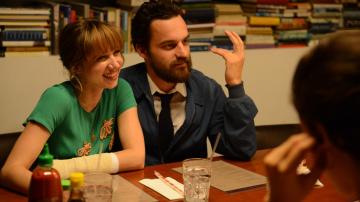
No actress gives more feeling to underdog young women as Zoe Kazan, which is why we always fall in love with her characters. This was true two years ago when she won the Best Actress award at the Tribeca Film Festival starring in The Exploding Girl. And it was true at this year's festival when one of the greatest indie actors brought tremendous sensitivity (and a lot of humor) to two characters in Jenee LaMarque's debut feature, The Pretty One, a quirky comedy with a touch of sadness. The two young women are identical twins: Laurel, a wallflower who remains home to look after her widower father (John Carroll Lynch), and the dynamic Audrey, who is a successful realtor and has men chasing after her. When Audrey is killed in a car accident, Laurel assumes her identity, moving into her apartment, working at her job, and dealing with all of Audrey's acquaintances--including Basel, the quirky neighbor Audrey detested (a bearded Jake Johnson from TV's New Girl) but she is attracted to; and her boss's husband Charles (Ron Livingston), who pursues her although Audrey broke off their affair. She tries to become Audrey so she can experience being "the pretty one" finally, but also as her way to deal with a terrible loss. Naturally she will have to face the dire consequences for her deception. I took part in the following roundtable with the personable Kazan and LaMarque at the festival, before any of us journalists had seen the movie. I note my questions.
Danny Peary: Jenee, I haven't seen your short Spoonful, which is also about sisters and a death in the family. So did this evolve from that?
Jenee LaMarque: It does share the sister aspect, and it's sort of darkly comedic in a similar way. It didn't come from it but it has a similar tone.
Jenee LaMarque
Q: Can you tell us a little about the writing process for this?
JL: There was a long writing process. This was actually the first screenplay that I ever wrote. I wrote the first draft when I was pregnant with my daughter who's now five, so it's been quite a journey. During the process, I went to AFI and studied screenwriting. I wrote most of the draft of the script when I was in film school, and then continued revising and writing afterwards. One of the wonderful boons for the movie was Zoe, who is not only a great actress and very funny but also an incredibly talented screenwriter. She contributed a lot as a writer and storyteller.
Q: Zoe, can you talk about your part in the collaboration?
Zoe Kazan: Sure. I asked Jenee for something that was above and beyond. I asked her to sit down and talk through the entire script with me. We had the luxury of having the time to do that. I came out to L.A. multiple times before we shot the movie and we would sit down and I would say, "Where did this line come from? " Or: "How funny is this supposed to be?" Or: "Is this moment supposed to be sad?" And we really talked through every moment of the script before we ever shot it, so I had a good idea of what Jenee wanted. And also, during that process, if I got to something that I felt was not going to sound right coming out of my mouth, I would ask to talk about it. Jenee was great about making revisions and also sticking by her guns when she thought we could make something work or if I didnt understand what her intention was. We did a good job of balancing that.
JL: I think Zoe and Jake Johnson also had great chemistry and could improvise off one another. There are some scenes where the way that they're communicating is very playful.
ZK: She really encouraged us to do that.
Zoe Kazan and Jake Johnson
JL: Yes, I really wanted them to follow the structure of the script, but along the way to improvise and make it their own. The moments that I find the most fun are those that I didn't plan to happen. The improvised moments are funny and real.
ZK: Having that freedom was really cool, because often first-time writers are really cautious about every word in their scripts. I know that I was with my first script for Ruby Sparks. We always tried to do justice to her script, so it was never about trying to make the script better. It was just about letting organic things happen.
Q: Zoe, because you were the screenwriter on Ruby Sparks, were you particularly attached to that movie?
ZK: Yeah, that was a very special experience because that was the first time I had written a script and I'd never been involved in something from start to finish like that before, and I was making it with my boyfriend [Paul Dano] and [the directors] Jonathan [Dayton] and Valerie [Faris], who have known him since he was a teenager. It really felt like a labor of love in a different way. But every time I do a movie, I think it has to be worth investing completely in and loving it like it's coming out of me. I didn't start writing because I felt I always needed to be in charge but because I felt I had stories to tell. I do that through acting, too. When I read Jenee's script, there were parts of myself that I felt I could address through her words better than I had been able to through anybody else's words before. That was a really cool thing. I think Jenee and I both connect on a personal level to the loss experienced in the film. I felt like that was a part of me that I wanted to be able to express. I also connected to the idea that these twins are sort of two sides of one coin. There's kind of a duality to both characters that was intriguing to me. Audrey is very forward and very confident but also feels some self-hatred. Laurel is buried inside of herself but also has creativity and joy underneath that. I hadn't been asked to do a lot of really sexy stuff on film before, and that's a big part of my life--I've always been a really sexual person. I went through a period of time when I was "sleeping around," and I honor that part of myself, rather than calling it immoral. And I was able to show the part of me that still feels like a gawky 13-year-old.' There's a part of me that's never going to feel pretty, and a part that's never going to feel like a grown-up, and I was able to give life to those parts of me and say they're beautiful too and worth looking at.
 Q: Playing the twin sisters, did you look to any other actresses who have done the same?
ZK: Well, Lindsay Lohan in The Parent Trap. She's so good in that movie it's crazy! I'm not saying that the movie is for adults, because it is not, but she's amazing in it! And after doing what we did in our film, I can't believe an 11-year-old could do what she did. Itas so insane. Also, I grew up on the Hayley Mills' The Parent Trap because that was one of my mom's favorites from being kid. I loved that. For me it was more about connecting to Jenees' world. Jene had a very specific vision. She knew what she wanted to do with the camera; she knew what she wanted in terms of tone. That's something that is really rare with a first-time director. So I was just thrilled that she wanted these things, and I was really trying to connect to that. I watch a lot of movies for inspiration, and I watched a a couple Jane Campion films and movies like that. Jenee turned me on to some videos this woman named Candice [Brieitz} made of identical twins who are posed in the same clothes. Jenee also gave me a reading on twins, explaining what it's like to lose an identical twin--that was probably more helpful than the movies.
Q: Since you play both twins, did you find it hard to perform opposite yourself? How did you get the timing right?
ZK: It was really hard, we had to work on that together.
JL: It's difficult. It took three times as long to shoot the scenes where she was playing both characters. She acted off of a body double, and it was trying to create a connection between the two of them. There's a lot of math and calculating. It's challenging because you create a performance for one twin and then you have to do a second performance.
ZK: And if my body double did something with her hands that was accidentally in the shot, I'd have to match that in my performance. That was hard because it limited me, and I probably became a little Napoleon on set. Do not do that with your hands! Because youre trained as an actor to be really generous with your scene partner and vibe off of what theyre doing, but I would be watching her with half my brain going, and thinking Is that going to be in there? It was a challenge--I got so much better at the technical aspects of building scenes after doing that.
 

DP: In The Exploding Girl and this film, you play young women who underestimate themselves. [Jenee nods] Did that appeal to you on a personal level and did you identify with them?
ZK: Yeah. I have to put on makeup for a living. It's part of what I have to do. I grew up essentially an enormous book nerd and I never felt I was the pretty one. I always felt like an odd duck. I think there are parts of yourself that you put away to become a grown-up. You protect yourself. But it's really wonderful in your acting to be able to bring those things out. I'm not a very shy person but there's a shy part of me and being able to let that part be is a relief. For instance, on The Exploding Girl, I didn't wear makeup throughout that whole movie, I did my own hair, and her clothes were mine. There's a release in feeling you're not the girl and don't have an obligation to be pretty. I really felt that on this film. We all go home and throw on sweatpants and take off our makeup and put up our hair up and we look like opossums. There's a part of all of us that doesn't feel good about ourselves and this movie deals with that. Audrey went out and convinced the world that she was beautiful and sexy and an adult. But there's a conundrum because all those insecurities also exist in her too, so how do we reconcile that?
JL: [I also see the two characters as two sides of the same coin. There's the part of us that feels insecure and scared and doesn't want to take chances--and doesn't deserve anything. And there's a part of us that's brave and goes out there and takes risks and maybe puts on makeup [to look prettier]. There's value in both sides. I'm not saying that if you're brave all your problems are going to be solved. That's not what this movie is saying. I think women deal with that sort of duality and ask, Where do I fit on the spectrum of being a woman?; and Am I going to choose to wear makeup or am I going to not choose to wear makeup? I hope that people honor both the sides. twins' father
Q: Zoe, what's next for you?
ZK: I shot four films last year, including this one, so I am seeking a tiny bit of a regrouping break. I didn't have any time to write last year because of that, so I'm just writing a bunch right now, I just finished doing a play here in New York. And then I have The F Word that I shot last year with Daniel Radcliffe coming out later. And, oh yeah, I wrote a new play. I'm going to workshop it at South Coast Rep in Los Angeles next week.
Q: Whats it about?
ZK: An affair.
Q: And what about you, Jenee?
JL: I have a baby due in August, so that is coming up next for me. I'm also working on a couple of screenplays, just the beginnings of them right now. I really focused on this movie for the last five years. It's such an honor to be here at this festival, finally putting it out in the world.
ZK: I'm going to brag about Jenee for a second. Jenee is just two years out of film school and this is her first festival. After it came out of Sundance, her script got put on the Black List and was a big deal. I think, Jenee, you've had a lot of pressure on you, and now it's really cool that you're going to go away and be creative again.
JL: Thank you, I'm really excited about that.
John Carroll Lynch plays the twins' father
 

Monday, July 9, 2012

The Girl Who Finally Said No

Trishna Is Playing in Theaters

The Girl Who Finally Said No

(from brinkzine.com 7/10/12)
TrishnaFPphoto.jpg Freida Pinto photo by DP
Michael Winterbottom's sumptuous Trishna, in which he transports Thomas Hardy's Tess of the D'Urbervilles from 19th Century England to modern-day India, was one of my favorite films at this year's Tribeca Film Festival. The scenery is gorgeous, the lovely Freida Pinto delivers a daring, assured, and exquisite performance in the title role, director Winterbottom breaks rules and takes interesting liberties with the novel, and the jolting ending is sure to be controversial. The result is that there should be lot of discussion on your way home. The film opens this Friday and I highly recommend it. The story of the ill-fated heroine will stay with you, as it does me. I took part in the following roundtables with Pinto and Winterbottom during the festival. I note my questions.
Roundtable with Freida Pinto
Q: When you go back to India, as you did on Trishna, does it shock you how little or how much has changed?
FP: It doesn't shock me because I grew up in an environment in Bombay where not everyone had the same opportunities that I had. I feel that Trishna is a perfect way to bring Tess of the D'Urbervilles from 19th Century England to 21st Century India, because you see so much urbanization and the onset of these educational systems because children want to be educated. Things are changing and it is happening at a fast pace, although it will take time until it trickles down to rural communities. It was actually shocking to see the changes that are already happening in rural areas. I would expect them to not happen because they're so far away from city life, but it has changed so much. You know, 21st Century India is so different from what it was in rural England even when Hardy wrote about it. It's happening much faster than it happened back then.
Q: You grew up in Bombay and in a very different class than Trishna. She is far removed from your own experience, so how did you connect to her?
FP: It was really difficult because of what you say. I never grew up in a situation where I had to be submissive, not just to men but females in my life. I had the independence and liberty to always make my own choices. I didn't know what the other world would feel like. So I started my research a month prior to the film starting. I went down to Rajasthan and spent time with a few families. Some of the families we actually used in the film. I met a lot of girls, all kinds of girls. There were girls like Chanchal, the really talkative one at the start of the film. They were kind of traditional but a little more outspoken than Trishna. And then there were girls like Trishna. I remember meeting a 16-year-old girl who was married and staying with his family. I asked her, "Have you finished school? Do you want to be educated?" She was like, "Yeah, I'd like to but now I've got to cook." She was not openly resentful of it. She had almost accepted that this was going to be her life from then on. Those are the kind of influences I brought to my character. Because that's when it struck me that there is a reality that exists outside of my own.
Q: Under what circumstances did you see this movie for the first time and what went through your mind afterward?
FP: Michael wanted me to see the film before I watched it with the audience at the Toronto Film Festival. Unfortunately, they burned a copy of the movie but the quality wasnt really good. I didnt want to ruin the experience so I stopped watching it. And I remember telling him, "Everything was too dark and I couldn't see anything." And he's like, "What? That was the feel of the film and you didnt like it?" And I was like, "I didn't mean that. But let's watch it at the premiere." When I actually watched it I looked at the way it was pieced together. Obviously, when you're shooting a semi-improvisational film you really don't know which direction the director is going to take it using the footage. It was really up to him on the editing table to decide what direction he wanted to go in, because we gave him all kinds of things to choose from. And what actually went through my mind after the screening was how everything he had said completely made sense. This was especially true when I wanted to have more of a say in what was happening with Trishna's situation, and he said, "Don't talk. Just be quiet and absorb what's happening around you. And we'll see how it goes." That now made the most sense because Trishna's passiveness as she absorbs pain, and her internalizing of it of it justifies Trishna's final act for me.
trishnatwointimate.jpg Riz Ahmed and Freida Pinto
Q: How would you describe Michael Winterbottom's directing style?
FP: He's very quiet but he's to the point. What I found amazing about his style of working was how unconventional it is. There are no Actions or Cuts. The camera didn't stop rolling as soon as the scene was over. It would go on to capture even mistakes because sometimes a mistake makes for a beautiful take. He was always encouraging his actors to improv on set, which is a leap of faith. A director has to really believe that they'll be able to do it and carry out his story. He was trusting and very welcoming to suggestions and very democratic on set. I can still hear him.
Danny Peary: Does Trishna ever say NO to a man in the film?
FP: Toward the end actually she says to Jay that she doesn't feel like dancing for him any more. And he kind of persuades her to do it anyway.
DP: Her passivity is really interesting.
FP: I needed Michael's help with that because it was really, really hard for me to keep quiet in a lot of situations. It was improv and Michael helped me quite a bit by saying this is probably where Trishna would say something or wouldn't say anything. That's the difference between letting the actor just play out the character and letting her own thoughts and own upbringing interfere with her character, especially when she's that passive. It was almost to the point that it gets disturbing
Q: Is the submission of a daughter to a father still true in India in every class?
FP: Not in every class. Definitely not in my family. Actually, down south in Kerala there is a matriarchal system. So, it's completely the opposite of what we would see otherwise. I think it really depends on the family, the extent of education in the family, and how much of the world they've seen. You'll find this kind of submissive situation in Trishna's lower-class society and also in the Rajput society, which is the rich and the royal family of Rajasthan. One of the girls I met was going off to get married. An arranged marriage. She used to ride a bike and have a completely urban lifestyle, and I was interviewing her and she said, "Oh yeah, this is going to be my last month at the hotel. I'm not going to be working here after that." I'm like, "Oh, a new job?" "Oh, no. I'm going to get married so I'm going to enjoy this bike riding for the last few months." I asked, "What do your parents have to say about it?" "Oh, my father wants me to get married." So, it doesnt really hold the same for all.
DP: Because you're a female from India playing a female from India, would you contribute anything to Englishman Michael Winterbottom's knowledge of the subject?
FP: Yeah. You know, I'm very happy that he went there before all of us. Even eight years before when he was shooting Code 46 and that's when he found Osian. He loves Thomas Hardy and his books anyway. I thought this would be the perfect place to shoot Trishna because he found the similar Tess. And he was very welcoming to suggestions that came from Riz Ahmed and me, especially from me because I am from India about my character, her passiveness and how she would probably possibly respond. Most importantly, how she would be with her father? There's a difference in how she would interact with her father and her mother. You know, she's never that open with her father. She never really has an open conversation with him. Not so much with her mother either. You know, the only person that she loves talking to are her siblings. That's the only level that she can actually relate to. Yeah, so Michael was very open to suggestions. And he already knew how he wanted Trishna to play out. So, it did help that I wasn't there telling him, "Oh no, she wouldnt wear that because thats completely not believable." He would just let me do it because he knew that I would not mess up.
SPOILER ALERTDP: Heres a question that you dont want to answer. Would Trishna kill herself even if she didnt kill Jay first?
FP: I thought about this so much and it's a really good question. I was very conflicted about whether she actually had to kill him. I was thinking that maybe she should just go back to her family and find another job on the farm. Maybe she should just do that. But then it struck me, this girl just had an abortion. You know how it is in villages. Everyone knows what everyone's doing. The word spreads like fire. She lives in a social situation where she's already looked down upon for what she's done in the past. She's brought shame upon the family. So, going back and living there is as painful as being looked down upon as someone dirty. It would be almost as difficult for her to do that as it is to stay with him. There is emotional torture, which rips her apart. But neither with him nor with her family can she really live again. I felt like she has so much strength in her, which she has used to kind of plow through all the situations she's been through. Maybe she can go that one extra mile and just live with this pain. But you never know actually with human beings, when they just flip and they just dont want to do it anymore. I would want her to be a survivor in this situation. But unfortunately--also because we were going according to the book--she does end her life. In the book she gets hanged, so it's a different thing. But her death is inevitable. I also feel like it's the death of her pain and suffering when she physically leaves the world. It's sad that she is always one inch closer to what she wants but she never gets it--whether it's the fact that she wants to complete her education or to be in love with this man or help a family.
DP: Or dance.
FP: Or dance. And that's the most important thing because the only time she comes alive is when she's dancing, even when she was in Osian with her family. So I almost feel like some kind of a death is almost inevitable for this character. Trishna is an unfortunate character. However, if I were playing her as Freida, I would do it so differently. I would go back to Bombay and find a career as a dancer or I would kill him right at the start of the film! I dont know. It's a tricky situation. I was rooting for her, I really was.
Q: She has the responsibility of earning the money for her family;her siblings depend on her, as do her father and mother. So when she kills herself, she essentially cuts them off of any financial aid.
FP: That is true. That's horrible. When she says goodbye to her siblings she pretty much knows that it's going to be very difficult for them to even complete their education. She's prompting them to just keep going, keep going, something that she couldn't do. And I felt that would be so damaging for a family because she was bringing in the income. But I was like, "Okay, this girl has gone through so much." Maybe this is the answer too. Maybe it is. I'm not promoting it, but maybe it is for her.
END SPOILER ALERT
Q: Tell me one thing you learned from Trishna?
FP: Just to say no when the time is right. Don't wait for time to fly by. Saying no,
even in situations in the film industry,
trishnapintohood.jpg Freida Pinto as Trishna
maybe with publicity, here you're asked to do certain things that you don't think are right for you or you can't relate to. Instead of beating around the bush, I think the best thing to say is: "I'm just not going to do it."
Q: How did your parents feel about you getting into acting?
FP: They were fine with it. They would be surprised if I did anything else because they knew I was dramatic enough when I was a kid. They had no idea what I was going to do when I grew up. I knew that acting was a passion but I never knew that a profession could be made out of it. I did not have a godfather in the industry or someone to guide me. I had none of it. So, I kept saying, Oh, I'm going to join the army, and then it was something else and then something else and then a wedding planner. So, they knew these dramatics would stop somewhere when I finally found my calling.
Q: I'm wondering if you think that beauty is something that helps you in your career or has it also been something where people have looked at you and said that she's really beautiful and we're going to use her only as a beautiful girl.
FP: It's funny because when my second film happened, none of the beauty questions even came up. I played a Palestinian-Italian journalist in Miral. So, I was just playing her as a 17-year-old girl and that question never really arose even though she is so beautiful.. In the Woody Allen film, yes, in playing a next door neighbor who is a seductress, that did come into the picture. But I feel it really depends on me, how I want to pitch myself when I go into meetings and how I want to play a character. I hate saying this, but sometimes they look for this "exotic" girl in the film. Then they'll send a script for an "exotic girl, " and I'd have two lines, which you can take
out without affecting the film at all. It's for me to say that the part is not for me.
Q: What's coming up next for you?
FP: I have two independent films that I'm working on at the moment. They're not really financed. I feel so passionate about doing independent projects and promoting them at Tribeca and other festivals that welcome independent films. I've been prepping for one of them since December. I really do hope it takes off. I wont say much because I know they want to make an official announcement before I open my big, fat mouth. It's contemporary, almost based on true life.
Q: What kind of prepping?
FP: Oh, physical prepping. It's not an action film even though I do physical prepping. But another film of expression, which is not necessarily just acting through dialogue but acting through body movements.
DP: Through dance?
FP: Yes.
DP: Like Trishna.
Roundtable with Michael WinterbottomQ: Did you see Roman Polanski's Tess?
Michael Winterbottom: Yes, I saw it when it came out and fell in love with Nastassja Kinski from that. Partly because of that, I later worked with her on The Claim. It was a western and the writer suggested borrowing a story [The Mayor of Casterbridge] from Hardy. She's lovely.
Q: Why did you choose to move the Hardy story to India.
MW: Because it's partly about a society in transition and change. In Britain, it feels like it's stagnating, which is a different sort of problem. In India, people's lives are changing a lot. A lot of people are improving their lives and trying to make changes in a world that is different from the one their parents grew up in. For all the people who make it, there are others who don't. There's the danger of falling through the gap between one world and the other. It's interesting because it generates a lot of stories that are simple but have big things at stake. Obviously the rural village community where Trishna comes from doesn't provide her with a lot of opportunities to express oneself as an individual. You're protected and safe as long as you don't venture outside; but as soon as it becomes modern and urban, all that protection disappears and you have to get what you want by yourself. There are still opportunities but the protection disappears.
Q: Did you like shooting there?
MW: I'd shot in India twice before and had difficult experiences. I'd actually shot in Rajasthan before and though we didn't have actors who the people knew, when we took the camera out we'd get three hundred people in the street following us. This time that didn't happen and I'm not sure why. It was quite challenging technically but most of the problems we anticipated didn't happen. It was easier in the hotels but even in Jaipur we were able to shoot this time. Maybe the economic changes have affected people and they have gotten more used to everything.
Trishnatwostars.jpg Riz Ahmed and Freida Pinto
Q: At which point did Anurag Kashyap come into the picture and when did you decide to have Anurag, Kalki, and Amit act in the film?
MW: Trishna likes to watch films and dance and the dance element was in from the very first draft of the adaptation; obviously cinema is part of Indian culture. Anurag himself I met at the beginning of the process of making the film, at the beginning of pre-production and he introduced me to Amit and Kalki. I always wanted the film to be in that world and had hoped to get real people to play themselves in a way but I didn't know Amit would be up for acting. He's actually quite up for that! And he's really good. Amit's quite shy but it was great because I'd never really worked with a songwriter writing songs for film. So it was really fun and sweet that we were able to have him in the film. And the dancers we met were great and they had parts in the film.
Danny Peary: You changed the accident at the beginning of the film from being her fault in Hardy's book to being her father's fault. I think it wasn't a minor change but affected everything that happens later. Did you feel that, too?
MW: Yes and no. When you read Tess, you don't really feel the accident is her fault. Of course she feels obligated to make up for that but I think she'd feel obliged anyway because she is the oldest daughter and she is who she is and has the possibility to help the family. It was more an expression of the character than what formed the character.
DP: I'm actually asking about the difference in the fathers. Because the accident is his fault in your movie, he feels obligated to her and does things like help her have an abortion without saying anything. He always gives her the evil eye, but she knows his weaknesses.
MW: Right. He is weak in that sense, but then again, in Tess, the father is weak, too. Maybe it balances out. One of the reasons I made the change was it was practical. In reality, in India we couldn't have her drive the truck. Women don't do that, it just doesn't happen. The family in Tess is much more marginal and he is much more feckless as a father and is a drunk. I talked to lots of drivers and this was a guy who actually, like a lot of people in India, is trying to make things better. His economic stage is going up before the accident. He has a decent house, his kids are going to school, he is paying off the jeep in monthly installments. It's like India as a whole is becoming better off. Until the accident. And she becomes the breadwinner and he feels shame because of where he is from.
TrishnaMWphoto.jpg Michael Winterbottom, photo by DP
Q: Something else that you changed is that you combined the two main male characters into Jay.
MW: It's tricky. I love Tess, but it's frustrating that Hardy makes such a clear distinction between Alec, her sensual lover, and Angel, her spiritual lover, because most people are both. I thought that in the movie it wouldn't be as interesting to have two black-and-white characters than one character who is wrestling with both aspects of why he is in love with her. Jay is someone who wants to be in love with Trishna and makes love to her because he thinks he loves her yet he has an armor of weakness. If you think about it, if he genuinely loves her he wouldn't make love to her. He's the owner of a hotel and rich and can make love to her without consequences, but for her as a woman and an employee, he should be able to imagine that he can't make love to her and have it all be fine for her. As soon as her fellow worker Chanchal is aware she has gone off with Jay, Trishan's position changes. Jay wants to be good but he's weak and spoiled.
DP: Basically everyone hates Jay by the end of the movie...
MW:..Good...
DP: ...and also at the beginning of the movie. But is he also a victim of the culture?
MW: He's a victim of his father in a sense. His father is infuriatingly strong and confident and has made his fortune. Jay, like Alec in the book, is a bit of a victim of that upbringing. He doesn't need to work or have a career, so he doesn't know what to do with his life. But it's really hard to have sympathy for a spoiled rich kid. You see that he is likable in lots of ways and could be a good person, but in the end he doesn't have the strength of character to carry that through. For me, he's the least clear character in the film. When Trishna tells him that she aborted their baby, that throws him. They don't communicate much. He falls in love with her but doesn't really know her, other than that she has a lack of imagination. Although in Bombay, they love each other in the moment, they come from two very different worlds.
He has an idea of her that her story of the abortion disrupts a little bit. But in the end that's not why things go wrong. When he returns from Britain, he has already decided to go back to Rajisthan and he sees this as being a good son who takes over his father's business. But he doesn't think what that means to Trishna. There, it's impossible for an incredibly rich person and incredibly poor person to be together. He basically forces her to go back to being his mistress and a worker who pretends not to be his lover. Although neither wants to acknowledge it at first, as soon as he turns her into his employee who is having sex with him on the side, as opposed to being his partner, he destroys their relationship.
DP: When you say Jay is not a clear character, did you intend him to be vague?
MW: I like that it's open to interpretation. I like the idea that you watch something and have to make your own mind up about what happens. It's not where this moment must be the moment when characters realize something or laugh or cry or whatever. I don't want one conversation to be where their relationship is destroyed but just one part of the process. I don't mind that people have different views. I like not having things scripted precisely; I like improvising and seeing what people do and then deciding what works.
Q: In that conversation when she says she had an abortion, he gets angry but just before that she accepted that he'd been cheating on her.
MW: Exactly. There's a double standard. He believes she's pure and simple because she has a different background than his.
DP: Did Feida understand Trishna right away or did she develop her?
MW: She did develop it through performing rather than a long time before, because in a way what's in the script is the story rather than the characters. The actors knew roughly what they needed to communicate, and Freida spent a lot of time talking with the real people in the film--the hotel workers, the dancers, and especially the young people in the family because she had to play scenes with them and know how to behave as a daughter in that family. She'd watch how the other sons and daughters and nephews in the house behaved. If you got actors from India to play those roles they'd have preconceptions about people behaved in that house but life is always much more varied and all the children behave differently and not a standard way.
DP: From talking to Freida, it seemed like she really thought about her motivation.
MW: I didn't have to worry about that! I let the actors do that!

Thursday, June 14, 2012

Daryl and Zoe on Lola

Lola Versus is Playing in Theaters

Daryl and Zoe on Lola

(from brinkzine.com 6/14/12)

lolaversuszoedaryl.jpg Zoe Lister-Jones and Daryl Wein
Mainstream critics have praised the first-rate cast in Daryl Wein's Lola Versus, which opened nationally last week, but I'm disappointed that several have accused the film of being trite and conventional. I'd love for those critics to try to list those films that it copies because they'd be hard-pressed. A lot of care went into making this perceptive comedy about a twenty-nine year-old, Lola (the always unconventional Greta Gerwig), whose life unravels after long-time boyfriend Luke (Joel Kinnaman) dumps her before their wedding, original--and it was done so subtly (almost line for line and scene for scene) that lazy critics didn't bother to notice. True, Wein and his life partner and cowriter Zoe Lister-Jones' second feature, following the acclaimed $15,000 indie Breaking Upwards, didn't venture into jaw-breaking extremes--for the simple reason they wanted to base it in reality--but the dialogue, characters, locations, cinematography, relationships, and even the way Gerwig and Lister-Jones (who matches the indie star as Lola's acerbic best friend Alice) move within the frame are not common to contemporary movies. Last week, I posted a four-journalist roundtable I was in with Gerwig (http://brinkzine.com/content/10999/.html). As promised, here are roundtables I participated in with Wein and Lister-Jones (a personal favorite whom I interviewed for Stuck Between Stations last year) on the same day. There's a profile of the couple in today's New York Times--it's mostly about them (and is worth checking out), this is mostly about their new movie. I note my questions.
Roundtable with Daryl Wein
Danny Peary: Why isnt there a third word in the title?
Daryl Wein: Zoe and I were lying at bed at two in the morning trying to come up with the perfect title. One of us said, Lola Versus... and we tried to think what the other word should be and we realized in that pregnant pause that it might be more interesting to leave the title open-ended because Lola's up against so much in the film. We thought that was a little more unconventional to let the audience fill in the blanks. Also we were exploring what it is like for Lola to be a PHd student studying the verses of silence in poetry, so in another incantation we actually spelled it with an es, and it was The Lola Verses. Then we decided that would be too confusing, and that people could just think of that subconsciously. So that was the inspiration for the title. Also: Lola being Lolitaesque, in that there is a young naivete to her, was part of the reason we gave her that name.
Q: Lola's about to turn thirty and people set themselves up with weird challenges because of this number.
DW: There's all this societal pressure that comes with these age milestones. At thirty, everyone expects you to have your life figured out. You want to at least be close to settling down with a steady job and a family. The anticipation of what you're supposed to do is in conflict with how you're socially conditioned to think and believe. When the rug is pulled out from under Lola, that's what makes, proverbially, the shit hit the fan even harder.
DP: But she learns there is no need for urgency.
DW: Absolutely. It's not about this desperate need to find that perfect person right away and have that plan so well mapped out. You can take the time to figure out who you are and what you want and get to a comfortable happy place before you're bringing others into your mess.
Q: Zoe just kills as Lola's best friend Alice.
DW: Zoe is hilarious. She's a brilliant comedian. She has sharp comic timing and also a vulnerable, dramatic side, too, which had a good showcase in our last film, Breaking Upwards. She's good at playing both. Zoe makes what could have been a really schticky sitcom thing into something grounded, authentic, and truly funny.
DP: Does Zoe write all her own lines?
DW: No, we write everything together. We have a healthy combination.
DP: Is it easy for you to write her?
DW: It is because I know her so well. We've actually been dating for eight years and I'm well-versed in the female experience.
DP: Because you've known each other so long I thought you might have a pattern where she writes the females and you write the males.
DW: It's funny, but we don't. It's pretty traditional in that whoever is feeling more excited or passionate about characters or part of a story jumps in with the writing and later offers up their notes or rewrites to the other person. It's gender equal. We don't write in the same room. We write separately and then show it to the other. If we sat in the same room and tried to craft sentences, we'd drive each other crazy. It would be like a painter trying to paint with someone next to them.
Q: Since you've been dating Zoe for eight years, was there any awkwardness when writing the breakup scenes?
DP: That was your whole first movie...
DW: Yeah, luckily we got that out of our system with Breaking Upwards. That was a very therapeutic process to go through. This one was less autobiographical so it was easier for us to write it and not be so worried that we might be offending the other person in our interpretation of what our real relationship is like. This one was more born out of our being friends with so many smart, funny, interesting women in the New York dating world--and Zoe's experience of being a single woman when we were in an open relationship.
lolaversuswomenstreet.jpgZoe  Lister-Jones and Greta Gerwig
They were having all these weird encounters with men and weren't able to find something that worked. That inspired us. It's rare to see funny, authentic single women post-breakup that aren't Sex and the City or Bridget Jones's Diary or any movie starring Julia Roberts or Katherine Heigl. It's rare when the woman make mistakes and isn't always charming and constantly the victim. Sometimes Lola crosses boundaries and alienates people.
Q: Lola isnt forgiven just because she's cute.
DW: Right. Often she's not cute. She's messy and raw--that spoke to us more than her being an always pretty and charismatic leading lady. You rarely see women in movies being unapologetic in a raw, genuine way. Sometimes people criticize women characters for speaking so candidly. They're not used to seeing women talking about their vaginas. We're used to men talking about their penises and pee-pee and poo-poo humor, and we only started seeing women do it in Bridesmaids, but there it was in a broad context. We tried to ground our humor in a reality we can identify with. We were trying to challenge the expectations of what a female protagonist tends to be, not only by casting Greta Gerwig but also in the way we wrote Lola's trajectory. She is ping-ponging back and forth in a way that doesnt take her from A to B, where at B she meets the next guy and they fall in love and have everything wrapped up with a bow at the end.
DP: What is harder or more fun for you two to write: characters who are breaking up or characters who are getting together?
DW: I think were always drawn to characters and alternative forms of relationships that we don't typically see. So it doesn't necessarily have to be them getting together or breaking up as long as it feels fresh and hasn't been written about to death. At the time of Breaking Upwards, we were seeing what it was like to be in an open relationship and having the nitty-gritty rules of being together but seeing other people. So we were trying to craft a couple who is together but is strategizing a breakup--they're not just breaking up but are actively creating rules. In many breakup films you see both sides but in Lola Versus we are seeing it solely from the female perspective.
DP: If you had made this film Luke Versus would you have been more sympathetic toward Luke? He seems to get out of the marriage because hes overwhelmed but otherwise he seems like an okay guy.
DW: When we were writing this we didn't want to portray him as the asshole villain, which he could have been. We wanted to show that it was more complicated than that. He goes through complex emotions surrounding the breakup. We dont show the breakup scene, but you can imagine what he says. In the conversations he has with Lola subsequently, we realize there were all kinds of factors that played into why they aren't together. They've been together for eight years, there was all this pressure around getting married, and maybe they weren't still exciting each other.
SPOILER ALERT
DP: I think what I'm asking is: If the film had been Luke Versus and we saw things from his perspective and got to know him fully, would we think that Lola should get back with him?
DW: In my opinion, and it's open to interpretation, I dont think they were ever truly right for each other. We imagine them to be the kind of couple that gets together in college --they fell for each other when they were too young--and thinks they are the ones for each other, and they stay together for a long time out of fear of leaving each other or because they're in denial about what's really missing between them. I think that ultimately Luke isn't fulfilling her, and visa versa. They are both looking for different things. Obviously, we're mostly focusing on Lola's pathology in this. If it was Luke Versus, I think we would have understood his pathology even more, post-breakup. And I think you'd see that he doesn't want to be with Lola anymore. He has been craving being with other women and having new experiences.
DP: At their age, everyone who wants to break up and let the other person down easy lies, "It's not you, it's me," although it is them. Then they add, "I need to be alone so I can go off and find myself." It's a cliche that is usually also a lie but in Lola's case it is a cliche that is true. She does need to be alone to find herself.
DW: Well, you're always rooting for the guy to get back with the girl and the girl to get back with the guy. You rarely see a movie where the woman ends up alone with herself by choice. There is an expectation that there will be a happy ending where she'll run off with the guy. But for us it was more important to root for Lola to figure out herself. It takes Lola months to figure things out and that she can say no to Luke. When the other person holds the power and broke up with you and they're happy and you can't stop thinking about them and wanting to get them back, you're in a vulnerable position. Lola goes through so many trials and tribulations but has to hit rock bottom to realize that's not the direction she should be going in.
END SPOILER ALERT
Q: Why didnt you have the breakup scene?
DW: We wrote it and shot it and then realized we'd seen breakup scenes so often and it was more interesting to tell the story without it. You get what's happening and it's more fun to catch up to what went awry. We knew that because of the film's marketing and trailer, people would already know they break up. It's more interesting having them on the happy track to getting married and buying the flowers and then boom there's a 180-degree flip. The rug is pulled out--that's how it happens sometimes. It was more important for us to get into the story of this woman spiraling after the breakup then it was to focus on why they were breaking up. The story for us starts post-romance.
Q: Talk about Lola's parents and casting Debra Winger and Bill Pullman.
DW: Lola's parents are supposed to be these New York hippie intellectuals who led an unconventional life in the seventies. Lola might have lived a more out-of-control life when she was a kid, and she rebelled by having an in-control planned-out life. When I was casting I was looking for actors who could fit perfectly into this world, and I cast great actors with amazingly long careers. You dont really see Debra Winger in comedies like this of late--the last movie we saw her in was Rachel Getting Married and she played a really dramatic role. It is interesting seeing her in a lighter, poignant, motherly role. She's smart, cool, and unconventional and that made her perfect for Lola's mom. Bill Pullman is such a sweet, kooky father. He has an offbeat quality and I'm always attracted to that, like Hamish Linklater playing Henry and Ebon Moss-Bachrach playing the one-night-stand guy, Nick "the Dick." There's something more unexpected about them than actors who tend to be polished.
DP: Did An Unmarried Woman flash through your mind while making your movie?
DW: We watched Paul Mazursky's film after we started writing our movie. It was an inspiration because it has such an interesting tone and the ending is so ambiguous and open-ended, with Jill Clayburg walking through SoHo carrying a large painting. That was a film that we referenced a lot while developing the project because we couldn't think of any other post-breakup story that follows a single woman in an honest way. Still to this day I cant think of any film with that trajectory. We were inspired by Jill Clayburg's performance, which was so powerful and compelling. Like Lola, her character is unapologetic, raw, vulnerable, and messy.
Q: Talk about the New York you shoot in this film.
DW: We moved around the city, trying to show different pockets. We used twice as many locations as are usually used in independent film. We shot in Vinegar Hill, Dumbo, the High Line, the East Village, Tribeca, even Times Square, so we were jumping around everywhere. There were homages to classic locations of New York, but there were also fresh, interesting places like Russ & Daughters smoked fish shop--it has been around for a hundred years but we were the first crew to shoot there.
Q: You seemed to take a lot of care with the cinematography.
LolaVersusDaryl.jpg Daryl Wein.  Photo by DP
DW: I think that almost all romantic relationship movies are shot very broadly. I haven't seen attention paid to the way they have been shot since Eternal Sunshine of the Spotless Mind. And that was shot by the incredible Ellen Kuras eight years ago! I wanted the way we shot this film to be more interesting than what you typically see and that's why I hired the amazing Swedish DP, Jacob Ihre, to give us more of a European art house aesthetic. He shot this great Norwegian film, Reprise, and I knew that the way he mixed styles would match the trajectory of what Lola goes through as a single woman in an interesting way, rather than just shooting everything conventionally. That's why we mixed hand-held with blocked off and tracking shots. We used all kinds of techniques to achieve the overall look. We also shot on film, which is rare, and worked really hard to get the budget to work for film. You see so many filmmakers shooting video because they can't afford film--or they dont care about the aesthetic. But I believe there is heart and soul in film.
Roundtable with Zoe Lister-Jones
Danny Peary: When I interviewed you before, I pointed out that you like doing scenes walking down streets. That's apparent again in this movie when many scenes have Lola and Alice walking outdoors in New York. You're the best at it!
Zoe Lister Jones (laughing): Walking and talking is fun! Wearing high heels on cobblestone streets in New York City makes walking and talking more difficult, but it adds to the challenge!
DP: We talked about the pacing, how you have to walk slowly but make it seem natural.
ZL-J: That's totally true so you can hit your marks at the correct time during the dialogue. It's all pretty technical. But it's fun in New York especially because there's so much to look at while you're talking. So many New Yorkers do walk and talk, including on their cell phones. New Yorkers are always talking. There's almost no silence.
DP: And Lola almost gets killed talking on her phone while crossing the street.
Q: In the Times Square scene you don't do any walking.
ZL-J: I know. There was just a skeletal crew on that. Daryl and two others followed Greta and Hamish and got to capture the madness of Times Square on film.
DP: I assumed that you wrote all your own zingers but Daryl says he writes some of them, too.
ZL-J: Yeah! We really switch off a lot. He writes dialogue for men and women and I write it for the men, too. It's not a gender-based process. Whenever I write a scene I'll pass it to him and he'll make notes or do some rewrites, and it's the same when he writes a scene, so at the end it's kind of an intricate melding of both of our voices. People ask us if he wrote something or I wrote something and neither of us can remember who wrote it.
Q: When you write about a female character do you think that you're going to play her?
ZL-J: No. Our last film Breaking Upwards was loosely based on the open relationship that Daryl and I were in, so we played versions of ourselves. But at first we didn't want to do that. We wanted Joseph Gordon-Levitt and Zooey Deschanel to be in it. And then 500 Days of Summer came out with them in it and we were like, "That's sooo weird." I think we're always trying to get recognizable actors because that allows our film to be viewed by a larger audience. Because we're just starting out, that's always our goal. When Lola Versus began we thought it was going to be a micro-budget indie like Breaking Upwards and I'd play Lola. But the script got such a great response that it was made by Fox Searchlight, which was so exciting. When Fox Searchlight came on board and it was going to be a legitimate production, Greta Gerwig seemed like an exciting fit for Lola and I stepped into the character of Alice. We don't really write for actors in particular. We just write characters who are interesting and funny to us and then have a casting process.
DP: Did Greta Gerwig audition?
ZL-J: No, she didn't read lines. We sent her the script and had a meeting with her and we hung out one night at the premier of her film No Strings Attached. We had a lot of fun. Then we had her read opposite other actors when we were casting around her. That was the first time we got to see her really put the part on its feet.
Q: You had a lot of funny lines directed at Greta but you couldn't knock her off her game.
ZL-J: Yeah, she's really present in a scene, and really works off what is given to her moment to moment. She listens. It's exciting working opposite her because she never plans anything, so [laughing] from take to take it can change pretty dramatically. That's great in the editing room because there are a lot of options for which way scenes can go.
DP: Do you change from take to take, too?
ZL-J: I do. I think I always have a bit of a director's head as well. Especially when I write a scene, I have a pretty good idea what I want it to look like. I don't change things dramatically, but I change little things. Especially for comedy, there are things you can change to help the comic effect and give it variety. But I don't think I go from zero to one hundred from take to take. Greta can change more dramatically--she gives herself a lot of room to play.
DP: Was it a fun or challenging dynamic working with someone like that?
ZL-J: It was always fun. Because I'm also one of the filmmakers, while acting opposite of Greta I was also crafting it and seeing how things were fitting into the story. So it was always interesting to see her take on things. She has a very specific rhythm as an actress and a unique energy that she brought to her character and helped bring Lola to life in unexpected ways.
lolaversusdancing.jpg Gerwig and Lister-Jones
Q: Talk about the theme of silence in your movie.
ZL-J: We wanted to deal with noise, particularly in a woman's head. I can only speak as a woman and don't know what the noise is in a man's head. A woman's head can get, figuratively, noisy. There's so much about self-image and relationships and a lot of self-analysis and a lot of self-loathing. And we wanted to capture that through Lola's fantasies and her dissertation--because her journey is to ultimately find a sense of peace. She is her own worst enemy in that journey. It's hard for her to apply the silence that she's studying in her thesis to her life--it takes time before she can make some of those connections and find a little bit of silence.
DP: Alice says to Lola that she has no friends but for her and Henry. I think that's significant in the movie. I asked Greta if Lola is a good friend, and she said, yes but not for that year.
ZL-J (laughing): I think she was a good friend. But what happens when you're in a long-term relationship is that your friendships really shift. When you're not in a relationship, your friends are your main priority, and when you're in a relationship your priority becomes your partner. That is a difficult transition and there can be jealousy and competition until you adjust to what your new role is in that person's life. So Lola has been with Luke for eight years. Alice is her best friend but Lola is ultimately a homebody who has found a routine with her long-term boyfriend so it's not about going out and partying and going to the bars where the cute guys are. That's more Alice's M.O. I think Lola has had been a good friend while with Luke but I think Alice is selfishly excited when Lola's single again so she can get her wing-woman back.
Q: In their case, opposites attract.
JL-J: Well, I think that's kind of true in friendships. Obviously there are shared interests among all those in Lola's social circle. They're fashionable, into music, intelligent, and have a sense of humor. But I do think that people are drawn to people who have different energies than their own a lot of the time. I think that's what makes the social dynamic interesting. In the film, everyone has a different rhythm but (laughing) "they make beautiful music together."
DP: Lola blames herself for her downward spiral and alienating Alice and Henry, but I told her that I also blame Luke, Alice, and Henry for letting her down. What do you think?
JL-J: Yeah, but I don't think it's black and white. I think throughout the film we were trying to not have all of those conflicts have a very clear villain or victim. Even in Lola's relationship with Luke, we never wanted to make him a villain. We wanted his trajectory to also be thoughtful and sensitive. He did something he had to do that hurt Lola but he isn't a total asshole. I think Lola is victimized but she also alienates herself from the people still around her during this year. When people are going through moments of crisis, especially breakups at that age, they can be pretty self-absorbed. So, yeah, there are definitely shades of gray in who's to blame.
SPOILER ALERTDP: Should Alice have gotten together with Henry?
JL-L: I don't want the audience to know that happens, but I will say I personally believe that she is allowed to. From the beginning--what makes it so complex--is that we hint that Alice has always been thinking about Henry. Lola has always been pushing Henry on Alice and telling her to date him; and Alice says that he does look cute and Henry says Alice looks pretty. Then when Lola drops the bomb that she made out with Henry, it's quite devastating to Alice because she had a glimmer of hope of getting together with him. So I think Lola and Alice are stepping on each other's toes. I think when you have to confront a close friend with difficult information, you don't always make the best choices. Sometimes you wait a little bit too long.
END SPOILER ALERTQ: There's a naval term for what happens with Lola and Henry after her breakup: "port of convenience."
ZL-J: Interesting! That's a good title for a movie.
DP: Lola and Luke have the same first initials, like Ross and Rachel on Friends and Luke and Laura on General Hospital. Were they the perfect match at one time and just grew apart?
ZL-J: Yeah. They met and college and grew up and are very different people from who they once were. They stayed together because they were on the same track and it's hard for either to jump off the train. They fell in love at a particular moment in their life but after eight years Luke starts to panic about the idea that they have grown into different people. They just haven't taken the time apart to realize who they are because of their codependence. In the back story we imagined that Luke was a total hunk and Lola felt that she scored big time. When you're in college, getting the dreamboat is so exciting! The thrill of that probably didn't wear off that much.
Q: Until thirty came. People don't realize that there's a long life after thirty.
ZL-J: I know. We were in a park and there were all these high school students who were acting so old--at every age, we feel we're so old, that we know everything and have done everything. Approaching thirty seems like a huge transition but in retrospect it is almost nothing.
LolaVersusZoeone.jpg Zoe Lister-Jones, photo by DP
Q: There's a funny scene in the movie in which Alice appears in an awful heavy experimental play with her boyfriend. Did you guys actually see a play like that?
ZL-J (laughing): Never like that. We took it to an extreme for comic relief. The most experimental theater Daryl and I saw was when we studied acting at Tisch at NYU. We'd see some black-box insanity. We liked that Alice is an actress because that lends a whole other level of desperation to her character. She can't be fulfilled in her love life or in her career! Everyone who lives in New York especially has seen plays their friends are in that are unwatchable and they have to lie to them afterward. So it's a funny New York moment when Alice comes out of the theater after being in a terrible play and Lola and Henry tell her it was amazing.
Q: What inspired you to write about Lola?
ZL-J: In the year Daryl and I were in an open relationship, my experiences as a single woman were very different from his as a single man. The dating scene for a single woman in her twenties was pretty bleak. All my single girlfriends were experiencing the same comically tragic lifestyle. We'd get together and laugh about it but also share our war stories about the variety of lame dudes we encountered and the guys we liked who would treat us like shit. So we felt it was a ripe story that we could mine a lot of humor and raw emotion from. We hadn't seen an authentic portrait of a single woman on the screen. There are the glamorized versions, like Sex and the City and Bridget Jones's Diary, but there was nothing that felt young or that we could relate to and that shifted between comedy and drama. Lola Versus is sort a call back to Paul Mazursky and Woody Allen in the seventies.
DP: Lola says at one point that to love yourself you have to love other people first. Is that true?
ZL-J: I think so. Often people say that you first have to learn to love yourself but sometimes I think it's the opposite in that self-judgment sometimes follows how judgmental you are of other people. Really appreciating the people who love you is sometimes the one of the hardest things to do--it's really hard to accept love in this day and age--but it creates an environment where you can ultimately love yourself.
Q: Are you interested in only writing scripts from your own ideas?
ZL-J: No, we're interested in working from other material. We like to write our own scripts but it would be exciting to veer from that path and do something really different.
Q: What's your next project?
ZL-J: We wrote another script for Fox Searchlight called Motherfucker.
DP: That title will go over well.
ZL-J (laughing): It will never get through. It's about a young couple and the girl introduces her boyfriend to her parents and he falls in love with her mother. It's an intergenerational romance!