Friday, July 5, 2013

The Way, Way Back Press Conference

Playing in Theaters

The Way, Way Back Press Conference

(from Sag Harbor Online 7/5/13)


I predict a warm response from critics and moviegoers to the charming and disarming directorial debut of Nat Faxon and Jim Rash, who won an Oscar for their script for The Descendants.  Their new picture, the coming-of-age tale, The Way, Way Back, is set today, at a beachtown in Massachusetts, but if it makes you feel nostalgic for the lost summers of your youth it’s because the directors/writers drew from their own teenage summers, including a difficult one Rash spent with a stepfather.  Shy, awkward fourteen-year-old Duncan (Liam James) thinks he’s going to have a lousy summer at the beach house of his wife Pam’s (Toni Collette) new husband, Trent (Steve Carrell playing against type and creating a fascinating character), who constantly belittles him.  But he finds safe haven at a fab water park, where he is taken under the wing of Owen (Sam Rockwell, one of our most underrated movie actors) and befriended by other employees, Caitlin (Maya Rudolph), Roddy (Faxon), and Lewis (Rash) and lots of other boys and girls.  And the cherry on top is the slightly older Susanna (AnnaSophia Robb, star of TV’s “The Carrie Diaries), the very pretty daughter of the boozy, chatty neighbor, Betty (Allison Janney).  Receiving needed attention and support, his confidence grows to a point where he can stand up to Trent, even when his passive mother can’t.  In anticipation of the film’s New York release today—I think it’s the perfect summer movie for the Hamptons, too—I attended the following press conference with the directors and Rockwell, James, Robb, Collette, and Janney last week in the city.  Carrell and Rudolph weren’t in attendance, but it was a lively, free-wheeling affair.
Q: Nat and Jim, talk about the cast that's here with you today.

Nat Faxon: I think all of these incredible people understand and appreciate ensemble-type films. Jim and I come from the Groundlings comedy group and a lot of the things we do are collaborative, including writing and performing with other people.  This movie has a collaborative spirit and is the sum of its parts.  It takes a certain type of person to understand that and jump in, so we’re so incredibly fortunate these actors came on this ride with us.
(L-R): Sam Rockwell, Jim Faxon, AnnaSophia Robb, Liam James Photo: DP
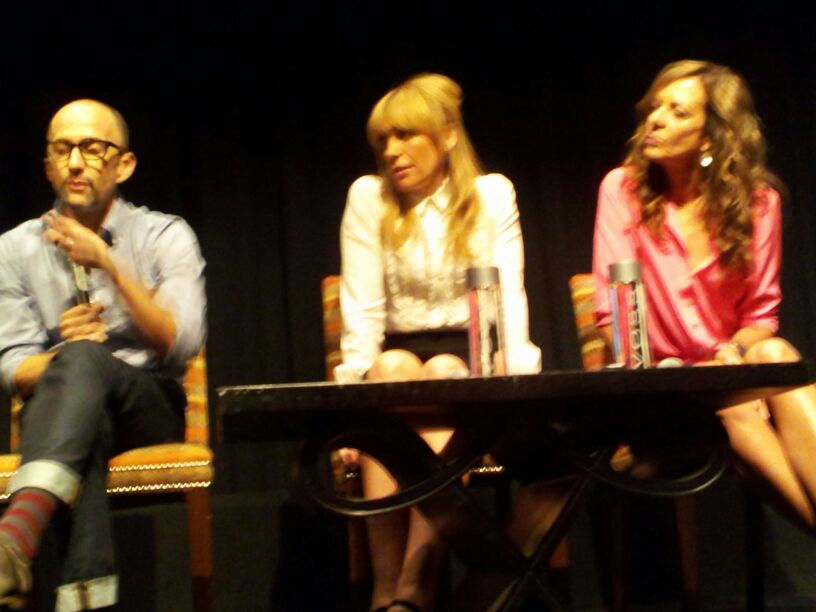
(L-R): Jim Rash, Toni Collette, Allison Janney Photo: DP
Jim Rash: We were looking for actors that we admired both as wonderful talents and good people.  That’s how we found this cast.  For the character of Trent, we wanted to go against type, and Steve Carrell came to mind.   Sam came to mind to play Owen.  Sam understood what Bill Murray was to us in Meatballs.  He said it on the phone before we had said anything, so we knew right away that we were all on the same page.
Sam Rockwell: Bill Murray is pretty evident in the script.  I think it’s kind of an homage to him, a little bit. But I think there are a lot of good prototypes for Owen, like Walter Matthau, a little Richard Pryor, and a bunch of others.

Jim Rash: He’s the adult who talks to kids as if they’re adults, which is always fun.

Q: When you two got together, did you think, let’s make a movie kind of like Meatballs meets Adventureland?

Jim Rash: I don’t know if we sat down and set up Meatballs and that kind of thing, but we started with a love for water parks and our training with the Groundlings, which is so character-based. The water park seemed to offer a place where an eclectic group of people might be. And then the first scene of the movie, the one-to-ten conversation between Trent and Duncan in the car, happened to me on the way to our summer vacation in Michigan. We launched with that sort of verbatim, autobiographical first scene. Then we merged those two thoughts. The water park became the perfect Oz in this story of this kid, Duncan.

Q: So do you see this movie as your revenge against your stepfather?

Jim Rash: It is cathartic, I don’t know if it’s revenge.

Nat Faxon (laughing): Every movie’s revenge.
Duncan suffers through dinner with married guests Kip (Rob Corddry) and Joan (Amanda Peet), with whom Trent has daliances

Jim Rash: Take that, Mom’s second husband! In your face!  Actually, I would not say that my stepfather and Trent are the same person.  Steve had an innate ability to elevate Trent above being just something demonic.  He made him a real human being, a true tragic male character. In regard to my stepfather, I understand his message to me now but didn’t at fourteen when I couldn’t process it and I was coming from a place of anger. Through Owen, weirdly, what Duncan does that summer is what Trent was alluding to, in a harsh way, when he said he should come out of his shell.  Duncan reluctantly gets on his bike and leaves the house and stumbles upon this Oz water park. Trent said, get out, make something of yourself. There are so many things at the beach to take advantage of. That’s what I was told as a kid. We went to Michigan every year, Lake Charleroi, and he was saying to me, I noticed that last year you hung around the lake house. Why don't you get out? There are so many great people to meet, and explore, and take advantage of things. So regardless of his having no tact and being harsh, he gave me something I didn’t understand then but understand now.  So it’s really cathartic to me, because I understand why our paths crossed briefly.

Q: In the movie, I think playtime is used as the redemptive factor in Duncan’s coming of age.  He actually breaks away from his miserable home life through play.

Nat Faxon: There are a couple of things that go into this. There are two male roles in Duncan’s life.  Trent's idea is to have Duncan fend for himself and make something out of himself.  Owen gives the same message but in a much more nurturing way.  He says to Duncan to come into the fold, put on our shirt, you’re official. In other words, join this sort of playground.  That is pretty much how Owen's mind operates. He is at his best for three months out of the year, while this water park is open in the summer. It’s a play opportunity for Duncan, too.  Owen’s offering something completely different than Trent. This place nurtures all types of people, so that they can celebrate who they are.  Duncan shares this wonderful experience people who come to this place have. The water park does in a sense become Duncan’s Oz.  We had long conversations with our DP, John Bailey, about how we could make Trent's summer house feel suffocating and isolating and closed-in.  That included shooting from a low angle so you can see the ceiling and feel that claustrophobia Duncan is feeling when he's in the house.  Visually, this contrasts with how we shot the water park. We shot it with a Steadicam to create movement and excitement, and we had a ton of walk-and-talk moments with Owen and Duncan so there is no feeling of claustrophobia. We wanted to make the park feel colorful and bright and open and fun and playful.

Q: Owen and Duncan is the relationship at the heart of the movie.  So, Liam and Sam, how did you two work together? 
 

James and Rockwell

Sam Rockwell: I think there was a pretty immediate chemistry between us. We had an immediate understanding of the relationship. It was just so easy, we were just sort of on the same page, all of us. We read the script a couple of times, but we all knew what it needed to be. It was kind of instinctive.  Jim and Nat would guide us, but it was very free-feeling working on this movie.

Liam James: A couple of days before we started shooting, Sam, Nat, Jim and I sat down together.  I was doing this new thing, this huge part, something I’d never done before, and they really made me feel comfortable and that I could do anything I needed to do for the movie. The thing that made me the most comfortable was how funny they were, all the jokes they were telling. Between scenes, I would go to them and just listen and laugh and have a great time. Sam and I had a lot of fun together. He's really into boxing and he showed me some moves. That was one way we kept loose between scenes.

Nat Faxon: Some cage-fighting, Liam survived.

Jim Rash: Kid’s gotta learn.

Q: To the actresses: I want to know how you got into the heads and hearts of your characters, and whether there was anything in your personal lives or youths that you drew on to play them.

Toni Collette: I’m not one of those actors who draws on previous experiences or anything that blatant. It’s always the script.  To play Pam, I started with this wonderful material, which was so clear and so rich and so complex and so enjoyable to play.  Everyone was so receptive and open to the material, and it was such a wonderful atmosphere to work in. That opened vice allowed something really relaxed and natural and special to evolve.

AnnaSophia Robb: I definitely agree with Toni.  My character, Susanna, was all on the page. I drew everything from the script. It’s nice to see a girl-next-door character be multi-faceted, not just one-dimensional. She’s going through things herself. Being on set and being with all these people just really got me into the headspace I needed I remember my first meeting with Nat and Jim and how we clicked. The chemistry felt so natural and comfortable. Being able to spend time with Liam and getting to know each other for the first time was great and I felt sort of adopted by Allison in a way. Being able to hang out on the set was a real privilege for me.

Allison Janney: Parties!  I can relate to Betty’s fun side because, Nat, Jim, and Sam, you’ve seen how I throw down at a party!   I like to dance, I like to have a great time. So I was excited about that when I first read the part of Betty [Trent's loud, nosy neighbor].  But I was also hooked by the fact that she’s in a lot of pain and self-medicating with alcohol and chatter to cover up what’s underneath.  That’s what fascinated me about her. She isn’t just a one-dimensional, silly character, she’s actually very complicated.  It was very exhausting to play her but incredibly rewarding because she's a brilliant character. A little Betty goes a long way!

Q: That first scene of yours when everyone arrives at the house next door and you won’t stop talking to them basically tells us everything we need to know about Betty.  Because of all your dialogue, was that scene daunting scene for you, or was it fun?

Allison Janney: I’m thrilled when I get to do a scene like that. It’s like being in a pinball machine, and I get to be in control of it, which I love doing in my acting--I’m not so good at it in real life. I relish getting to take over a scene like that and be the one spinning it all over the place. I can’t get enough of that.  It was fun when we got to go all the way through it; when I had to break it up to do coverage of the scene it became a harder to keep the same energy. By the end of the day I was exhausted and had to get into a hot bath.

Nat Faxon: That scene took the whole day, so in a way, the day was Allison. She was really in control of the pace.

DP: Toni, you had the difficulty of playing a passive character.  How did you do that without letting the audience lose interest and drift away from Pam?

Toni Collette: From my point of view, I thought the audience was going to find her so frustrating, so passive, so inactive. But what I loved about it is there was so much going on in this new world around her. She’s trying to provide something for her son with the wrong man. She knows the truth, she just lying to herself.  There are a lot of wheels turning for a very long time, although she’s not expressing what she’s thinking.  But I think there’s so much she can express without words, so I kind of enjoyed that.  I’d like to do a silent movie!

DP: Liam, how difficult was it playing a shy, tongue-twisted kid and not being able to let yourself go?

Liam: I didn’t feel frustrated with Duncan, but it was almost painful how awkward he is at the beginning.  So I was pleased with what happens with him over the summer. Everybody was talking this transformation Duncan goes through, but we shot the film out of sequence, so I just had to trust Nat and Jim when they were saying that I was doing it right.  When I saw the film at Sundance and in my hometown of Vancouver, I was really happy how it all came together.

Q: Duncan comes alive when he dances for that young crowd at the water park.  How much of the dancing was you?

Liam James: That wasn’t me.

Jim Rash: No, it was. He was terrified when we said, “Now you need to dance.”

Liam James: So terrified. I got there that morning and read what we were going to be doing that day, and was like, “Where’s the choreographer, guys?” And they were like, “Get up there.” One of the moves I did was “the leafblower.” I think that says a little about how little they showed me. 

Sam Rockwell (laughing): I like that you’re attributing a style to what you were doing.

Liam James: It’s a move I learned when I was twelve years old, someone showed it to me one time so I thought I’d do it.

Sam Rockwell: To me it was more like a zombie thing you were doing.

Liam James (deadpan): Thank you.

Sam Rockwell: You’re welcome. It was a compliment! No, everyone, he was fantastic.

Liam James: The dancers were amazing who were there, I was really intrigued to talk to them and get to know them.  I even asked them a couple things when I was nervous.  That’s kind of how it worked.

Q: Summer is often a time of transition and change. Jim, you talked about it a little before but can you, Nat, and your actors recall any of your memorable summers of change?

Jim Rash:  As I said, the first scene in the car happened to me on the way to our summer vacation.  That was my stepfather at the time.  But that wasn’t transitional. I do remember that for some reason my dad decided to be involved in my development as well and he sent me to Outward Bound for about three weeks.  As a teen, at first you’re like, “Ugh, this sucks,” and then you sort of really embrace it, and then you come back and tell your high school friends, “I’ve changed! You don’t understand what happened, guys. I was in the woods and things happened.” We did backpacking and rock climbing and I had to do a three-day solo trip with only an orange, a bagel, tarp, and four pieces of string. I came to realize that three days is a lot of time to be alone.

Sam Rockwell: Especially for someone like you, Jim, who lives inside his head.

Jim Rash: And there was a huge thunderstorm.  It was not very entertaining.  I remember I tried to write a really short story there, I think I still have it.  It was so terrible, you know. That was a summer I remember.

Nat Faxon: I spent my summers on Nantucket Island.  That inspired us to instill in the movie the sense of going to a certain place summer after summer. So much happens in the nine months you’re at school and then you come back and open your summer house and nothing has changed. There’s something very comforting and familiar. I have a lot of fond memories of growing up like that.

Sam Rockwell: I spent summers with adults because I was in the theater as a kid.  I was around people who were sort of bohemian and were a little crazy. So I had some unconventional summers for sure.

AnnaSophia Robb: I started acting when I was nine, and I think last summer, when we shot this, was probably my most transitional. I had just graduated high school, I was 18, it was my first movie when I was on the set by myself, and it was kinda scary and a little bit lonely at times.  But to be able to spend time with an amazing cast was so much fun for me and it’s now so exciting to see the final film because it reminds me of that time.

AnnaSophia Robb and Liam James Photo: DP

Duncan shows Susanna the water park
 
Allison Janney: I grew up in Dayton, Ohio, and did a little theater when I was about fifteen.  I did some backstage crew work and I got a big eyeful of some colorful people like the Ames Brothers, Kitty Carlisle, and the Smothers Brothers. There were a lot of very funny stories that I can’t tell you. It was an unbelievable world I saw--professional theater.
Toni Collette: Australia is one big beach.  It’s all very oceanic and salty, and you have these feelings of freedom.  Summer is my favorite time of year. I absolutely come to life and love it. There’s one holiday that I had when I was young that wasn’t planned at all. I had a fight with my parents on Boxing Day, when they went to visit my auntie Betty in the city, I rang a friend who was going on a road trip with some girlfriends that she’d met at university. She said, “One of them pulled out, there’s a spare seat in the car, I’m coming to get you.” I grabbed a load of clothing, shoved it in a duffle bag, grabbed a guitar, and ran out to the car, not knowing where I was going. We drove up the coast. I slept on beaches, got kicked off beaches by rangers, and ended up at a folk festival and had the time of my bloody life.

Q: Jim and Nat, this is your first opportunity to direct a film. What was that like for you?

Jim Rash: It was stressful for sure, but in a wonderful way. It was a whole new chapter for us.  We’ve been writing together for a long time, so we just tried to approach working and directing together from a similar place. It helped that we knew this story very well because we’d lived with it for eight years. We had to trust ourselves and pull up anything that as actors we’d appreciated about the directors we’d worked with. That was the artillery we’d go in with and feel confident about. We knew that whatever advice we took from every director we sat down with, it was going to be a whole new game when we got out there. It was a wonderfully complicated but an awesome experience.

Nat Faxon: I echo those sentiments. Often on the set you’re stressed out because you’re asked so many questions, and you have so many decisions to make, but you try to remind yourself, “We’re so lucky to be doing this and to be surrounded by these actors and this incredible crew who are all working together to create something and fulfill a dream of ours.” We just tried to create a set that was loose and fun and enjoyable.

Sam Rockwell: I love working with actor-directors, and these guys were no exception. They really did create a great, loose set. They wrote such a wonderful script, that it was kind of a no-brainer to do the film. Maya Rudolph, who Jim and Nat knew from Groundlings, would come in and I felt she was almost like therapy for you guys, right?  You guys would do bits with her and it seemed like that would relieve your stress.   These guys are so funny, and they would throw me zingers, and I’d do some adlibbing to get them in.

Q: By the end of the first act, I was waiting for Owen and Trent to have a huge confrontation. I wanted something like McMurphy vs. Nurse Ratched. I don’t understand why you guys didn’t do that!

Sam Rockwell: We did do that. Owen confronts Trent at the water park.  I understand your expecting more but it’s probably good you’re left wanting more. I think a taste, a little moment, is all you need.


Nat Faxon: Jim and I always try to use restraint in what we do, both in our writing and our directing.  When we worked with Alexander Payne on The Descendents, we admired his ability to recognize that less is more.

Jim Rash: I think there’s something so subtle in Owen’s action, when he steps between Trent and Duncan.  I think it’s almost expected that they will have a big blow-up and a throw-down, but by having him do something as small as a simple physical move, we were achieving the same thing.

Sam Rockwell: I was going to muddy that moment with an adlib, and they pulled me back.  They were right because it would have diluted the moment.

Toni Collette: You may want a confrontation because you care about Duncan, but I think it makes sense that Owen confronts Trent in a gentlemanly, minimalist fashion. Duncan’s the one who gets to push him and actually show his anger, and that’s who you want it to come from.

AnnaSophia Robb: I think it feels real, also.

Sam Rockwell: That’s true, there’s a real catharsis.

Q: The balance of comedy and drama was executed really well in this movie, so I was wondering how you went about that.

Jim Rash: Nat and I have always been drawn to finding the comedy in what seems to be very dramatic moments. Obviously it’s that way in The Descendants. To us, it’s just about really thinking about our day-to-day lives and finding the comedy in true-life moments.  We can go from something that’s so funny to something that’s tragic in our day-to-day reality. It’s just being honest.
Rash, Collette and Janney Photo: DP

Allison Janney: When they were directing me with River Alexander, the young boy who plays Betty’s son, they told me--and it was just such a great piece of direction—to look at the relationship as if they we were an old married couple. And it was really fun to play it that way with him.  Some of the things that Betty says to her son seem, on the page, to be pretty harsh and I wanted to make sure that was balanced with the enormous amount of love that Betty has for him. I wanted that to be there so that her saying harsh things came from a place of love; in that way it comes out wrong and funny in an awful sort of way. That was my challenge and they were wonderful directing me to do that.

Q: You mentioned living with the story for eight years.  Did you keep revisiting the script during that time? How’d you know when the writing process was done?

Nat Faxon: The script evolved over the eight years and many things changed, but the core of the script stayed true to what it was in the beginning. We probably pulled back on some of the broader moments that we’d originally thought of in the water park, as the family stuff took more prominence in the script, just trying to make sure that those two worlds belonged in the same movie, in tone. It’s always an evolution, really, because you’re always constantly tweaking until you’re shooting.  We knew that it was done and I had to put a stop to it, when Jim’s part, Lewis, just kept getting bigger and bigger and bigger. “We’re done revising now, Jim. We don’t need any more of Lewis!”

Q: AnnaSophia, could you tell us your favorite water park ride?

AnnasSophia Robb: I had never been to a real water park until this film, but of the water park rides that we shot on, I’d say my favorite was the big black slide that goes shooting down. I’d get a little drop in my stomach sliding down. I got a big wedgie also, but it was funny.

Sam Rockwell: I never heard a man’s voice go as high as Jim’s when we went down that slide.

Jim Rash: I was terrified of that. We’d pretty much wrapped and they opened up the park for us to have some night-sliding. It’s terrifying in the day, then add to that fear that you’re going to go down this very steep incline at night when it’s pitch-black. I don’t even want to talk about the visuals that went through my head about what could happen. I sat for a good amount of time before I would go down. There was a bar that you can hold on to if you want to go faster but there was no reason I’d want to go faster! I just let my body naturally fall down.

Sam Rockwell: Jim also shares a character trait with his character, Lewis.  He’s also a germaphobe. So that always played into Jim’s thinking about going down the slides.

Jim Rash: I had a really hard time in a lot of the water park!

Sam Rockwell: Where’s this water been???

Liam James: I’ve been to water parks once or twice in Vancouver.  The whole water park for me was such a great experience, I think I did it the most out of everybody. Sometimes after work I would go throw my bathing suit on and I’d go down all the slides.

Jim Rash: This is the first time I’m hearing about this!  Why weren’t you working on the next day’s scenes?  Why didn’t you go home and work on your dancing?
Liam James: And my singing.
Q: Steve Carell wasn’t able to be here, but can you guys talk a little bit about working with him?

Allison Janney: It was my first time working with him. I adored him. I loved to watch him laugh when they called Cut! on a Betty scene and I would literally just slump and fall out of my chair. I’d go from Betty to zero and that was his favorite part of my performance.  He would make me laugh, too.  Once we had a late-night shoot, for scene “The Adults Stumble into the Dunes.” So Steve, Toni, and I, being a method actress, sat up in the house, in the actors’ holding room, and had some champagne, some “beach punch.”  We sat around and told stories and laughed until they called us to the set. We literally ran and stumbled into the dunes. And we nailed that scene!

AnnaSophia Robb: I remember the night that Allison was talking about, because Liam and I were downstairs filming Duncan and Susanna’s first awkward scene, and I remember in-between scenes I could hear laughter Liam and I would run upstairs and just listen to all of them tell their stories and laugh. I felt like I was eight. It was a really special time just to be able to hear all these wonderful actors that I admire so much just bond and share stories.
Nat Faxon and AnnaSophia Robb Photo: DP

Toni Collette: It was wonderful to get to work with Steve again after Little Miss Sunshine.  He’s just such a pleasure in every way. He’s so open and lovely to work with, a brilliant actor. And a gentleman and truly nice person.

Liam James: Steve and I had scenes in which Trent and Duncan are butting heads and Trent even throws luggage at him. Between scenes it wasn’t like that a at all.  Steve wasn’t trying to make me feel bad about myself. [Laughter] One time Duncan had to have this big smile on his face for a scene.  Steve was off-camera at the time and I heard  this funny laugh that he does and it just cracked me up.  So Duncan’s smile was genuine and I can thank Steve for that. 

Sam Rockwell: I didn’t really get a chance to work with Steve in the movie except for that brief scene at the water park, but I’ve been a fan for such a long time. I think he’s so great in the movie.  I usually play the creepy guy and he’s always the nice guy, but for this movie we switched it. It’s a great red herring for the audience, I think. What’s so great about these press junkets is you get to see the people you made films with again.  Last night I had a nice conversation with Steve. It’s fun to become friends with people I admire.

Nat Faxon: I certainly share all the same sentiments that Jim does about Steve’s approach to his character, and his bravery in playing a character who really doesn't have a huge arc. Trent’s a tragic character who doesn’t evolve, who doesn’t start at point A and end at point B and learn his lesson and become a changed man. This is a guy who says he wants things to go well but his actions don’t reflect that. You almost sympathize with people like Trent; you hope they figure it out but they may never do that. Kudos to Steve for having the courage to play a guy like that. I just have such respect for him.

Jim Rash: Nat and I really appreciated Steve’s desire to talk in detail about Trent with us.  He wanted to talk out loud about Trent and his headspace.  He just reaffirmed that it was a great choice to have him play against type. And to watch Steve Carrell walk us through his process?  It was a real honor.


Lian Lunson on Her Lovely Musical Tribute to Kate McGarrigle

 Sing Me the Songs That Say I Love You: A Concert for Kate McGarrigle is Playing in Theaters

Lian Lunson on Her Lovely Musical Tribute to Kate McGarrigle

(from Sag Harbor Online 7/5/13)


Poster featuring Kate McGarrigle and her children, Rufus and Martha Wainwright
Sing Me the Songs That Say I Love You: A Concert for Kate McGarrigle fits my category, Movies That Should Play in Sag Harbor.  But for now, until Tuesday, you’ll have to see it in New York City at the Film Forum.  I have been a huge fan of the unique Canadian duo, Kate and Anna McGarrigle, since their first self-titled album was released in the mid-1970s, so I was thrilled to learn a film of a memorial concert on May 12, 2011 at Town Hall in NYC had been made to pay tribute to Kate--the brilliant singer and songwriter had died from clear-cell sarcoma at the age of 63 in 2010.  I was even more excited to learn that Kate’s supertalented kids, Rufus and Martha Wainwright, were behind the film and Rufus had handpicked Lian Lunson to direct it.  Lunson was a perfect choice because she had shot the acclaimed documentary, Leonard Cohen: I’m Your Man, which includes a concert in which the McGarrigles and Rufus and Martha perform beautifully.  I interviewed the personable Australian director before that film played at the Film Forum in 2005 and was delighted to do the following interview with her a week ago to help her promote her new movie—which includes marvelous performances by Rufus and Martha, Anna, Emmylou Harris, Norah Jones, and even Jimmy Fallon, along with archival and new offstage footage—and champion her extraordinary subject, the much missed Kate McGarrigle.

Lian Lunson Photo: DP
Danny Peary: What part of Australia are you from?
Lian Lunson: I'm from rural Victoria, the countryside outside of Melbourne. I moved to Sydney to go to drama school, which I attended for three and a half years. Then I did a lot of theater and starred in a TV-movie ["Army Wives" (1986)] and a feature film ["The Big Hurt" (1985)] and had a couple of smaller roles. So I was just starting to get known when I moved to L.A.
DP: Did you go to Hollywood to be an actress?
LL: Yeah, but I lost interest in about five minutes because it was much different from what I'd known. Australia had a much smaller acting environment, so we all knew each other and the few major casting directors all knew us. Even if you weren't getting paid, there were a lot of theater groups and opportunities to perform. I guess acting was my way out of Australia to come here, but it wasn't really the right thing for me to do. I'm very proactive and like getting involved in things rather than sitting around and waiting. I grew impatient and went into production.

DP: You produced music videos for such well-known artists as Neil Young, INXS, Pearl Jam, Public Enemy, and Dwight Yoakam. Was it because you were a music fan that you gravitated toward music videos?
LL: No. When I first came to America I started doing work on various film sets, doing pretty much every job. As part of that I got into the producing aspect, learning how to structure budgets. The particular production company I worked for, overseeing budgets, did mainly music videos and commercials, but I left that company and started to produce on my own for various directors. I formed my own company, Horse Pictures, in 1997. I did my first video with Willie Nelson, which was great because I was already such a huge fan of his.  Based on that, he asked me to do a feature-length film about him for PBS.  I ended up being in that world of his for nearly two years.


DP: Then you made your documentary, Leonard Cohen: I’m Your Man. How did you learn about the 2005 Cohen tribute concert at the Sydney Opera House that featured many rock and folk artists singing his songs, including Kate & Anna McGarrigle, and Kate’s supertalented kids Rufus and Martha Wainwright?
LL: Hal Willner, who is a very good friend of mine, is a Grammy-winning American producer who does these great concept shows where he ingeniously puts together unique people with amazing songs. He told me he was putting on the Leonard Cohen "Came So Far for Beauty" concerts, beginning in Brighton, England, with an amazing group of performers. The third one was in Sydney, and he said there was the possibility that it would close the annual Sydney Festival
at the end of January 2005. I thought it would be great to film it, given that it was in the Opera House. But I felt I could do that only if I could include Leonard in my movie. I really wanted to make the film about him, with the songs in the concert being like chapters in his life.
Lisa Lunson flanked by Leonard Cohen and Bono

DP: You didn’t know Kate and Anna at the time you filmed the Leonard Cohen concert in Sydney?LL: That’s where I met them originally.  

DP: When I first interviewed you, the Cohen movie had gotten any distribution in Australia. Did it ever get it?
LL: Of course, it played for about 7 months. Everything’s changed on this film. We’re self-distributing it.

DP: Who is we?
LL: Me. This film, I ended up doing pretty much everything.  It wasn’t something that I wanted to give to a distributor that would play it in the cinema for a week and then exploit it in perpetuity. This was something incredibly personal for Kate’s family and I worked really hard so it would stay in the family. We’re very lucky to have this open at Film Forum, which is an amazing cinema that takes care of its films. But we don’t have the funds or anything to do a campaign to play it elsewhere. But that’s the way it is, and I’d much prefer doing it this way. Kate’s children, Rufus and Martha--this is their film and they’ll keep it within their ranks.

DP: What is your reputation in Australia now, are you one of them?
LL: I have no idea. I still live in Los Angeles and don’t go back and forth very much because it’s expensive. But I grew up in Australia and as I said, my Leonard Cohen film had a good run there.  And Sing Me the Songs had its Australian premiere at the Sydney Film Festival, so I was there for that. We had two screenings, on a Friday night and a Sunday. The Friday night was really good, it was full, and I called all my friends who were coming on Sunday and said, “It’s 12 o’clock on so no one’s going to be there. But come anyway and we’ll go have lunch.” And we get to the cinema and there’s this big line out the door. It was really amazing.  I asked my friends, “Whose film is this?  It’s mine!”  Australia, a little more so than America, embrace singers like the McGarrigles and Wainwrights in a really big way. They’re more interested in that sort of music and Rufus and Martha have a huge fanbase there. I can have screenings in America and some people will know about the McGarrigles and others won’t. They aren’t obscure, but they’re not mainstream. Rufus’s name has become a little bigger than his mother Kate’s.

DP: I’m surprised about their popularity in Australia.  In our previous interview, you said everyone in Australia at one time had punk albums and Leonard Cohen.  But I doubt if they had Kate and Anna McGarrigle albums because you didn’t know of them until you were making the Leonard Cohen documentary.
LL: I wasn’t really aware of them then.  But I did know of them from before the Cohen film, when they sang on a Nick Cave album, and I heard these amazing, unique voices in the background and wondered who was singing.  But, you’re right, I wasn’t aware of them in Australia. That’s why I was so surprised when I went back there and there were so many McGarrigle fans.  People I’ve known since I was a teenager were there and they knew every song, and I was like, “How did you know about the McGarrigles and I didn’t?”  But it was really nice to see. I think many people in Australia found out about the McGarrigles from seeing the Sydney concert in the Leonard Cohen film, because they had such a big presence in that.  I had never heard of them before. I liked Leonard Cohen, opera, and country. I grew up listening to Willie Nelson and Emmylou Harris. Emmylou’s album “Bluebird,” was such a huge part of my history so it was a thrill meeting her. She’s a beautiful human being and I’m happy she’s in the movie.
I’m kind of glad I didn’t know about the McGarrigles’ music before. Making this film and editing it and seeing it 24/7 in my house, with these songs, was really an unveiling for me of incredible song writing by this incredibly underrated woman, Kate. Getting to know her songs and the caliber of her writing, and how honest and intellectual she was, really struck me. I came to this sort of fresh and was completely blown way.  If I take any project on, and put two years of my life into it, I want to have grown enormously from it afterward in a spiritual sense.  I want to know that I have grown as a human being, in every way. You want the world look different.  I knew when Rufus asked me to do this that it would be a project like that.

DP: How did it happen that Rufus asked you to make the film?
LL: We’d stayed in touch since the Cohen film. We were had lunch with the Town Hall show coming up, and he started asking me how I would go about making the film. He wondered what it would entail and how much money it would cost to shoot the concert.  I started telling him some of my ideas and I remember him just getting overwhelmed with sadness and tearing up. It was still a very terrible period for everyone. Then he said, “Will you do this?”  I said, “Of course.”  I knew that it would be such a delicate time for Rufus and Martha and everyone.  It was so brave to even attempt to try to do something when everything was so fresh and raw. In my mind, I thought it was a rich place to step into because everyone has lost somebody and has gone through this terrible grief at one time.  Now I’d be able to document it.  This family is generous with their feelings and their emotions and sharing that it would be interesting and hopefully help other people who have gone though the same thing. We can’t all put on concerts for the people we’ve lost, but I thought this will be somewhat of a cathartic experience for the people who have gone through something similar. I don’t make “behind-the-music” documentaries, I’m more interested in the mystery and the ether around a human being. And the ether around this human being was loss and sadness.   Some critics have slagged me for not telling the full story of Kate McGarrigle, but I wasn’t interested in making that type of film.  Somebody else can tell her life story, but my intention was to capture the emotional atmosphere within the family at that time and a moment that was a concert.
DP: It’s a strange situation for me because I don’t look at this film as a viewer coming from the outside and being objective.  I am on your side and wanting many people to see the movie so they can appreciate the McGarrigles like we do. It’s because after attending many of the family-and-friends concerts when Kate was alive I feel I know these people personally.   I’m sure a lot of people feel exactly the same as I do.
LL: I’ve come across a lot of McGarrigle fans through social networking and whatever, and it’s very much like that. They feel very close to them. I discovered a Kate and Anna appreciation group on facebook and for those people the McGarrigles are like an obsession. They feel very much like they know them.


DP: Like they’re family members who would be welcome at their gatherings.
LL: Exactly. I’m sure these fans are going to see the movie, but I also tried to make it for people who don’t know anything about Kate McGarrigle. They’re not going to learn that much about her in this film, but they will see how much she was loved. And hopefully they will leave the cinema and Google her and go listen to her music.
DP: So you want this film to lead to something more.
LL: Yes, they’ll hear these songs by this incredible woman songwriter who was completely underrated and realize how talented she was.
DP: When Rufus introduced the film at Sundance-London, he stated that Kate was underrated.
LL: She should be much better known than she was when she was alive. I think her work will become a lot more known after people look her up! The one thing that’s extraordinary about the energy in the film is that it’s just really about love. It’s an outpouring of love. I hope it makes people ask, “Who was this woman?”  She has these amazing children, Jimmy Fallon knows her, this cross-section of people all seem to know something about her.  A lot of the young kids were the biggest fans of my Cohen film, because they were seeing what they didn’t know existed. They went, “Wow. I didn’t know that guy.  He is cool!” I hope this film makes people say, “Wow, Kate McGarrigle!  Some of her songs are incredible.”  I hope they buy the soundtrack.  It’s all live stuff, from other shows, too, and it’s beautiful.  They played it the other night between the screening and tribute concert, and people just were tearing up.
DP: At the concert that you filmed, what was the feeling in Town Hall?
LL: I likened it to an Irish wake. It was very funereal. It had that feeling to it, for me. It wasn’t a dark feeling, but there was just a deep, deep sense of sadness and mourning.  There were light moments, which gave everyone time to take a breath, but everyone was somber and there were a lot of tears.. It was really very touching.  When I look at religious art, I’m drawn toward someone incredible because I think what I see is the devotion of the painter to that spiritual entity, sort of deep love and respect and honor. I’m struck by the energy of devotion. That’s how the show felt to me, watching these artists who are close family and friends painting Kate’s songs with the deepest level of emotion they had. I think it’s a very rare experience these days for an audience to see that.
DP: Some of Kate’s personal songs are so sad. Do you think it’s because of her broken marriage with Loudon Wainwright or later relationships?
LL: Rufus said the other day that his mother wrote about life. She was very honest when she wrote about having children or about her divorce.  Anna McGarrigle talked about a song the other night.  She said her sister was reading this huge, really boring book. She was such an intellectual that she read the whole thing, in French.  Then she wrote a song in English about the story of this whole book. Anna said, “She’d never let me perform it; at least now I can perform it.” I think Kate’s songbook was so rich.   Rufus says, “You know, my mother was a real romantic.”
DP: I always thought there was a balance in the songbook of the McGarrigles.  The songs that were sad were so sad and other songs so playful. The concert was such a sad day that I wondered if people knew that when she’d perform Kate would wear funny hats and Anna would sometimes have a mustache on.
LL: I think there’s room for that in another film, and I hope someone does do a film about Kate and Anna and their whole career, because this film’s focus is really her children and what they were going through at the time, and that energy. There are some light moments in it, but I just sort of followed their lead when mostly they were going through this grieving process. I tried to follow the feeling that was there and not try to manipulate it any way.  I didn’t say, “Oh, we need a light moment here.”
DP: In terms of style, you use a lot of close-ups, as you did in the Cohen film.  Talk about your love for faces and how in this film the faces convey a lot of emotion.
LL: I’m a huge fan of the music films of the 1970s.  When I’m watching a concert film, I want to feel like I’m sitting there watching the people on stage. When you start cutting around and doing other stuff, it turns into something else. If you’ve got a person who’s singing beautifully, and they’re right here, you don’t need anything else.
DP: Where were you?
LL: I was at a camera station. I had to call these cameras. I had to be behind a monitor and make sure the camera people were doing what I wanted because they weren’t trained to shoot like I shoot.  They wanted to cut back and forth or pan, and I’d have to say, “No, stay with you’re doing.” I had to really watch all the time. But still I was feeling the emotion.
DP: Norah Jones, where did she come in?
LL: I think she’s been a friend of the family, and a good friend, she’s been in all these shows. So amazingly talented…I just think the way she sings these songs is so beautiful, such a beautiful talent.
Norah Jones

DP: She’s good, she’s great when she sings with other people. I know you’ve seen her perform with Willie Nelson. Where does Jimmy Fallon fit in?
LL: He was a friend of the family. He met them in the late ‘90s, I think, and – he comes from an Irish Catholic family.
DP: He was really good doing “The Swimming Song.”
LL: He was great, and he’s a nice person too.  With him and the other guest performers I included entire songs.  When I was cutting the film I showed it to some friends who said, “That song goes on too long, you need to cut it up into bits,” but I would never do that. Ever.  The songs need to play out.
DP: You never show the audience at Town Hall.
LL: That was my choice.  The audience is not something I like to see in concert movies. If you show people clapping in order to validate the performances, it’s a waste of time. I didn’t come to see these people, I came to see the concert. I don’t care much for that stuff. Are people so trained that for them to have a good time they must see the audience had a good time?
DP: You also edited the film, so later when you saw all those close-ups of teary performers, Rufus particularly, what did you think?  
LL: I should do more close-ups. That’s how I like to watch things. I tend to stay where the most emotion is, on the stage. In that song “Talk to Me of Mendocino,” you've got the amazing Norah Jones front and center, but really the place to be in that song is with Rufus, because he’s really going through something emotionally.
DP: And the camera moves mostly to him, though she’s singing too.
LL: You just feel the energy of the person who’s really going through something, and that’s who I go to, like a missile.
DP: You also have this great shot that’s not a close-up.  You follow Martha in long shot as she walks across the stage although you usually don’t like panning.
LL: It’s really rare that I would do that with the camera but that was such a beautiful moment for her to go over there. Most people would say, “You should’ve stayed on the horn player because that was his moment,” but I wanted to watch Martha watching the horn player. It was much more interesting for me to see her watching him than me seeing him.
DP: For me there were a lot of just emotional moments in particular songs. To me, the saddest person was Anna. Was that your feeling also? There’s just so much going on with her.
LL: So much, so much. More than anyone knew, I think. I don’t know Anna very well, but I think when I looked at the footage, it was just very evident.  
DP:  At the family Carnegie Hall Christmas show tribute in 2011, it seemed like Anna was drifting back and not wanting to perform because she had lost her partner.
LL: The other night there was a fundraiser that BAM put on that closed the Cinematheque Festival.  They screened the movie at the beautiful Rose Cinema and then there was a panel of Emmylou Harris, Jane McGarrigle, and Anna McGarrigle just talking about the early days of Kate.  It was a really special event, the people around me were thinking that they’ll never get to see this again.  And the following night they did this incredible show. I’ve seen the other tribute shows where there was a deep sense of mourning.  In the days before Kate died, you’d go see her and it would be a celebration. This show felt more like that. It was like they were doing their own songs and there was a joy to it, and it was like the closing of that mourning period. Now, we’re celebrating her legacy, let’s just move on. It felt like a really positive and powerful thing for all of them. What was so lovely about this panel the other night was seeing Anna talk about thatI would have filmed it on my iPhone if it hadn’t died!
Emmylou Harris, Anna McGarrigle and Anna's daughter Lily Lankin perform  "Darlin' Kate," which Harris wrote after her friend's death

DP: You didn’t feel it was important to show the concert chronologically.
LL: No, it wasn’t important at all. I don’t think so. What was your favorite song in the movie?

DP: “Proserpina.”  It was her last song and when everyone she loves sang it, emotionally, you can feel her presence.
LL: That was very powerful.  It’s so powerful that she wrote something like that before she died. This woman was so connected to many things, in this case Persephone, in Greek.

Singing "Prosperina"

DP: I also loved the Christmas song Rufus and Kate reflect on near the end. They learned it as kids so it was very emotional for them.  And me.  
LL: For everyone, I think, but for them particularly.
DP: You know what I also loved in several performances? How Rufus and Martha appreciated each other. They watch each other sing, and with their expressions they said to their sibling, “You got it right, you did it beautifully, thank you.”
LL: It’s a beautiful moment in the beginning, when Martha is standing behind Norah Jones and she’s watching Rufus, because she can see he’s getting very upset. She’s just starting at him, hoping he’s going to be able to get through it. It’s just so beautiful, just the way she’s looking at him, hoping he’s going to be able to do it.
DP: My hope is that your film won’t just get due recognition for Kate and Anna McGarrigle but also Martha, whose unbelievable talent is on display in this film, as it was in your Cohen film.
LL: She’s so great.  She’s grown so much.  Rufus has also grown enormously.
Rufus and Martha Wainwright

DP: I was also feeling while watching your film that they have such gratitude toward their mother for everything.
LL: Enormous gratitude. I think the more they go on in life, the more grateful they’ll become, too.  You just look at Kate’s body of work. I think the kids are very concerned and really want to create this amazing legacy for her and just really hope a whole new audience will come to her work.  And even the people who knew her a little bit can sort of appreciate these incredible songs that she wrote.
DP: When you were making this film, were you thinking you’d have to please the family?
LL:  It was very much for the family. Rufus and Martha were very involved. They would come to my house and I would show them clips and I would do a cut and send it to them. They had their ideas but they’d be very gracious about letting me do what I do. They’d be suggesting tweaks here and there, but generally it was pretty much that we were all on the same page. It’s very brave and good of them, because sometimes people are expecting a certain type of documentary film or whatever. And they sort of knew my work from the Leonard Cohen movie. I don’t make straightforward documentaries, and they knew that.  They saw the first half of the film but the first time they saw the finished cut was live at Sundance London, on the big screen. I had made a slight change on Easter Sunday and once I made that the whole film had to change, so I was madly rushing because of the deadline for Sundance London.  So the whole film had changed and they hadn’t seen those big changes.  It was scary for me.
DP: They were okay afterwards?
LL: They were okay. I think it was very hard for them to see it, they were wiped out.
DP: I got emotional watching the footage of Kate playing the piano and singing. When you watch it, do you feel that way?
LL: I see this person who had so much powerful energy and so much life.   Once Rufus and I decided I was going to do the film, he sat me down and showed me a slide show of the last year of his mother’s life. I was really overcome by that. You saw this woman who was incredibly brave, and in no picture was there any sort of sadness or fear or why me? It was just her looking straight into the future. There was a progression.  They’d go on holidays together, they spent their last times together, she was slowly getting more ill.
DP: There’s a “wow” shot of Martha in the bed with her.
LL: That was their idea. Rufus wanted the picture in the movie because he felt his mother would have wanted that.
Kate and Martha

DP: It was beautiful. And the footage of him and Martha in the graveyard?
LL: I wanted to see where Kate was buried, it was the natural thing to do. It’s a graveyard outside of Montreal, one of the most beautiful I’ve ever seen. When they’re walking down that pathway, you can see a beautiful piazza at the very end, and the twelve stations of the cross are all around the graveyard.

DP: Anything you learned about the family while making the film that you didn’t think you would, because it’s a concert film?
LL: I learned how important it is for families to do things together, especially in this day and age. That’s what was so remarkable about them, the McGarrigles and Wainwrights.
DP: It’s also nice that Rufus and Martha have continued the tradition of having concerts by the family and the extended family. Martha has said that earlier in her career she tried to establish her own identify by moving away from the family as a performer, but now she goes toward it.
LL: That’s true. And you know it’s amazing how she looks more and more like Kate!

 Kate McGarrigle


Wednesday, July 3, 2013

Talking to Director/Writer Josh Boone and His Young Stuck in Love Stars

Playing in Theaters

Talking to Director/Writer Josh Boone and His Young Stuck in Love Stars

(from Sag Harbor Online 7/3/13)


I'm surprised that the title Stuck in Love was never snapped up before for a movie because it would have fit about 90% of the films ever made.  Writer-director Josh Boone originally had another title for his crowd-pleasing comedy, which opens in New York City this Friday and I hope will play in the Hamptons soon.  Writers.  That title would have applied to the successful, but now frustrated novelist Bill (Greg Kinnear); his cynical nineteen-year-old daughter, Samantha (Lily Collins), who has just sold her first novel; and his shy sixteen-year-old son, Rusty (Nat Wolff), who hopes to become another Stephen King but for now writes romantic poetry.  But the new title also applies to the nonwriters they love: Bill's ex-wife Erica (Jennifer Connelly), who insists she will never return to him but never fully pushes him away; Samantha's kind classmate Louis (Logan Lerman), who breaks through her tough exterior; and Rusty's first love Kate (Liana Liberato), who hopes he can rescue her from troubles.  And it applies to parents who have unconditional love for their children, and vice versa--although Samantha has broken off all ties with her mother for being unfaithful to Bill and leaving the family three years before. But while I'd rate Stuck in Love as the better title for Boone's debut feature, I think it's kind of a fail-safe choice when what this film deserves is a cool title that indicates it is far more creative and clever than one would expect from its familiar premise.  Boone's dialogue is consistently shrewd and witty, his humor is offbeat, his tone is cheery, and his wisely-selected cast breathes life into his likable characters.  It's fun.  Last week I did this interview with the amicable Boone, a native Virginian who was in New York City for only the second time.  Following it is an interview I then did with his impressive young stars Liberato (Truth) and Wolff (former star of Nickelodeon's The Naked Brothers Band and the son of actress Polly Draper and jazz pianist Michael Wolff and singing partner of his younger musician/actor brother Alex Wolff).  Boone, Liberato, and Wolff were too modest to say it out loud but they all were obviously stuck in love with their movie.

Interview with Josh Boone

Josh Boone Photo: DP
Danny Peary: I read that you started writing this film in high school.  So did you spend the last couple of years rewriting it?
Josh Boone: I didn't rewrite it because I wrote only the first page in high school.  I wrote the script in the fall of 2009. I had thought about the idea for five or six months and wrote down notes, and then I wrote it in about a month. A year later I got fed up with waiting for it to happen and started sending letters to producers.  I got to Judy Cairo and a year later we were shooting. It happened really fast. I shot the movie last year.
DP: Why did you initially have such a problem getting the film off the ground?
JB: I was attached to direct it, which was the problem because I hadn't directed before.
DP: I have the feeling that you wouldn’t give up this script to another director.
JB: I never wanted to sell scripts, I just wanted to make movies. When I was kid that’s all my friends and I did, write scripts and make movies on video. We were dorky movie geeks like the kids in Super 8.  I came out to Hollywood and got my first agent when I was eighteen or nineteen and for years things almost happened. I had actors attached to projects, but nothing sold because I wanted to direct.
DP: When you say projects, how many did you have planned?
JB: I probably wrote twelve or thirteen scripts and one or two were optioned several times and I had casts attached to them.  I just wasn’t able to pull the money together. But I stayed aggressive. I always say that way more talented people than me fell by the wayside just because they couldn’t stick it out long enough to get into position to make a movie. It actually took ten years to get this film made.
DP: So how many years did you think it would be called Writers before its title became Stuck in Love?
JB: The first time I met Judy Cairo, she said, "I want you to know that nobody will ever call this Writers."  I said, "Why not?"  She asked, "If you went to a movie theater and looked on the marquee to see what was playing, would you go see a movie called Writers?" I said, "Probably not."
DP: I've interviewed Greg Kinnear and Lily Collins and met Jennifer Connelly for past films. They are genuinely nice people.  My guess is that everyone you cast in your first film is nice.  The characters they play make bad choices but are basically good, so I'm thinking that’s partly what attracted them to your film.  Were you looking for nice people?
JB: Obviously the first thing I wanted was great actors.  But I also figured I wanted to work with people who weren’t going to make my life more difficult. There are people at my agency who would have let me know if someone was difficult or not.  You're right that they’re just really wonderful people who elevated everything. I was really lucky to bring together that cast.
DP: I read how ecstatic you were to get Jennifer Connelly to play Erica, because she is your favorite actress. In the film's production notes, you say that one of your favorite films was Once Upon a Time in America, which was her debut as a young girl.
JB: I loved that movie when I was younger. As a teenager I definitely had a big crush on Jennifer Connelly.  When we met I told her!  She and Greg Kinnear brought so many ideas to the movie.
DP: While watching the film, I was thinking it could be the sequel, part 2, to a film in which things went badly for Rusty, Samantha, Bill, and, perhaps, Erica a few years earlier.  Can you picture an earlier, sad film leading to this film, in which good things happen?
JB: You’re saying that if it had a prequel, Stuck in Love is what takes place three years after the fall.  I don’t know. I know the characters, and felt for this film I needed to have them at certain places in their lives. They need to go to new places for the character arcs, and I felt how it begins is the best time and place for them to start.
DP: Things hadn't improved for anyone since Erica left Bill, but Stuck in Love shows the recovery stage for them and their kids, Rusty and Samantha.
JB: Yeah, this is how they finally heal, I guess.
DP: Cynicism, represented by Samantha, vs. romanticism, represented by Rusty--is that a theme of your film?
JB: I guess so.  Stuck in Love came from a really sincere place; I think the reason it’s positive is that I was drawing from my childhood, just putting stuff in it that really happened to me and was personal. I don’t know why it came out this way other than at the time that I wrote it I was just very earnest. I really did mean everything I wrote.
DP: Could you have made this film with an unhappy ending?
JB: I think that never would have felt right.  It always felt like it should end just as it does. It’s definitely wish fulfillment on my part to try to make what happened in my life when I was younger turn out right. Does that make sense?
DP: I know your parents were divorced and that was terribly upsetting. Were they evangelicals?
JB: Born-again Baptists. My first ten years were actually very normal, and then my mom got very religious and everything completely shifted in my life for the next ten years. It was an interesting childhood.
DP: So is the film autobiographical only in regard to Rusty?  Or are there parts of you in more of the characters?
JB: It’s not just parts of me.  Samantha, Rusty's older sister played by Lily, is based on my younger sister a little bit.  My parents got divorced when I was already 16 or 17, so I've always felt I dodged a bullet emotionally, but my sister and younger brother were four or five years younger and had a much more traumatic experience.  I saw how they reacted to the divorce and the bad decisions they made over the years that I don’t think would have happened if they’d had a more stable home life.  So I think Rusty and Samantha's stories are the most autobiographical; Bill and Erica, the characters played by Greg and Jennifer, aren’t really like my parents at all. The circumstances of the divorce are similar, I just kind of flipped or changed certain things to keep anyone from being embarrassed.
DP: What’s interesting to me is that in your script and the characters, is there’s no anger coming from you.
JB: I guess that's because I can look back at it objectively.
DP: Was your sister angry?
JB: She was very angry.  She's about twenty-six now, but it took her many, many years for that anger to diminish. Divorce is very tough on girls, especially teenagers.
DP: It's no secret that Rusty is essentially you and this film contains a lot that is autobiographical.  Does that include his first love with Kate?
JB: Yes. When you’re in high school, you can feel so passionately about somebody.  It’s just so intense when you’re young and you know it’s never going to be like that later in life.  I remember being in class and looking at this one girl, and in the movie I tried to show what went on in my head.  Time stood still for a moment--that what it felt like when I looked at the girl Kate was based on.
DP: Was that first page you wrote in high school about you and her?
JB: Yes.  She was sitting in the classroom, too. And I literally wrote down on one page what was happening at the moment.  From that page, I'd put in the movie that Nat's in the classroom and looking at Kate.  That’s what I put into the script.
DP: Did you write something for that girl, too?
JB: I guess this film, in some ways. I think I wrote her a poem in high school, something I pulled out of an old collection of English papers. I tried to put stuff in it that was real.
DP: Did she react the same way as Kate does to Rusty's "Angel" poem?
JB: I guess so, yeah. My buddy and I would cast her in our movies just to be able to hang out with her.  I'd think, Oh, I like this girl, let’s make a movie with her.  She was a really nice girl, and a good person.
DP: But you gave her screen counterpart, Kate, a lot of trouble.
JB: That girl was very troubled in high school, too. I’m still in touch with her, and she’s in a great place in her life now.
DP: Did you tell her about the film and is she flattered?
JB: Yeah. I told her it’s 75% fiction, but it’s emotionally true. Nat’s character is definitely very, very close to who I was when I was that age.  I also was a huge Stephen King fan.  Rusty's just cooler and more handsome.
DP: Nat Wolff's terrific in this film, and he makes Rusty extremely likable. He even has one of his songs on the soundtrack.
JB: I was lucky to get him. Liana brought him to me. I kept telling people I needed someone like Patrick Fugit in Almost Famous, one of my favorite films. I want somebody sincere and vulnerable and who doesn’t think he’s really cool. Liana had auditioned for some movie with Nat and they had a connection as actors, and she said I needed to meet him.  He did such a good job.
DP: Lily Collins seemed to be a little in over her head trying to carry Mirror Mirror, but even then I thought she had potential.  She really fulfilled it in this film. 
JB: She wanted to play Samantha so much. I had so many girls up for that part, but Lily just stalked me. When I finally met with her, I talked to her about her relationship with her dad [rock music superstar Phil Collins]--and saw she had a similar family dynamic--and how she had written for newspapers and magazines and was really passionate about writing. She’s very smart and flies so much that she has time to read a lot, as I always did.  It was just meant to be that she played Samantha.
DP: All the characters and the actors who play them are smart.  I think that comes across in the film because your script is smart. 
JB: Thanks, I appreciate that.
DP: I point this out because I sense you went for that, having a smart script, and took special care with every bit of dialogue. Is that because you felt that if you were making a film about writers that you had to write smart dialogue for them? 
JB: I guess so.  I read so much when I was younger. In my family there was no sports at all, it was always books. And books lead to movies. Books were my world, so even for the books you see in the movie, I picked ones that I thought the characters would read. 
DP: Talk about the theme of maturity. Everybody of every age grows up in this film.
JB: I wanted the film to be a coming-of-age-story but for everybody, even the adults. Are we ever mature, no matter how old we get?  I don’t think everybody every grows up.  I look at myself now and say I still feel like the kid I was once and that I’m just pretending to be an adult.  Maybe it’s just me, but I think that's kind of how we will always feel.  We don’t feel that much different than how we felt as kids because we're still the same people.
DP: One thing about your script that strikes me is that Rusty never asks his mother to get back with his father. It's interesting that you don't let him force it.
JB: I was like Rusty in that I could go back and forth from household to household and was at peace with both my parents. I tried not to judge them.
DP: And at the end Rusty waits for Kate, just like his father has waited for his mother to return.
JB: I guess so, you don’t really know what happens.
DP: I know you're a big fan of Woody Allen's Hannah and Her Sisters. One way the films are similar is that within a year’s time, everything changes.
JB: Yeah, I have two Thanksgivings in the film, one at the beginning and the second a year later. I kind of borrowed my structure from Hannah because I needed to figure out how to tell my story while jumping back and forth between characters.
DP: It’s not only structure that you borrowed. It's also adults resenting their talented kids in some way, and people who love each other being mean to one another.
JB: It’s all that, like in Hannah when Michael Caine brings Barbara Hershey into the bookstore and gives the poem to her.  That stuff is so great.
DP: Both films are about how time heals. 
JB: I think it’s true, or maybe it's that after a while you can forgive and let some things go.
DP: So, if not that, what is your big theme here?
JB: I don’t know that I necessarily have a theme, I just wanted to tell a story--first love, first mature relationship, and marriage and divorce.  Hopefully everybody who sees it can relate to somebody in the movie. Maybe they’ll watch it on Netflix in five years and be in a different place in their lives and think, "Oh I like this story better now." I try not to be too analytical about it.
DP: When Kate and Rusty have their first kiss, she says, "I think you’re going to be very good for me."  I think that's a key line in the film in regard to several relationships.
JB: Greg brought that line to the project.  I wrote something similar, but we reworked that line of dialogue based on what he said. I think when Kate says it, it's very selfish on her part.
DP: I didn’t find it selfish.
JB: She's saying, "You’re going to be very good for me," but she's not asking herself, "Am I going to be good for him?" 
DP: But Rusty sees something special in her and believes, correctly, I think, that she’s going to be good for him, too.
JB: When I was younger I wanted to save girls with problems, like Rusty does with Kate. It was my thing.  Maybe it was because they were bad that I liked doing it. 
DP: Your new projects, The Fault in Our Stars and Pretenders are totally different from Stuck in Love.
JB: I’m making Pretenders next year and it couldn’t be more different, more dark. Yeah, I will never make a movie like Stuck in Love again. It just was the right thing at the right time.  It made the most sense for where I was in my life when I wrote it.
DP: Is it an age thing?
JB: I think so.  I needed to write about all this stuff before I got older and forgot all the details. I’m now 34 and I feel old!
Interview with Nat Wolff and Liana Liberato

Nat Wolff and Liana Librato Photo: DP
Danny Peary: Josh says you two had a connection before making Stuck in Love.
Nat Wolff: We were friends for about a year before we did this movie. She was nice enough to be in one of Alex and my music videos, for Maybe. That was our first time on camera together. We had the same agent, and we both went up for a movie that I won’t mention by name, and we got really close to getting it.
Liana Liberato: We worked really well together.
NW: We really loved working together so we’ve been trying to find something for a long time.  Liana actually found this script and sent it to me, saying, "There’s this really funny stoner character that you have to check out."  I read it after a couple of weeks and we had a meeting with Josh.
DP: Did you audition together for Stuck in Love?
NW (laughing): Liana didn’t have to audition, she’s too cool for that. She was given the part. They made me come in to see if I had chemistry with her. 
LL: That’s because Rusty is a very important character and they wanted to make sure they picked the right actor.  When we met with Josh, Nat got up to go to the bathroom, and Josh looked at me and whispered, "I love him." 
NW: We rehearsed beforehand. We did a scene outside a concert that isn't in the movie, and then we did a scene that’s in the movie, right before Rusty and Kate go into the closet to have sex for the first time. I remember we did a lot of improv. It was just really exciting.
LL: Nat killed it. Sometimes they have a list of the actors’ names in the audition room, so the director and producers can write their notes down next to each actor.  I was being really stealthy and took a look at everyone’s notes to see what they said about Nat. I was so confused, because they put like ten exclamation points next to his name.  I was like, "Oh, my god, what does that mean?" Obviously, it was a good thing.
DP: Liana, I really liked you in Trust as the teenager who is raped by someone she meets online. In an interview for that film, you said it was hard playing some scenes but you felt it was important to represent other girls who have been victimized by online predators. When playing Kate, did you feel you wanted to represent other girls with drug problems?
LL: Yeah, absolutely.
NW (laughing): Liana is so good at playing these troubled girls.
LL: I think it’s really easy for Kate to come off as a bad person and I didn’t want that to happen. I tried to make her as normal and sweet as possible, and someone who just happens to have this really big weight on her shoulders.  She will have to struggle with addiction for the rest of her life. I met with a girl who’s a recovering addict and she had the exact storyline that Kate does.  I was able to talk to her whenever I needed help with my character.
DP: Talk about the line Kate says to Rusty, "You’re going to be good for me." Josh thinks it is a selfish thing for her to say.  I don’t find it selfish.
LL: I think there is some selfishness beneath the line, but I think using it is her way of charming him as well.
DP: I thought there’s a kind of desperation in your character, and this is the one guy who actually sees good stuff in her.
LL: Right, he respects her.
DP: Nat, does Rusty think she’s going to be good for him?
NW: I think he’s just madly in love with her. They’re in the relationship for different reasons.  She’s the girl of his dreams, and she looks to him to get her out of a rough spot. I don’t think those are healthy reasons to start a relationship, and that’s why a lot of people who see the movie believe it’s doomed from the beginning.
DP: In this film, there's hope for every relationship at some time.  I think what really might doom the two characters is their ages. If they'd met several years later, they'd be more mature in dealing with their situation, perhaps.  Is that part of it? I know Josh really wanted young actors to play the young parts.
LL: Like he says, because of Kate’s issue, the relationship seems doomed from the beginning. Also it is Rusty's time to experience first love and first heartbreak. 
DP: Does Rusty get his heart broken or is it disappointment?
LL: Well, he stays in a closet for, like, two days.
NW: What do you mean exactly?
DP: First love comes with first heartbreak, but Rusty's not destroyed afterward, and I don't think he wouldn’t say, "I wish that romance had never happened because I hurt too much now."
NW: Right, I don’t think he would say that.
DP: So is Kate a good "first love" for Rusty?
NW: I think she is. He’s sort of disconnected from the world and doesn’t really put himself out there, and I think she opens him up.  I do think she is really good for him.  I don’t know if viewers necessarily see that, but I can see it when I watch the movie. 
LL: There’s good and bad to any relationship, really.
NW: I think Rusty has one of the biggest characters arcs.  There’s a big change in him and by the end of the movie he is definitely more mature.
DP: Josh says everybody in this film matures. In the movie, a Flannery O'Conner line is quoted, in which she contended that people experience everything before they turn twenty, so can write then.  What are your feelings about that line?
LL: I think you’ve experienced enough in your life to write by that age, but you haven’t reflected on it yet.  All these important moments happen but we won't be able to get an actual perspective on them until we’re much older.
DP: A mature answer. And Nat, since you're bumping hands with Liana, I assume you agree?
NW: Yeah, I’m not going to beat that answer.
DP: Many movies today have kids, teenagers, and young adults getting into trouble because they lack adult supervision. That's certainly a theme of this movie, too. From your own experiences do you believe adults oversee kids lives or do you think kids, even those with attentive parents, make their own ways? 
LL: I think a lot of kids these days get a lot more freedom, whether it’s with their parents’ knowledge or not.
NW: Young people can exist so prominently online without the knowledge of their parents.  I think that might be our biggest difference from other generations. I just saw Bling Ring and Spring Breakers.  Those are good movies that make me feel pretty bad about my generation. They kind of make me upset. If aliens come to earth and see just a few things from our generation, I hope they watch Stuck in Love because this movie has a lot more hope. Not that those other movies aren’t cool for what they are but they do leave a negative feeling.
DP: Stuck in Love is a hopeful movie for all the characters. The obvious question is how much do you relate to Rusty?
NW: I grew up around musicians and actors, so when I read the script I could relate to the idea of having a family where all conversations revolve around one thing. It’s great in a way because we all care and are really passionate, but it also creates the same kind of conflict that it creates in the movie between Samantha, Rusty, and their writer father. I think of all the characters I've played, I found more elements in Rusty than anyone.  He’s kind of an easy character for me to slip into. I felt relaxed when I was playing him because I have similar elements in myself.  I really loved Rusty and was sad when the shooting ended and I wasn't able to live in that world any more.

DP: And, Liana, do you know girls like Kate?
LL: Surprisingly, not really, I had to go search for them. I’ve obviously not been in Kate's situation or anything similar to that extent, but I relate to her in a way.  I know that she’s human and makes mistakes just like everyone else.  She went down the wrong path, but she has a good heart.
DP: I told Josh that he wrote characters with goodness in them and then cast nice people.
NW: We all lived together in small hotel in North Carolina during the shoot and we've talked about what a disaster it would have been if we hadn't liked each other.  Now Josh is one of my best friends.
LL: It’s really easy on some films for people to not get along.  But on this it was really easy for everyone to connect.
NW: It’s like when young kids think about what making a movie would be like. My dream would have been this movie.  It's not usually like this.
DP: Well, Josh just really cared...
NW: We all cared.