Thursday, August 15, 2013

Linda Given Respect at Lovelace Press Conference

Playing in Theaters

Linda Given Respect at Lovelace Press Conference

(from Sag Harbor Online 8/2/13)


Even if that former FBI official (Mark Felt) who informed to the Washington Post about Watergate crimes by the Nixon White House hadn’t used its title for his code name, “Deep Throat” would still be the most famous porno film ever made (and that’s even counting Paris Hilton’s sex tape).  It was a cause célèbre when it came out in 1972, the first XXX film that women unapologetically attended on date night with their husbands and boyfriends.  Everyone could make the excuse that it was, as its sneaky promoters contended, the first porno feature in which it is the female who seeks sexual pleasure. (As if nobody had seen Mona!) A financial blockbuster, it became an instant touchstone for the sexual revolution, a test case for first-amendment rights, and reference point for late-night talk show hosts, and was hailed as the breakthrough film that might allow innovative young directors to the include hardcore sex in movies intended for the mainstream audience (which never happened).
Its star, Linda Lovelace, became a household name and, though she wasn’t particularly pretty, a fantasy girl for both sexes because she seemed to have a healthy disposition in regard to sex and could do one particular act so well that the Kama Sutra needed a new illustration. Surely many women (and men) entered the porn industry because of Lovelace and her graphic but cheery movie.  But how everyone viewed Lovelace and the film changed a few years later, when she contended that had been forced at gunpoint to be in the movie by her abusive ex-husband and manager, Chuck Traynor, and had been exploited by the filmmakers, who didn’t let her share in the profits.  As she revealed all she’d been through in a sleazy autobiography, Ordeal, she was claimed by both feminists and right-wing anti-porn zealots. She even spoke out against the porn industry on college campuses.  Nobody knew what parts of her story were to be believed.  Now there is a movie that gives Lovelace—who died at age 53 in 2002 from complications after a car accident—that gives her a sympathetic voice. 

In anticipation of its release this Friday in New York City, the following press conference was held.  Participants included actors Amanda Seyfried (who will get award consideration for playing Lovelace), Peter Sarsgaard (Traynor), Sharon Stone (unrecognizable as Lovelace’s cold, domineering mother, Dorothy Boreman), Hank Azaria (“Deep Throat” director Gerry Damiano); Chris Noth (fictional porno producer Anthony Romano), Adam Brody (porno actor Harry Reems, who never spoke at the conference); Debi Mazur (porno actress Dolly); and writer-directors Rob Epstein and Jeffrey Friedman.

Q: Amanda, your movie is about a woman who went through hell.  Her autobiography was called “Ordeal.”  But we don’t really know whether to believe her story or not.  Can you talk about that, and what you thought were the biggest challenges in doing the movie?

Amanda Seyfried: I’m a pretty cynical person, so I knew right off the bat, when I entered into this project, that I was going to have to leave that [question of what’s true] at the door. My job was to validate Linda Lovelace in lots of ways. The challenge was the responsibility of playing her, especially because we were in touch with her kids.  I wanted to justify her and reiterate what she was trying to get across. Playing a real person in general is really hard. I’d never done it before. It would have been even harder if she were alive, for sure.  That was the biggest challenge.


Amanda Seyfried answers a question at the press conference as Sharon Stone and Peter Sarsgaard wait their turns Photo: Brad Balfour
 
Q: Did you have any doubts about taking on this role?

AS: Honestly I didn’t have many doubts. Apparently a lot of people did, which is why I was lucky enough that it to came to me.  Of course there has to be some thought about how you’re going to be perceived afterwards, with a role like this.  But after I met Rob and Jeff, there was barely any hesitation. It just seemed like the perfect challenge for me. I needed an emotional outlet and to lose myself in something--and I really believed in this woman. It really wasn’t that hard a decision to take this part. There’s such a stigma about it among actresses I know, but I just don’t feel like it’s that scary.  We’re all human so that was the least of my worries.
Jeffrey Friedman: From our perspective, Amanda is a fearless actress who can do comedy or such a heartbreaking film.
Rob Epstein: We’re both very privileged that she’s in our movie.

AS: Back at ya.

Q: Jeff and Rob, did you worry that telling such a dark story wouldn’t be appealing to many viewers?
JF: I don’t think we started from that point. We really saw it as a story of a young woman who found herself in a circumstance not of her making at a very young age, and how she had to struggle to find her own power and voice within that. That was always the overriding theme for us. Linda was taken into a very dark place because of the nature of her relationship with Chuck Traynor, the fact that she was the victim of domestic violence.

Q: Peter, there are some scenes in this movie that are really hard to watch. Were they really hard to film? 
Peter Sarsgaard: Well you choreograph scenes like that more than you would choreograph other scenes. With a love scene or a fight scene, you don’t usually just say, “1, 2, 3, Go!”  For this, you figure out who’s on top, who’s on the bottom, who’s strangling whom.  The challenge with scenes like that is to breathe life into what could very easily be stilted and static.  You need to be loose within the situation and be able to trust the person that you’re with.  I had total trust and faith in Amanda. I remember first meeting her.  A lot of people talked about her being brave and I saw that she was really going to put herself into the role completely.  So I thought, “Alright, then I’ll meet her there.” Also when we did the difficult abuse scenes, I felt that we had a safety net of people we were working with.  We felt protected and that’s what made it all possible.
An increasingly controlling Chuck Traynor (Peter Sarsgaard) and Linda Lovelace (Amanda Seyfried)
AS: Yeah, from the beginning we created a foundation where we felt safe and trusted it each other.
PS: It was not gradual but there from the start.

Q:  To the directors: Did you guys sit down with them and say, “Okay, we’re going to do these difficult scenes and it’s going to be fine?”
Rob Epstein: Well, the four of us  had a week of rehearsal, and that was key, I think, for Peter and Amanda to get to get to know each other as people, and to trust one another as actors. We really worked on the characters.  What was hardest for all of us were the violent scenes.  It was particularly difficult for Peter to have to go to that dark a place.  There’s an underlying guilt that informs his character and that’s only one of the many dimensions to him that Peter brings out.

Q: For Amanda and anyone else, I’m wondering if there are any movies in your careers, including this one, that you don’t want your parents to see?
AS: I don’t want my dad to see my naked body.  We’re going together to the premiere and I’ll want to cover up. I don’t have any problems with him seeing me in violent situations and sexual situations are a little tough, but it’s really just the nudity. I think anybody can agree with that.

Debi Mazur: I saw this film because it was part of a press junket and I wanted to see the performances.  But I realized I can’t watch myself having an orgasm on the big screen.  I’m happy that I’ve had the opportunity to play it as an actor and I built myself up going into the scene—and incredibly I got to rehearse at home a lot since the actor playing the role happens to be my husband--and it’s fantastic at the moment, but it’s very   uncomfortable to watch it.  I did another film many years ago, and I was really skinny and I was doing a nude scene. I watched myself be intimate on camera with somebody other than who I was having a relationship with in real life and it was just weird.

Hank Azaria: My parents?  No way I’d let them see me in Godzilla.  [Laughter]

Q: Sharon, I read that you convinced the directors to let you take on this role. Given that there isn’t a lot of footage of Linda Lovelace’s mother available, where did you go to research and create the character you played?
Sharon Stone: I was very fortunate to get this part from these brilliant and thoughtful directors, so first of all I want to say “thank you” to them. The guys came to me with a lot of great material on Linda’s mother, but I did do some deep digging online and found material, found pictures, and found things written about her. But of course, I also grew up in that era. There were a lot of those kinds of ladies where I grew up deep in Pennsylvania.

Q: Amanda, a lot of porn stars say they have been abused as children. Did you meet any of them in preparation for the role? 
AS: I didn’t meet anybody who had been abused when they were in the porn industry, but we met with Linda’s children, who know her story.
JF: Linda’s two grown children, Dominic and Lindsay, came to set one day. I remember them being very moved by Amanda’s performance.  They really felt they were hearing their mother’s voice, which made us all feel very good.

RE: And they were also moved by Sharon’s performance.  They felt it really captured their grandmother. Lindsay said that she and Dominic are each in long-term relationships and neither they nor the people they’re with can bring themselves to read Linda’s book because it’s so graphic and disturbing.  But what was the most moving for both of us was when she said they could show this movie to their partners so they will understand how important their mother was to them. That meant a lot of us.

DP: Sharon, from what you’ve said you seem very protective of your character, I guess.  Let me ask about the reconciliation scene.  Tell me that I’m wrong when I say there’s no way that Linda, when she can finally see clearly, would go to her and forgive her.

JF: That was based on my interpretation of a resolution that we know did happen.  When Linda was on her deathbed, her mother and her father were by her side and they reconciled.  So that was our representation of the way in which they reconciled.

DP: But Sharon, did her mother deserve a reconciliation with Linda?
SS: I had wonderful parents who had four children. Being a parent myself now, I can say that whatever happens with your children, they never stop being your children. We may not always like them or the choices they make, but I don’t think we ever stop loving our children. So when your child does try to find the best of themselves and wants you to help with that journey, the very best thing that you can do is to give them yourself.  Because that’s our job, what we accept when we agree to be a parent. So from my personal point of view, I would say yes, resoundingly, she deserves to be forgiven.


(L-R): Jeffrey Friedman, Rob Epstein, Hank Azaria, Sharon Stone Photo: Brad Balfour
 
Sharon Stone Photo: Brad Balfour

RE: One of the wonderful things about Sharon’s performance is that you really get the sense that Dorothy Boreman was trying to be what she thinks is a good mother.  The way she goes about is horrifying at times, but it comes from a place where she’s trying to do the right thing and doing what she needs to do to get her daughter on track. It’s partly the result of the times and her own upbringing. You never feel that it’s coming from a place of evil. It’s coming from a place of caring.

SS: A lack of experience. She has had her own difficult journey. You see Linda’s mother in a time when women’s rights were not yet really clear, when information for women was not clear and on the table. And you can see how desperately she needed that information, how much it could have helped her.

JF: Just to add to that: this took place in a time when the culture didn’t have the language for domestic violence. When the mother and daughter have that heartbreaking scene when Linda comes home after leaving Chuck to escape abuse, they don’t have a language with which to talk about it.  So it’s all the unspoken.  Fortunately, we’re at a different place now.

SS: It’s so valuable that Linda demonstrates that it’s not how you fall but how you get up. That theme is one of the reasons I took this part.

Q: Here’s a lighter question.  Something that provides the movie a measure of levity are Linda’s hairstyles over time.
AS: The hair is really insane. I had quite a few transformations, and I loved that. It was super fun.  The Afro was my favorite!
RE: She said, “Can I just wear this one for the whole movie?”  Hank’s character, Gerry Damiano, who directed Deep Throat, had an awful toupee, really the world’s worst.  Hank, you know the story of the toupee, right? It was a low-budget movie and we didn’t have the money for an expensive toupee, so our hair person took an old Afro and made do.

HA: The thing is, Gerry really wore his hair like that. And I think he was a hair dresser! An auteur!  [Laughter].

Q: Chris, did you do any background on your producer character?  I’m from that era, and he’s so realistic.
CN: He’s sort of made up and sort of based on a real character.  I felt that my job was to try to make him a real person, somebody who wasn’t just moving the plot along.   His main motivation, which is the main motivation for many people, is money.  His main focus is on pursuing money, although I think he has a soft spot in his heart, deep down.

RE: Chris’s character, Anthony, was based on the person who actually helped Linda escape from Chuck Traynor. 

(L-R): Sharon Stone, Peter Sarsgaard, Amanda Seyfriend, Chris Noth, Adam Brody, Debi Mazar
Photo: Brad Balfour
Q: Amanda, Linda Lovelace was known for what the title of her movie implies.  Did you practice on a popsicle?
AS: When you’re simulating something, sometimes it’s easie, as an actor, to actually be doing something. Technically, my lips would be red so it would be more realistic. It was a banana popsicle.  It just seemed right at the moment to help me. Simulating that is weird.

PS: It was even weirder to have popsicle juice all over me.

AS (straight-faced): I felt bad about that.

Q: Amanda, did you relate to Linda Lovelace in any way and did you learn anything about yourself from playing her? 
AS: I had heard about her long before this movie came into existence, and then I didn’t really care about her story and thought she was a two-dimensional character. I learned that it’s important to know that everybody has three dimensions and everybody’s a human being. I think a lot of women can relate to her in that she is kind of stuck in her life. She made some bad choices and was escaping one bad situation [with her mother]and entering into another bad situation [with Chuck Traynor]. How could she foresee that or what happened to her after she became famous?  In a lot of ways, she’s always just trying to figure out who she is and trying to find her footing in her life, like we all are. Her circumstances are pretty awful throughout the whole thing, which is why I wanted to play her.  I felt like I could do her some justice. She tried so hard to be heard, and here we are trying to tell her story again, make her a real person.

Q: This movie takes place in a period of evolution in our culture.  Can you talk about the contradictions regarding pornography? On the one hand it contributed to sexual liberation, but it also resulted in the exploitation and abuse of the actresses who took part.
RE: In the context of this film, pornography stands in for the so-called sexual revolution, which is something that we remember. Even at the time it was mythologized, and it was a lot more complex than it seemed. My view is that it was mostly beneficial for heterosexual men, although a lot of women probably had a good time too. But there was a gradual process for women to claim their bodies and for gay people to claim a place in that freedom.

CN: At the time, I think there was a bit of an illusion about sexual freedom, in the same way that there was no language yet for domestic violence.  People jumped into it without thinking of the dangers, and while we celebrated one side of it, saying it was freedom, we didn’t know the damage it could cause when you take it too far. Obviously porn became a bigger and bigger business, but at that time, it seemed to me, there was almost an innocence about it. Like, “Yahoo! Let’s all do it!” And they had all those orgy clubs, and there wasn’t yet the knowledge of what could come from that.

SS: Disease wasn’t around yet, but it was beginning to ramp up.   They weren’t using condoms then, in the ‘70s, and there were tons of drugs.

RE: Nothing’s changed but everything’s changed.  We did visit a porn set as part of our research, but, ultimately, we didn’t see ourselves as making a film about pornography or a commentary on pornography.  It was really a backdrop to telling a story, and we had to recreate the circumstances under which Linda was involved in Deep Throat. Ultimately, as we say in the movie, her career in pornography lasted only 17 days. She did eight loops with her husband and then Deep Throat, and then spent the rest of her life feeling like she had to overcome that.  So, again, it’s about Linda’s story more than a pornography story.  But at the same time she became a sex symbol and the genie that led all of this out of the bottle. We’re obviously in a very different cultural state with regard to pornography. You can get it for free on the Internet; and kids are growing up with it.

Q: It must have been an intense shoot, so what did you guys do to relax when you weren’t shooting?
SS: We were making this film fast and on not such a high budget, so there wasn’t a lot of time for hanging out.  We spent our free time creating a tremendous support system.  That was important for Amanda a me. The wonderful thing about playing moms and having such a wonderful, intelligent, thoughtful, prepared actress playing my daughter is that being a mother I could bring that to the set and support her.

JF: Our second day of shooting, we had to shoot that intense scene with Linda coming home to her mother and asking her to take her in.

SS: It was smart to put it up front. These guys really knew how to pull us into it.

AS: Sharon, I was terrified, terrified. And it really would have been different had it not been you helping me through it, especially with the maternal energy.  It was amazing.

SS: Thank you. And it was wonderful to see you come to work and give it your all and deliver such a complex performance.

Q: Amanda, how did you shake off this role emotionally and physically?
AS: I still haven’t shaken it off entirely, in fact. I’m struggling every day. How did I try? I did Les Miserables three weeks after this wrapped. I jumped into that, in which I play an 18-year-old virgin.  It really couldn’t have been any more different.  [Joking?] I mean there are actually a lot of similarities between Cosette and Linda.  But it was hard to shake this off, really hard. I realize that I actually lost myself in the role, for the first time ever in my career. I feel like a real actor now!

Poster with the real Linda Lovelace


Saturday, August 3, 2013

Rachel Robinson Tells the Real Story of "42"

Find of Video

Rachel Robinson Tells the Real Story of 42

(from Sag Harbor Online 8/3/13)
42Poster
Poster for 42, shows Harrison Ford as Branch Rickey and Chadwick Boseman as Jackie Robinson
 
 
I was pleased to discover that 42 is #1 of movies on VOD.There’s a lot missing in the telling of Jackie Robinson’s 1947 rookie season, and some needlessly intentional inaccuracies, but Chadwick Boseman as Jackie, Nicole Beharie as the equally gallant bride Rachel—the best-looking movie couple of the year—and a barely-recognizable but forceful Harrison Ford who nailed down an Oscar nomination as Branch Rickey—were perfectly cast and what is on screen is compelling, enlightening, and often makes the viewer damn mad.  It’s heartening that so many people saw the picture in theaters and now are now ordering it on-demand because it’s genuinely about their wanting to learn more about our post-war social history and sports history and about the one baseball player who transcended the game.  I first learned about this movie two years ago from Rachel Robinson while standing in front of a poster for the 1950 movie chestnut, The Jackie Robinson Story, at the Jackie Robinson Foundation in Manhattan.  I was there to interview her for a biography I was coauthoring with Tom Clavin, also of Sag Harbor, on Robinson’s Brooklyn Dodgers teammate, Gil Hodges.  Here is an excerpt from that interview with one of my heroes, mostly having to do with 1947.
42rachelRachel Robinson
Danny Peary: After Branch Rickey left the Brooklyn Dodgers after the 1950 season, he took over the lowly Pittsburgh Pirates and signed almost no black players.  So do you think he signed Jackie so that he could break the color barrier or simply because he thought Jackie would make the team better and boost attendance?
Rachel Robinson: We both truly believed he did it for the best reasons, that he didn’t do it for economic reasons but moral ones. We had a lot of trust and respect for him.
DP: Was it flattering to Jackie that Branch Rickey made the effort, during spring trainings, to find facilities in Havana and the Dominican Republic—and to build Dodgertown at Vero Beach–to make it easier for Jackie and future black players on the team?
RR: It was typical of the kind of planning that Branch Rickey did for him to try to find ways of supporting the black players who came in. We always thought his planning was very meticulous. He thought ahead of time. But when the black players got to Cuba in 1947, they were not happy.  The four of them [Robinson, Roy Campanella, Don Newcombe, Roy Partow] were put up in a Havana hotel and the other players stayed in a better hotel on the island. They felt almost betrayed by that, because they kept them separate.  It wasn’t the way they’d hoped. It was better in the Domincan Republic the next year.  I didn’t go to either place. In those days, wives were not invited to travel with the team. We were given a chance, maybe once a year, to go on a trip.  Otherwise, the players had roommates. I guess it was an economic thing as much as anything else.
DP: In spring training in 1947, when the team was in Panama, Dixie Walker’s petition to not let Jackie put on a Brooklyn uniform was going around the clubhouse.  It was being signed by most of the Southerners, but not by Pee Wee Reese from Kentucky, and by a later-repentant Carl Furillo from Pennsylvania, but not by fellow rookies Gil Hodges from Indiana and Duke Snider, from California. Was Jackie trying to figure out who were his friends on the team, and who were not his friends?
RR: In 1947, Jack had so many challenges and a great opportunity, so I don’t recall that he’d begun deciding who was for him and against him. There were other things that were more pressing, and much more important to him, than his teammates. The petition itself was a challenge, but it was a challenge for Rickey, not for Jackie Robinson.  You paid attention to some of the more outspoken players, like Dixie Walker, and others who wanted a way to get out of Brooklyn and had to be traded. But I wouldn’t say that at that point Jack was saying, These are my friends and the ones that are going to be good to me, and these are the ones that are going to undermine me. I think given the climate in the world, and the forces that were not in favor of integration, I think what he was looking at was how he could contribute to the team as a player, not so much at his welfare. That was secondary. Because he knew that he was a good player, he knew that he could hold his own on the team, and he wanted to be part of a winning process. He wasn’t looking for people to come pat him on the back, or have a Coca-Cola with him. Socializing was not that important to him.
As the years went on, it became more evident and more important who was for and against Jackie, because they were trying to build a winning team. In that process, it was very important to have some unity on the team. He wasn’t looking for friends, he was looking for teammates.  Of course he was looking for teammates who were very skilled players, as Gil Hodges was, and who had the team’s interest at heart—and who would do anything they could to create the solidarity that was going to make them a winning team.
DP: Socializing outside the clubhouse, between black players and white players, was just rarely done in those days.
RR: That’s true. We didn’t get upset that we weren’t part of things. The team would get together for a social event, and we would go, and we’d enjoy that. But we had friends, and we had family, and we had our place in our own community, so it wasn’t essential for us to become friends and socialize with the other players. It’s like any work situation– you want to get along with everyone and you want to be respected by them but you don’t necessarily need to have them come home with you.  There were people who became like friends, we didn’t socialize as much as friends will do, but we knew that we could count on each other in times of stress. Joan and Gil Hodges got together with us for dinner a time or two.  It would have been in Brooklyn.  I felt close to them as a couple. Jack talked about how he admired and liked Gil. He thought Gil was part of that core group that was always intent on winning as a team, so he was part of the unity.  Jackie thought he could trust him and also had confidence in him, both as a player and as someone he related to. There was a warmth to Gil, not in an effusive way, but just being himself. Quiet, but with a smile, or something that’d make you know that he was right there with you. Joan and I sometimes sat together at the games, maybe with Pee Wee’s wife, Dotty Reese and Betty Erskine. I sat with them and talked to them the most.
DP: The person who supported Robinson the most at the time of the player uprising, maybe because he was instructed to by Rickey, was the manager Leo Dorocher. He squashed the petition.
RR: Yes, he did. He stepped right in over the petition.
DP: But in 1948 Jackie and Leo started to have their rift. The story is that Jackie came to camp and was overweight, and Leo was insulting to him, saying “Wear a rubber suit and you’ll lose weight” and all that stuff. Was that the beginning of the rift or was there something else that was going on?
RR: I think the tension between them was that Jack was overweight and Leo thought that meant he wasn’t doing his best in terms of getting ready for the season. I don’t think it started before then.
42coupleChadwick Boseman as Jackie, Nicole Beharie as Rachel
Jackie and Rachel wed in 1946
 
DP: I read where you said people misunderstood the relationship between Jackie and Rickey.  They think of it as being paternalistic, and you think it was more like collaboration. Do you always have to correct this?
RR: Not always, but sometimes I have to reinforce my thought that it was a collaboration.  It was the pairing of two men who needed each other to make this work–and who respected each other and trusted each other so that they could make it work. I don’t think Jack thought of it [differently], although he might have said that it was like having a father figure, because Rickey was so intimately and consistently involved. But it was the pairing that was important. They talked sporadically, and it was usually in terms of something that was coming up that they had to plan together. But it was frequent, at certain stages, particularly early on.  It wasn’t telephone calls; it was in-person., Rickey didn’t go into the clubhouse, Jack would go to his office. Occasionally, I would be invited to sit in the office and just observe, but not often.  I loved to see them together.  I appreciated Branch so much. Over the years I began to feel a very strong affection for him because of the way he interacted with Jack, and how they planned together, and talked through the troubles they might be encountering. I had a lot of respect for him.
DP: The story we generally hear is that Rickey told Jackie that there’d be two years that Jackie must turn the other cheek when he experienced racism at the ballpark. Was it two years or one year before he was allowed to fight back?
RR: Jack was never told that it was a two-year trial. I thought the media decided that, or they had heard from Rickey that it might take two years, or something like that. I always felt that they had some objectives that had to be met before Jack could be free to be himself. I thought that Jack determined that as much as Rickey did. So when he felt that he could manage on his own, he was ready to step out. I thought Rickey supported that. I never felt that Rickey said, “Now it’s time for you to be yourself,” or “Next season you can break out and do whatever you want to do.” I never thought it was that way, and this is part of my view of their partnership–they respected each other’s judgment, and Rickey would expect Jack to say, I’m ready now, and the conditions are such that I can be myself and not do any damage to the experiment. Jackie changed by the second year, he was no longer taking anything. You could see that, it was demonstrated on the field.  He’d also argue with umpires. I never missed a home game. Jackie would look for me–I would try to communicate with him through the airwaves, mentally. If he was arguing with an umpire, I’d say, Please stop, we can’t afford to lose you. I’d say that as a fan of the Dodgers who wanted the team to win.
DP: Jackie’s incredible career ended after the 1956 season because he was traded to the Giants and rather than play with them, he retired.  Tommy Davis told me that during the ’56 season, Jackie was asked by general manager Buzzie Bavasi to call Tommy to help recruit him to come to the Dodgers.  For him to have done that for the organization, Jackie must have thought he’d be around for when Davis arrived in camp the next year.  So the trade must have been a surprise to you.
RR: Jack had begun to sense that these were his last years. He had more difficulty getting ready for spring training – physically and also not getting excited about doing it and all that. So he knew there wasn’t much time left.  Before Buzzie called him to say he was traded, Jack gave a story to Look magazine, stating that it was almost time for him to retire, that kind of thing.  What was hard was the notion that they traded him without discussing it with him, or preparing him for it, which was disrespectful given his status and importance and years of service to the team. There was no ceremonial stuff planned to lead up to this. Then, to be traded to the hated Giants was of course another part of the disrespect kind of thing.
DP: Did both of you say, “This disrespect is intentional?”
RR: We thought that not just because they wanted to trade him, but because of the way they went about it.  How they did it was disturbing.  Buzzie just picked up the phone and said, “You’re traded.”
DP: I’ve always thought there was the possibility that he was traded because, despite being from California, Jackie would have vocally objected to O’Malley’s plan to move the team there in 1958.  He was very outspoken.
RR: That they knew he’d object and so they traded him instead? I don’t know, that’s just speculation.
DP: Dave Anderson of the Times thinks Jackie might have been traded because if he went with them to L.A, O’Malley could never fire Walter Alston. If that happened a lot of people would want Robinson to be the new manager. O’Malley didn’t want to be put in that position.
RR: I’ve never heard that.
DP: Was Jackie interested in managing?
RR: He would have been interested had it been discussed, but it was never discussed with him, so he never had the expectation that he would be the manager of the Dodgers. But like any other player who’s done very well and been with a team ten years, you might think it was a possibility. But with Jackie it was never put together as any kind of possibility, so he never expected it, really.
DP: Would he have expected such a thing, to be a pioneer–the first black manager?
RR: If he did feel like that, he didn’t say that to me.
DP: Like a lot of baseball fans, I have a fondness for the 1950 movie bio, The Jackie Robinson Story, even though it had no budget and Jackie wasn’t an actor.
RR: The Jackie Robinson Story was a low-budget film, shot very quickly. I think what attracts people is that Jackie played himself.  Ruby Dee played me and we have been friends ever since. I think Jack had fun with it, and enjoyed having some kind of record of his life done on film. I don’t really want to critique it, because back then they really didn’t have the resources to make it into a major production.  I hope the day will come that we have a movie about Jackie with proper actors and a good script.

Sunday, July 28, 2013

Jordan, Diaz, and Coogler on the Powerful Fruitvale Station

Playing in Theaters

Jordan, Diaz, and Coogler on the Powerful Fruitvale Station

(from Sag Harbor Online 7/26/13)


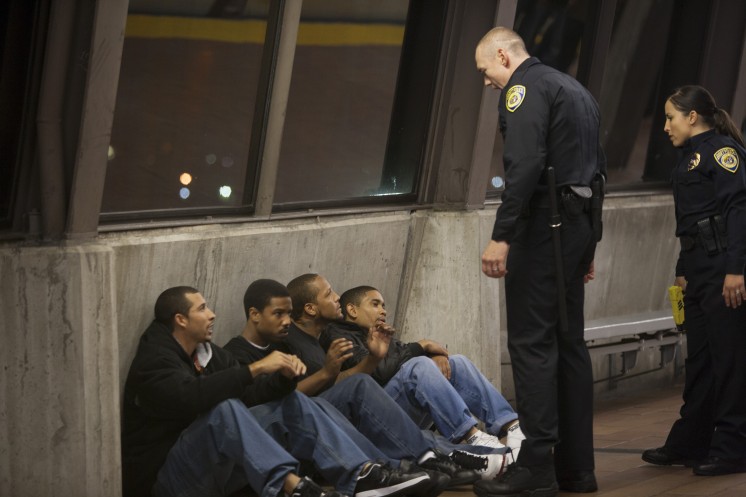
Fruitvale Station, which opens at the UA East Hampton Cinema 6, on Friday, is about the last day in the life of Oscar Grant, a twenty-two-year-old African-American who was detained on a BART platform in Oakland after a scuffle on the subway on New Year’s Eve, 12/31/08, and shot to death without provocation by a white transit cop.   The young officer, who claimed he accidentally grabbed his gun while reaching for his Taser, might not have received even a two-year prison sentence for involuntary manslaughter–for which he served only eleven months–if his crime hadn’t been captured by many subway passengers with their camera phones.  Real footage of the killing that stunned a nation begins the movie.
Ryan Coogler’s feature debut has for obvious reasons been included in the conversation about the Trayvon Martin-George Zimmerman trial–for which there was, unfortunately, no video.  But the best film of the year (along with What Maisie Knew), which I believe the Weinstein Company will push for a Best Picture Oscar, could stand on its own as a testament to both Grant and scores of other young black men who suffered similar fates because of their race. Through Michael B. Jordan’s complex Oscar-worthy portrayal, Oscar Grant (like Trayvon Martin) becomes the face of all the anonymous young African American men who have suffered from discrimination–including profiling–and all who were killed before they could fulfill their promise.  Grant was no saint, and had even been in prison for dealing drugs, but he was beloved by his girlfriend Sophina (Melonie Diaz), their daughter Tatiana (Ariana Neal), mother Wanda (Octavia Spencer), grandmother (Margorie Shears), and his entire family–there is lots of hugging!  And there was a good chance he would be able to turn his life around.   He was a decent man who was worth rooting for and that he barely made it into the new year is heartbreaking.  Ryan Coogler is quoted in the film’s production notes: “I want audiences to know that he was real person.  He was a person with real struggles and personal conflicts, but also with real hopes, and real dreams, and goals.  And his life mattered deeply to the people that he loved the most.  I hope that the film gives the audience a proximity to characters like Oscar that reading a newspaper headline can’t.”
Fruitvalestationtwophoto
Michael B. Jordan and Melonie Diaz Photo: DP

Prior to the film’s New York City release, and prior to the not-guilty verdict Zimmerman received, I took part in the following two roundtables, first with stars Jordan and Diaz, and then director Coogler.  I note my questions.
Michael B. Jordan and Melonie Diaz
Q: Why did what happened to Oscar Grant make you want to make a film about him?
Michael B. Jordan: Because it could have been me.  Oscar would have been 27 today, I’m 26. He’s from Oakland, I’m from north New Jersey. Oakland has the same kind of relationship to San Francisco, the big city, as north Jersey does to Manhattan, in a way. I used to catch the PATH train over here all the time for auditions and the West Indian Day Parade, stuff like that. I’d come into contact with cops all the time, and those situations could have easily escalated into an incident like Oscar Grant’s.  I saw a lot of similarities, minus his drug dealing.  Loss of life–I am so tired of it. You get tired of seeing those incidents happen over and over again. Sometimes you’re not allowed to really express yourself or have an opinion on certain personal matters. This film was my opportunity to express myself in the way I wanted and not be completely judged.
Danny Peary: Do you include personality traits among the things you have in common with Oscar Grant?
MJ: I think Oscar and I have a lot of similarities.  I think he was a people-pleaser. He just wanted to make everybody around him happy. It was a juggling act all the time with him, and I think he got tired after a while. Me, personally, I’m kind of the same way with my family and friends. Sometimes I overextend myself and put myself last a lot, just as Oscar put himself last a lot. I have a quick temper, too.  I takes a lot to get me mad, but when I’m there, I’m there. I think that’s kind of the same for Oscar as well. We just had different circumstances.
DP: Did you want the Oscar Grant as you portray him to be an exact replica of the real Oscar Grant?  Or did you intentionally move away from him so he’d be part Oscar, part you, and part all young black men?
MJ: No, I tried to dissolve myself as much as I could into my character.  Acting for me, sometimes, is drawing from my personal experiences and trying relate that to what my character is going through.  That’s where the role kind of comes from. I tried to blur the line between me and my character.

Oscar (Michael B. Jordan) is a loving father to Tatiana (Ariana Neal)

DP: Melonie did you try to be 100% like the real Sophina?
Melonie Diaz: No, I didn’t want to imitate her.  My Sophina is more of a representation of who she really is. She and I do have a lot of things in common.  We’re both young women, we’re both incredibly strong, and we’re very opinionated.  But I’m not a mother. Also in terms of physicality, she’s really different from me in how she chooses to wear her hair and do her nails.
Q: Did either of you experience anything like what your characters did?
MD: I feel lucky to have never lost anybody or had anything close to that experience. I feel very, very blessed.
MJ: As I said, I’m a young black man from north Jersey, so I’ve had my run-ins with the cops. Way too many times, my friends and I have been harassed, pulled over, hand-cuffed on the side of the road, and had our cars towed.  I’ve been told my driver’s license was suspended when it wasn’t and I had to walk home.  When you get pulled over fifteen times in the course of two summers, it stays with you after a while.  I pulled from those experiences—and my outlook on authority and the cops—when I played Oscar Grant.
Q: How did you deal with all of Oscar’s anger issues in the film without making him unlikable?
MJ: The most important thing about Oscar is that he’s a human being. He’s flawed, he has many emotions—and anger is one of those.  He has a very quick switch, a quick temper, for sure. We tried to find moments in the script where we could show his thought process for trying to put a lid on his anger.  For the most part he keeps his anger in check.  We see flashes of it here and there, including the flashback of when he was in the prison. He didn’t want to fight physically with anybody that night he was killed. He was tired, it had been a long day; he was just fighting to get back home to his daughter. It quickly turned into him fighting for his life. That was the one fight that he lost.  Ryan and I collaborated on a lot. We thought a lot out beforehand because we had such a short amount of time to shoot things.  He did allow time for a few things to organically happen, and that’s when we imagined all these things that aren’t exactly on the page but are between the lines. I think it was really important to have those moments.
Q: Talk a little bit about getting to know Oscar through his family and friends and of the most unexpected things that you found out about him from them.
MJ: I don’t think there were many unexpected things.  The gist of a lot of conversations I had with Oscar’s mom was about her relationship with him and how they treated one another.  Melonie and I got to hear how Oscar and Sophina were with one another, especially on that last day, and where they were in their relationship.  It was also important that we spent time with Oscar’s best friends, who reminded me a lot of my friends back home in Jersey. We met at a barbeque, in a park, and one time on the train and we’d just listen to them tell stories. Everybody had different perspectives about Oscar because he was different around everyone. He was a very complex and layered young man, and we tried to find moments during his final day to show him in different social settings. He was a social chameleon who for the most part blended in no matter where he went.
Q: As a woman, I feel like the woman’s story often gets left out of scenarios about a men going away to jail or dying.  Often the story of the woman who is left behind and is still the wife or girlfriend or mother to their child doesn’t get told.  But, Melonie, this film got into that.
MD: That’s something that really resonated with me.  It started on the page; Ryan did such a good job in terms of structure, showing how Oscar is affected by the women in his life. They are kind of what made him who he was. It was really refreshing to me that Ryan chose to shed light on Sophina, because she knew Oscar better than anyone. I think of her as an of example of the many women who are left behind to raise their family and must tell their kids about their fathers. It’s another tragedy and very upsetting. There’s all this hatred that rolls into pain and loss, and that was something I really connected to. I wanted to play a woman that goes through that journey. I think there are a lot of women out there like that, and people are going to watch this movie and be like, “Yeah, I know that girl.” Sophina is like a lot of girls that I grew up with. She’s a great mom, and she’s tough and not afraid to speak her mind.
DP: Is there still talk in the family about what could have been if Oscar were still alive?
MD: I know that Sophina and Oscar were at this point where they really wanted to do right by each other. He was going to be faithful and they were going to get married, move out of the neighborhood, and put Tatiana in a private school.  They were at a crossroads and Oscar could have been great from then on. What could have been makes his death even more devastating.
Q: What was the most challenging scene for you two to film?
MD: All the stuff in the BART sequence, when Oscar’s upstairs and Sophina is on the street waiting and doesn’t know whether he’s okay.  On a side note, it was kind of like a joke, I told Michael that he couldn’t be around me while I was shooting that scene in which Sophina worries about Oscar still up on the platform.  And Michael kept poking his head in to be funny.
MJ (laughing): That didn’t happen every time!
MD: I’d be signaling and telling him to “Move, damn it!” That was tough.
MJ: Physically, the most challenging scene for me was probably when Oscar gets operated on. Just lying there and having people poke and prod and draw blood was not fun at all. And it was hard being in the morgue, on that slab for hours, knowing one day I’ll be lying in a real morgue, with other bodies! Otherwise, the most challenging sequence for me, too, was the BART stuff, when Oscar is shot on the platform.  We had four hours to get it, with one camera. We didn’t have time to do a lot of takes, so it was hard to go through so many emotions in a short amount of time. There was a lot of pressure.
Detained at Fruitvale Station

Q: Do you think the Oscar Grant case changed how the police treat people, racially?  Is there more fair treatment now?
MJ: I don’t think so.
MD: Things that are not changing, as we see with George Zimmerman.  It’s really sad to me that it’s a theme in our society and what we watch on our daily news.  There should be something about what’s going on and how we can change it.  Hopefully this movie starts conversations.
MJ: I agree with that. Hopefully this film can start smart conversations about the way we treat one another and the value of life. You see, it doesn’t matter who’s on the other side of the trigger. You see what is happening in Chicago right now. This summer’s been crazy there; the rapid loss of life is unheard of.  Four or five people are being killed there every day.  Where’s the gun control in Chicago? It’s mostly black-on-black gun violence, so people don’t care so much. But what happened in Connecticut, with all due respect, was treated in a different light in the media. That was a big thing, but so is what’s happening with black kids being killed in Chicago. We need to start looking at the bigger picture.
Q: How do you feel this film relates to the Trayvon Martin case.
MD: I feel in wake of the Trayvon Martin case and even the repeal of DOMA, there is obviously an issue in regard to how we choose to perceive and judge each other based on the color of our skin and our sexual orientation. There’s a lot of hatred and unkindness right now, and I think this film is at least a step forward in terms of bringing this social issue to the forefront of people’s minds. Because clearly we all want to talk about it.  What’s so interesting about this movie is that we take it to Cannes or Sundance or anywhere else and the responses are all the same. I think there’s something really special about that.
MJ: I’d rather not get into the Trayvon Martin case.  It would just be my personal opinion. ["My heart hurts so bad right now." Jordan stated after the verdict. "It broke me up. That’s why I think this film means so much, because it keeps happening again and again. [We must] learn how to treat each other better and stop judging one another just because we’re different. It’s not just a black and white thing. It’s a people thing.”]
Q: What are you doing next?
MD: I did an episode of Girls, and other than that, I don’t know!
MJ: Same here, pretty much. I read a lot of scripts, trying to figure out what’s next, but I’m not really sure.  I’ve got a romantic comedy with Zac Efron coming out January 31st. After this film I wanted to switch it up a little bit and show some diversity. I had to do something lighter.

Roundtable with Ryan Coogler
fruitvalestationdirectorphotoRyan Coogler Photo: DP

Danny Peary: Talk about your choice to start the film with documentary footage of the real Oscar Grant being shot by the transit cop, making everything we see afterward a flashback.
RC: It was a choice that came about through the editing process. It wasn’t in the script.
Writer/director Ryan Coogler
I had two editors on this film.  One was Michael Shawver, and he’s from Rhode Island.  My other editor was Claudia Castello, who is from Brazil. They’re from different worlds but worked together for me on my movie. They were both really adamant about starting with this footage because they hadn’t heard about this situation. I hadn’t felt the need to include the footage because I’m from the Bay Area.   I’d seen it so much that I could watch the movie with it in mind.  But as we were going through the editing process, I realized that a lot of people didn’t know anything about this situation, so it made me feel I had the responsibility to put it there so that anybody who watches the film will have seen it at least once.
DP: Are you happy with that choice aesthetically?
RC: Absolutely. I think that more than anything it helps to put everything in perspective. When you watch the footage the first time, your reaction is shock, and maybe anger, and maybe confusion.  You see it and say, “It shouldn’t happen again.” After seeing the footage, you know Oscar Grant as a person and feel a connection in a different way.  I think that is a big reason why we made the film in the first place.
Q: Why did you decide to tell this story?
RC: I was deeply affected by it emotionally. I was in the Bay Area when it happened. I’m from there, I was born and raised there. I’m the same age as Oscar, have the same ethnicity, have the same complexion, dress the same.   So I’m watching the tape of the shooting and I see myself. That was the initial feeling that I had.  For everybody in the Bay Area, it was very emotional.  The Bay Area is a very political, really liberal place. Obama had just got elected that November. California was the state that put him over, and were really excited at that time.  So for that to happen there, for it be photographed, for the N-word to be used [by a transit cop] started different things going back and forth.  For one side, Oscar was an icon for any kind of injustice.  On the other side, he was demonized and said to be a felon who got what was coming to him–he was good for nothing and justice was served. Somehow it got lost that he was just a regular guy trying to get home that night.  I thought that making a film would help add perspective into that.
Q: The movie very much presents Oscar through his layers of anger. You have him fighting for his life, fighting to reform his life, and also fighting to hold his very short temper in check.
RC: I’ve never had anybody put it that way.  I think Oscar is dealing with a lot of anger on that day, and most is directed toward himself. Self-hate is an issue that a lot of African-Americans face in general.  There are a lot of things that he’s dealing with. He’s the man for a lot of people in his life, for every woman in the film.  But at the same time he’s very emasculated.  All these women have jobs. His mom calls him, and she’s working. His sister calls him, she’s working. Sophina works.  He and Sophina have a four-year-old daughter, Tatiana, but he doesn’t have a job at this time, and he’s spent the last year and a half in prison, away from her. He’s very angry at himself for having missed that time with her, which is why he’s doting on her now–he’s trying to catch up. I would argue that almost every time you see him getting upset at someone in this film, it’s really a misdirection. He’s feeling humiliated.
Q: Forest Whittaker was quoted as you are a talent. Can you talk about the experience of working with him as one of your producers?
RC: Forest is an incredible person. A very humble person. I left a class to go meet him the first time.  I was a big fan of his work and was very nervous.  He came in and had this really calming aspect to him, almost a Zen-like quality. It was great to get to talk to him and see how he approaches his art and his life. In many ways, he gave me a mental safety net. He gave me freedom to make decisions and to be more collaborative than I was before. He made me comfortable and was always available to put me at ease and offer help in case there was a political or logistical issue. Any time I thought stuff was hard, I remembered all the hard stuff he was doing.  He makes about four films a year, and has all these other responsibilities. He’s involved in conflict resolution, working for the UN, abroad as well as domestically.  In many ways what he does with his career is very admirable.
Q: I read that you had Michael B. Jordan in mind for Oscar early on.
RC: I’d seen Michael’s work and had him in mind when I was writing the script.  I knew that Oscar would be on the screen 98% of the movie, and one of the most important relationships I needed to establish would be his with the audience. The actor had to believable at all times playing a character who is different with different people, sometimes within the space of a few minutes. Michael could do that.  He was also capable of being very professional on a short shoot, twenty days.  It was great that he had worked in television, which is as fast as a schedule can go. He’d also worked with a lot of non-actors, in a lot of crazy locations.  I wanted somebody who’d had that kind of experience as my base, so everybody could wrap around him.  He also looks like Oscar and is around his age. When I first met him, I fell in love with him. He has a quality that can’t be taught, that draws you in. He’s an incredible thinker, an incredible talent.
Coogler Directing Jordan and Octavia Spencer

Q: How did you decide how to write the scenes when Oscar is alone? Obviously there’s no account of what he did on that day when he was off by himself.
RC: It was from talking to Sophina. She was very much the kind of girlfriend who will ask her boyfriend, “What did you do today when you were by yourself?”  So we had that.
Q: How about the scene when he pets a stray pit bull while he’s getting gas and then he cradles it after it is run down in the street?
RC: That scene is supposed to be polarizing.  Some people hate that scene, and some say it’s their favorite scene in the movie. For me as a filmmaker, and Michael as an actor, that scene was very important.  It wasn’t a scene that’s there just to show Oscar’s a good guy, it wasn’t about that.  It was that Oscar’s favorite animal was a pit bull.  He would tell Sophina that when they moved to a house he wanted a back yard so he could get a pit bull. He’d always lived in apartments where he couldn’t have a dog, and this was part of his American Dream. Young African-American males in other areas are attracted to pit bulls, that’s a dog we often choose to have because we seem so much alike. You hear about pit bulls in the media mauling somebody and being awful creatures, but actually they’re the sweetest dogs in the world. The parallel is that we lose our lives like that dog that dies in the street.  You see in other scenes that Oscar is always trying to be cool, tough and collected, no matter what he is going through, but during that moment with the dog [before and after it is run down] you see another side of him. Let me tell you the origin of that scene.  I have a little brother with the same personality type as Oscar. He’s very outgoing, very bubbly–he’d walk into this room right now and make everybody laugh–but he’s also keeps a lot of hard stuff inside. One day he came home really bummed out, and I could tell something was wrong so I asked him what was up. He told me he saw a dog at a gas station get hit by a car, and the dog died right there in front of him.  He told me that, and then I’d think about how Oscar has seen people die in the street and how he just kept moving.
Q: Is what happens to the dog part of the parallel you are drawing?
RC: Yeah, it’s a foreshadowing.
DP: Here’s a strange question. Did Chad Michael Murray, the actor who played the transit cop who shot Oscar, find it difficult playing that part?
RC: Chad’s an incredible guy, a really nice person. He was concerned about playing that role, and we talked about the choices that he would make while doing it. We talked through a lot of it.
DP: Did that shake him up at all?
RC: Yes, it did, but he did it. He’s an amazingly talented actor and I was proud of his performance, as I was with the performance of Kevin Durand, who played the other officer.
Q: Can you take about how you thought it was important to take us into Oscar’s home, and to see such things as his grandmother preparing gumbo?  It added a lot for me.
RC: It was very important to me, because for me this film is a domestic drama. It was very important to me because that side of Oscar Grant has never been shown. It was never talked about in that case. What has been shown is a black man being shot, and Oscar fit into that category.  But there was another aspect of his life that took up most of his time. Most of his time was spent domestically.  I’m from this community and I know dudes who sell drugs but are also close to their grandmas and call them all the time.  Birthday parties like the one for Wanda, Oscar’s mother played by Octavia Spencer, are some of the happiest times on the planet for them–just to be in these homes during a celebration like that, especially if you’ve been gone for a year. It was important to show that stuff because it’s so rarely shown. That’s where the similarities lie for all of us. People can see that and say, “This guy’s like me.” It’s unfortunate that the representation in the media is one-sided.
Q: What are you doing next?
RC: I’m looking at a high school football movie. I’m just hoping to do something as important to me as this project.


Saturday, July 20, 2013

My Brother the Actor in Computer Chess

Playing in Theaters

My Brother the Actor in Computer Chess

(from Sag Harbor Online 7/20/13)


Gerald Peary at Opening of Computer Chess at Film Forum  Photo: DP
Computer Chess fits my category Movies That Should Play in Sag Harbor.  The fourth film directed by mumblecore icon Andrew Bujalski, it is now in its first weekend of a two-week run at the Film Forum in New York City.  Even though it had an impressive reception at Sundance and has been coveted by film festivals worldwide, the rave reviews it has received in New York—A.O. Scott called it “sneakily brilliant” in the Times—were a pleasant surprise.  And surely a relief to its director, producers, and distributer, Kino Lorber, because there was worry that this odd, cryptic, heady film might confuse or turn off many viewers, critics included.  Shot with cruddy, thirty-year-old video camera that resulted in images that would be rejected by C-Span, Computer Chess takes place in the early 1980s at the dawn of the digital age.  At what has to be a Motel 0, an annual computer chess tournament takes place, pitting clunky, desk computers that have been programmed by tech geeks (some from major institutions) to feed them the best moves.  Also at the motel that weekend is a couples encounter group, which encourages sensuality and human connections—which the lonely, robotic human chess players should aspire to.  Standing out among the oddball characters at the chess tournament is grand master Pat Henderson, who organized and oversees the event and hopes to prove, as he has done in past years, that smart humans can still best computers at chess.  The nonactor who plays Henderson is Gerald Peary, a long-time movie critic and professor in Boston, documentarian (For the Love of Movies), and—notice the similarity of our last names?—my brother.  He was in New York City for the opening of Computer Chess on Wednesday and, before I saw it or his well-received performance—he was “born to play this part” said the Village Voice—we had the following conversation.
Danny Peary: How do you know Andrew Bujalski?

Gerald Peary: Andrew now lives in Austin, Texas, but he’s from Newton, Massachusetts, which is near where I live in Cambridge. He was a student at Harvard University, and that’s where he started making movies. I actually was the first outside person to see his first film, Funny Ha Ha.  Robb Moss, who teaches film at Harvard, called me and said, “I have a film made by a student.  I won’t tell you about it, but can you take a look at it?”  He sent a VHS to my house, and late that night I popped it in my VCR and Eureka!  A revelation. It was just an incredibly good independent film, with a story about this wandering 20-something young woman right out of college, looking for jobs and looking for love and nothing works out.  It was so touching, and so strange because of what Andrew is now famous for: the conversations are very meandering and circuitous. We listen to these intelligent Harvard grads who use the words like and awesome a lot, and sound slightly stupid and educated at the same time.  So it’s the zeitgeist of a certain kind of 20-something person, and he just nailed it. It was one of the earliest pieces of what we now call mumblecore. Andrew played the male lead in the film because, he says, he wanted to make sure the actor in that part always showed up.  He played this guy who works at his job and falls in love with this girl and it doesn’t work out. It’s just like in Chekhov, where there is no love relationship that works out. That’s true of all his movies.

DP: You were writing for the Boston Phoenix, so were you expected to review the film?

GP: I’m not sure what I supposed to do. I called Robb and said, “This is great” I don’t remember actually meeting Andrew but he just reminded me that I was the first person to program his film, at Boston University.  I run a cinematheque at Boston U, and he came to show Funny Ha Ha and speak to the students. Year later he brought his second film Mutual Admiration.  So over the years Andrew knew me as a film critic and a real fan, and I knew him as just a guy in the Boston film community.  Then he moved to Austin with his family and I visited him when I was there, having dinner at his house and whatever.

DP: Andrew and another mumblecore director, Joe Swanberg, have been linked together, including in the New York Times last Sunday.  Do you also see a link between them as people and as filmmakers?

GP: I think what’s nice about the mumblecore filmmakers is that they’re pretty friendly and not competitive. Joe Swanberg especially is someone who’s worked on lots of other people’s films. In fact, he shot some of my documentary For the Love of Movies.  When I went to Austin, Joe shot several things that are in the film.  When I went to Chicago, he brought a crew and we shot a conversation between several young film critics that didn’t make the final cut.  And that’s very typical. Andrew and Joe have known each other for years. The difference is that Joe is unbelievably prolific. One year he made a movie every two months, and he’s made over twenty films now, including the upcoming Drinking Buddies.  On the other hand, Andrew is extremely slow and probably has anxieties watching Joe make movie after movie after movie. For a whole bunch of years, Andrew didn’t make any movie and was fretting that nothing was working out.

Director Andrew Bujalski at NYC Opening at Film Forum  Photo: DP
 
DP: He is known for not having scripts, so was he taking actual scripts around?

GP: Yeah, yeah. He was hired by Scott Rudin to write screenplays, which I think never worked out. He had a little movie that was almost made starring Jim Carrey, and then Carrey, typical of actors at that level, lost his nerve and walked away, So Andrew was back to zero with nothing, and that’s when he famously reached into a jar and found this scenario that he’d written many years earlier about computer chess. And out of desperation, because he just couldn’t stand not making a movie again, he started working on this one. The rest is history!

DP: In the eleven years since he made Funny Ha Ha, did he ever say that he might cast you in a movie someday?

GP: Never.  People now say to me, “Oh, you’re in Computer Chess because you know the director.”  Well, like you, I know a million directors. I’ve interviewed a million directors, and I’ve been witty and said smart things. And only one other director has for one second thought of casting me in a movie!

DP: Was that Joe Swanberg?

GP: Yes. I’ve also known him for a bunch of years after seeing his first movie, Kissing on the Mouth, at SXSW. We became friends and I brought him several times to speak at Boston University. And we actually did this little test at my house one day for a movie he never made. The two of us did a ten-minute improv while his wife shot it.  He has the footage somewhere. I was his crabby uncle from another generation and I chastize him for making dumb mumblecore movies that have no plot and no story. And I say that in my day there was Bergman and Fellini and I ask him why he doesn’t make real movies if he’s going to make movies. It’s me teasing him about mumblecore movies, although as a critic and movie fan I actually like mumblecore movies.

DP: So how did Andrew officially ask you to be in Computer Chess?

GP: I got an email one day from Andrew in Austin, telling me he was making a new film.  There was the part of a chess master and he wanted to know if I’d be interested in auditioning for it.  I thought, What? Wow, unbelievable!  I said yes, I would be interested. So he sent me another email saying, “Could you do me a favor? There’s a little scene. Do some improv on this scene in three different ways and send me the tape.”  It was the scene in which the chess master, Pat Henderson, walks into a large room at the motel at the end of the weekend during which the film takes place, thinking it has been reserved for his match with the person who won the computer chess competition.  But a New Age couples encounter group that has also had a convention that weekend is there and the grand master has to try to convince the guru to give up the room.  I got my department secretary, who’s an actor, to play the guru and made the videos and sent them to Andrew.

DP: Andrew has joked that he thought you were ideal “to play the blowhard chess master” who runs the tournament.

GP: I think that’s because he’d seen me do a lot of public speaking and moderating panels, as Pat Henderson does prior to the tournament.  But after I sent him the tapes I believed I was absolutely not going to be cast.  I was totally depressed because, boy, what a great chance it was for me to finally act in a movie.
DP: Well, it was “a great chance” for someone who was actually waiting to be in a movie, but had you been waiting for that opportunity?  
GP: Like very person, I think, I’ve thought about it.  You remember that forty-five years ago I did act in college and summer theater, and I directed theater in grad school.  I don’t think I was a very good actor, but I had that experience. And lately I’ve explored the idea to go to the other side of the camera because I’ve been making documentaries. So yeah, I was really excited when he offered me the part. 
DP: You didn’t ask him, why me?
GP: No, I didn’t want to question it. Andrew’s tradition is to use 90% non-actors in his movies, so I was just one on a long list of non-actors in his movies.
DP: Was your character based on anyone?
GP: I don’t know who this person was, but there was a historic person who in the early ‘80s was an American chess champion who did challenge computer teams.  He’s not that famous except in the chess world.  He’s alive, he saw the movie, he loved the movie, he sent Andrew a really nice letter about it. And he wasn’t insulted Henderson is a comedy character.  He liked the milieu and he thought the chess world was captured correctly. It was important for Andrew to receive his letter of endorsement.
DP: You said that Andrew pulled out a scenario from years past.  So there was an actual script he gave his cast?
GP: No, I never got a script.  There wasn’t one. There was just an eight-page treatment, he talks about. Actually I’ve never seen anything on paper, and I don’t think anybody else who’s in the cast has ever seen anything. The costumer hinted to me that there was something more that perhaps she had seen to prepare for her job, but I’ve still never seen a word on paper for Computer Chess. And now Andrew claims in interviews, including in the New York Times, that his first three films, which everyone believed were totally improvised—and I don’t know because I wasn’t there for Funny Ha Ha, Mutual Admiration or Bees Wax—and that Computer Chess is actually his first mumblecore movie because it is improvised.
DP: While making the movie, you told me that because there was no script that you didn’t know what the film was about of what anyone else was doing in scenes you weren’t in.  But you had thoughts about what the whole film might be like once it was put together. Were you right?
GP: No, I was totally wrong. When I first saw the movie at Sundance, it was a complete surprise.  And it wasn’t just the shock of watching myself on the screen in what turned out to be a pivotal part. Andrew never told anybody in the movie what the story was. Not only was there no script, you just did it scene by scene as the scenes came up. I guess this is a pact we made, because I don’t remember ever asking Andrew what the story was.  It was: Andrew, if this is the way you want to do it, let’s do it that way. We shot in this awful, awful motel, at the edge of Austin, which is the motel I had stayed in because of lack of money when my wife Amy Geller, the producer, and I showed For the Love of Movies there. So I’m back in this terrible retro 1950s motel and one day I walk outside and they’re shooting a very beautiful woman floating in the middle of the swimming pool.  And I thought, “God, that is the story!”  I didn’t know who she was but I assumed the main story had to be about that beautiful woman, that she was the main character in the movie. Anyway, I see the movie and that woman floats by in the swimming pool for one second, and Andrew cuts to the two characters who are talking there, and she has nothing to do with the movie.
DP: While on the set, were you always trying to figure out what the movie was?
GP: I didn’t. I don’t know if anybody else did either. No, I really went along with Andrew keeping it all secret.
DP: Was it like being on jury duty, when you’re not allowed to talk about the trial with the other jurors?
GP: No, Andrew is an extremely easy-going guy, and he never gave us any instructions about not discussing the film with each other.  I don’t know if other people tried to figure stuff out so they’d know where they fit into the film.
DP: Well did you try to figure out if you were doing a good job each night?
GP: No.  I was there eleven days and six days I shot. On the days I shot I just had a leap of faith.  If Andrew thought the scenes were okay, then I assumed they were okay.
DP: He had you do three different takes for your audition tape.  So would he do the same thing on the set?
GP: Yeah, he would do three takes. Rarely there might have been done as many as five takes, but he never did a scene over and over again.
 
The tournament
 
DP: Was the film shot chronologically?
GP: No. I actually had that experience that you often hear about from professional actors.  On the first day I got there, I shot my last scene in the movie.  I had the camera in my face as my character plays a chess match so you can guess what he’s thinking, and that’s pretty hard for your first scene if you’ve never acted in a movie before.
DP: Did he give you any kind of motivation or instruction or did he say it is you our last scene, do it any way you want?
GP: This is the mystery, I guess, of a very good director.  As with Woody Allen, there was almost no direction. Seemingly I did what he wanted me to do, and he would have intervened if it was incorrect.   The only thing that he imposed on me was to make sure my chess vocabulary was correct. He had a chess champion from Austin on set, a lovely guy named Peter, who made money in high tech and doesn’t have to work anymore.  Just a good guy, and he was really helpful about my chess language, so anything I wrote for my character to say that included chess references, I’d pass it through Peter to make sure the words were right.  The one thing I did keep messing up was saying, “That was a really good game,” and he would say, “No it’s match! That was the only incident that I remember when I was wrong.
DP: Did Andrew ask you if you actually play chess?
GP: Never. He never asked if I had any chess background.  As you know I was my high school chess champion.  The last time I played was at the South Carolina chess club before we moved north, in 1960. So I haven’t played chess since then. I did play a few matches before going to the set, thinking that would be relevant. My character does play one match against the winner of the computer chess tournament.  That was my last scene that I filmed on my first day.  
DP: So explain to those of us who haven’t seen the movie how computers fit in.  Do people play against computers in a tournament?
GP: No. The individual computers have been programmed to play chess and during matches they tell those programmers which moves to make against other computers and their programmers.  So whoever best programmed their computers wins.  It’s the early eighties so the computers are big and the programmers lug them into the motel for the competition.  The teams come from places like Cal Tech and MIT.  This is still a time in history when human beings can beat computers. Now computers can beat them in a second.  Pat Henderson is the last of the old-time chess people who can beat a computer.  But I can’t tell you who wins when he plays against the winning computer.
 
Programmers
 
DP: Well, the film is set in the early eighties and we know that computers would soon  beat every chess player.  The encounter group for couples is also very much part of that era.
GP: As a film critic watching the movie, I see that the movie has a day story—the chess tournament—and that night story with the encounter group. Pat Henderson is one of the main characters of the day story, but is not part of the night story at all.  I told this to Andrew and he thought it over and said, “That’s true, he isn’t.”
DP: But is anybody from the chess story in the night story?
GP: Yeah, characters float between those stories. The night story is quite surreal and David Lynchian, and the day story has more light. My character has no knowledge of the night story at all.  Neither did I. 
DP: Do you think Andrew wrote one film, then another separate film, and combined the two?  Is that possible?
GP: I have no idea how he came up with the encounter group story, but I think the stories go together well.
DP: Do you think there are surprising elements in this film?  
GP: It’s a surprise to anybody watching a movie to see this completely retro black-and-white movie which is in some ways, as ugly a film as you’ve ever seen in your life. It’s the worst VHS tape that you have.  There’s all kinds of video crackles and odd kinds of things happening.  Lines are on it and everything else. People have walked out of the movie saying, “God, it’s just terrible-looking.” Andrew intentionally filmed it on an old camera, which was part of the reason he wanted to make the film.  For a hundred dollars on eBay, he bought this prototypical video camera and shot the movie with it.
DP: So the film could almost pass as found footage?
GP: People have thought some of the stuff in the beginning looks like found footage.  Of course, it’s not; it was all shot by Andrew.
DP: In the trailer for the film, we see your character talking to the camera.  Is Andrew behind the camera?
GP: No, Pat Henderson is talking to his own cameraman. It’s intentionally a terrible camera angle. In fact my first lines in the movie are Henderson yelling at his cameraman, telling him not to shoot into the sun.
Pat Henderson (Gerald Peary)
DP: So are we always made aware that there is a director filming the action?
GP: I don’t think so.  It’s about a moment in history when we’re moving into the digital age.  This is what Andrew doesn’t talk about.  His first three movies were all shot in 16mm, and he loves 35mm; this time he’s finally making a digital movie but in an ornery, stubborn, crazy way. It’s his sad look about the new world coming in, the world of the digital. And without being condescending in any way, it shows how people who are in the digital world have real trouble communicating as human beings, whether making love or just talking.
DP: That’s why he includes the encounter group where everyone is touchy feely.
GP: But he’s never said any of this, just implied it.
DP: He has said, in the Times, that he was never the forerunner with anything, that he lagged behind. Knowing him, do you think he wishes he was making films in an earlier age?
GP: I don’t know, but probably.  He’s a movie fan, he likes to go to a movie theater and see a 35mm film.  He actually likes more popular movies than I would have thought.  He’s closer to your tastes than mine.
DP: Do you think you and Andrew would interpret the film in the same way as you do?
GP: Andrew, I guess like many directors, doesn’t attempt to interpret it at interviews and at Q&As I’ve been with him after screenings. I don’t think anybody has ever really tried to talk about the film philosophically, nobody ever gets to that.  Andrew’s an incredibly bright guy, an intellectual who went to Harvard, but he doesn’t get into what the movie is about.   At Sundance someone in the audience asked, “Okay, I saw the movie, so what does it mean?”  That’s a bad question because he’s not going to answer that.  All he can say is, “What does it mean to you?”  I’ve never asked him about the meaning because I believe the famous quote, Trust the Art, Not the Artist.  There is a lot of leeway in interpreting what the film is about, and I might not agree with him.  I’ve seen it now four times, and it’s open to interpretation.  I like movies with ambiguity.  I think that’s one of the strengths of the movie.
DP: So even though they’ll never get confirmation from Andrew that they’re right, everybody should be able to come up with an interpretation?
GP: I think so. But some people are going to not bother and say it is a stupid movie that’s not about anything.  There are usually some walk-outs. If you like the movie, or hate the movie, you have absolutely never seen this movie in your life before. Which is I think another great virtue.
DP: Even if it’s a complete original, do you see it as a descendent of Slacker?
GP: There’s definitely a connection with Richard Linklater movies. Wiley Wiggins is a literal connection because he’s in Linklater’s Dazed and Confused and Waking Life, although Andrew says he cast him as much for being a computer person as an actor.  But also, Richard is a friend of Andrew’s and they’re part of the Austin school of filmmaking. Boston is all documentary, but Austin filmmakers make narrative films that are definitely connected by all the talk and philosophical ideas.
 
DP: When people use the word existential to describe this film, is that correct?

GP: I’d call existential.  Here’s my thing about acting.  Existence before essence is from  Sartre and that means that the moment you’re born is when your essence starts and there’s no God, no spiritual thing. In French films and art films, a character’s essence starts the moment the film starts. No characters have any life outside of the film itself. To me, that’s the most interesting thing about the story. A French director told me, “When I work with Isabelle Huppert all she wants to know is What is my costume?  That’s her only question about her character. The same director says, “Whenever an actor comes up to me and asks for his motivation for a scene, I say, ‘What do you think your motivation is?’ The actor tells me something and I say, ‘Yep, that’s your motivation.’” Andrew, to me, works in the same way. I knew almost nothing about my character.  I kept on my wedding ring, which meant Pat Henderson is married but I didn’t know who his wife is and whether they have kids. The American way of acting is so method-influenced, where there is back-story for all the characters so the actors know their entire stories. If your character works in a butcher shop, you work for a couple of days in a butcher shop. You learn everything about your character. Acting with Andrew, you just go to work and shoot.
DP: And your character’s essence begins the moment the camera turns on.
GP: Certainly. I had a costume and I wore these big ties and they definitely helped me determine the way I walked.  In a couple of scenes I walk though a shot with this cocky swagger.  There’s a little Jack Benny in there.  My character is a self-deluded and gloriously vain, but I didn’t ask Andrew if he minded that I do Jack Benny.
DP: You said earlier that you wrote some of what your character says.  Weren’t you supposed to improvise?
GP: Actually, there was very little preparation for my scenes. Andrew might have said, “In this scene you might say something like this.”  And I would sit down and write out what I might say in a dialogue, and I would show it to Andrew and he would say, “Okay, yeah, that’s good.”  Then we’d shoot and I’d improvise off of what I remembered I’d written on that piece of paper.
DP: Since you didn’t know the rest of the story, could you have written anything?
GP: No, because Andrew knew the story and would say, “No, this is wrong.” I do have a couple of scenes where other characters walk past and Pat comments without knowing who they were.
DP: In the film’s trailer, Pat makes a big deal about there being the first woman competitor. Is that a big deal in the movie?
GP:  She is the potential love interest of a shy programmer. That line was one of my improvs.  Typically, the trailer gave away the laugh.  Pat brags that there’s a lady programmer this year, I used the word lady. That was part of my improv. I also used the word meow at one point.  Andrew liked that and it stayed in.
DP: Percentage-wise, if you did 10 things, would he accept 10?G
GP: I feel like it was a pretty high percentage.  He never said anything was absolutely wrong.
DP: Did you ever hear him have exchanges with other actors, approving or disapproving, or were you not privy to any of that stuff?
GP: Andrew is not somebody who talks out loud to someone for everyone else to hear.  Probably he took people aside and talked to them. I don’t know how their scenes were done. I guess I was in this zone, having never been in a movie before, and I was concentrating on what I was doing. In a good way, because I think I did it pretty well. I kept out all the noises around me and tried to be in the moment for my character, so what Andrew was doing for other people didn’t really register.
DP: Were you allowed to be on the set if you weren’t shooting?
GP: There was no policy about that, but most of the scenes were shot in tiny motel rooms, so having other people around would have been intrusive. But I do remember being around a couple of times and watching.
DP: Did you actually like not knowing what the film was about?
GP: I think it was easier for me, not worrying that I had to say exact lines. I have nightmares still from 40 years about being in a play. Every actor has a nightmare that never goes away. Mine is that I’m in a play and can’t remember my lines and I’m running around trying unsuccessfully to find the script in time. I’ve honestly had that dream 100 times in my life, so it pleased me on this movie that I didn’t have to worry that much about what I said.
DP: Were you relieved when you and film started getting good reviews?
GP: Definitely relieved. I couldn't remember how big my part was and I guess the shock of the movie is that I actually have a major role and I could’ve completely screwed up the movie. That Andrew took that leap of faith with me without knowing I could pull it off was crazy. I think I’m getting good reviews partly unfairly, because other film critics love to see a film critic on screen. Critics are not always the nicest people but they are okay with acknowledging that someone in their profession seems to be okay. I think it’s a really good ensemble and there are so many good performances that it’s slightly embarrassing that I’m being singled out.  I wish people would write some more about others in the cast. I’m not being coy about it, they are really are good.
DP: You are relieved that the film itself is getting good reviews.
GP: There are a million independent films and about 90% of them really go nowhere at all, so it’s so pleasing that this film is getting great write-ups and is wanted by theaters. It has a great distributor, Kino Lorber and it will play at Landmark Theaters across America. I don’t know how long it will play in any place and it’s hard to imagine it playing in Peoria, Illinois, at all  Not all fans will get the film, because it’s pretty artsy; it’s not a film for everybody. Most moviegoers are very main-stream and you really do have to have an askew sensibility to get the movie. It’s an art film.  It’s already kind of a cult movie.
DP: So now that you’ve caught the acting bug how will you feel if Andrew doesn’t cast you in his next film?
GP: I still scratch my head and am totally grateful that Andrew cast me in Computer Chess because he had no reason to.  Now, how would I feel if he didn’t cast me again knowing I can act? [Smiling]  Slightly upset.